Faith-Based Business Execution and Strategy
Bridging Faith and Business: Distinguishing Christ-Centered from Secular Servant Leadership in Strategic Consulting

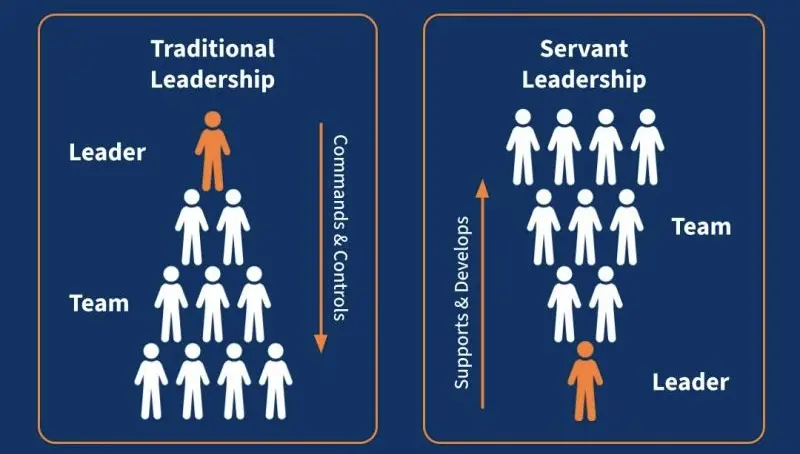
The integration of the theoretical and practical dimensions of servant leadership faces hurdles when attempting to balance biblical principles with the demands of business performance. In the realm of strategic business consulting, aligning faith-based values with performance metrics and return on investment can appear incompatible. This tension underscores the challenges of integrating Christ-centered servant leadership within the norms of secular organizations. As Blanchard and Broadwell (2018) noted, servant leadership constitutes a continuous effort to enrich others. Similarly, Keller and Alsdorf (2012) emphasized the unique role of Christian ethics in shaping an individual’s professional conduct. This analysis explores servant leadership from both man-centered and Christ-centered perspectives, scrutinizing underlying assumptions and methodologies. The goal is to highlight the distinctions that emerge when faith intersects with leadership in strategic business consulting, thereby offering a framework for embedding biblical principles into contemporary business practices.
Man-Centered (Worldly) Servant Leadership
Contemporary servant leadership, often observed in secular environments, emphasizes empowering employees, building trust, and achieving performance goals. Blanchard and Broadwell (2018) described it as leaders serving their teams to improve relationships and results. Dami et al. (2022) confirmed that this leadership style increases job satisfaction through trust and strong leader–member exchange (LMX), demonstrating its value in organizations. Erdogan et al. (2022) further noted that family-supportive leadership enhances employee performance by improving work–life balance.
However, Langhof and Gueldenberg (2021) suggested that secular servant leadership may lack a solid moral foundation. Their study of Colonel Stauffenberg demonstrated that ethical clarity in leadership requires an external value system; without a biblical framework, service can become misdirected. Their findings indicate that while man-centered models can promote positive behavior, they may lack clear moral grounding.
From a biblical perspective, Fischer (n.d.-a) pointed out that worldly leadership often confuses influence with manipulation. Leaders may adopt the language of service while still prioritizing self-interest or organizational goals. This divergence from biblical values highlights the need to align leadership with godly motives and eternal purposes, rather than solely market-driven outcomes.
Christ-Centered (Biblical) Servant Leadership
In contrast, Christ-centered servant leadership is rooted in inward transformation, emphasizing the character of a leader in Christ rather than merely outward actions. Crowther (2018) highlighted that biblical servant leadership requires a covenantal relationship characterized by mutual commitment and empowerment. This paradigm reflects Jesus’ teaching in Mark 10:42–45, where He rejects the pursuit of authority among His disciples and redefines greatness as service to others (Yengkopiong, 2023).
Fischer (n.d.-b) explained that the biblical model of servant leadership emphasizes humility, accountability, and spiritual attentiveness. Challenges such as pride and workaholism can damage leadership relationships, making the Sabbath principle a vital reminder for leaders to trust God rather than operate out of fear. Tolbert (2023) further argued that stewardship and service are inseparable, emphasizing that biblical leadership involves governing with mission and stakeholder responsibility under God—unlike worldly leadership, which often prioritizes power or profit.
Why Integrating Biblical Leadership Is Challenging in the Marketplace
The implementation of Christ-centered leadership within secular business contexts often encounters obstacles due to the perceived difficulty of incorporating spiritual values into corporate environments. While Keller and Alsdorf (2012) emphasized the concept of work as a vocation rather than merely a job, aligning this calling with operational strategies remains a complex undertaking.
Langhof and Gueldenberg (2021) warned that servant leadership is not inherently ethical. Without a spiritual foundation, leaders may end up serving something other than Christ. The consultant-as-servant must continually ask, “Whom do I serve?” In practice, this requires avoiding manipulation—even when it appears effective—and choosing integrity and respect.
Furthermore, Dami et al. (2022) and Erdogan et al. (2022) suggested that trust and motivation are significantly influenced by a leader’s character. Consequently, biblical servant leadership challenges consultants to measure success not only by quantitative outcomes but also by faithfulness and the well-being of those they lead.
Conclusion
Biblical servant leadership offers a compelling alternative to performance-driven leadership by refocusing on Christ-centered power, purpose, and people. While man-centered leadership may achieve short-term engagement and satisfaction, it often lacks the ethical clarity and long-term vision inherent in a Christ-centered approach. For consultants navigating the intersection of faith and work, servant leadership is more than a method—it is a commitment to reflect Christ in every decision and action. Although integrating biblical values into business is challenging, it is also transformative, guiding leaders and organizations toward a higher purpose.
References
Blanchard, K. H., & Broadwell, R. (2018). Servant leadership in action: How you can achieve great relationships and results. Berrett-Koehler Publishers, Inc.
Crowther, S. (2018). Biblical servant leadership: An exploration of leadership for the contemporary context. Palgrave Macmillan.
Dami, Z. A., Imron, A., Burhanuddin, B., & Supriyanto, A. (2022). Servant leadership and job satisfaction: The mediating role of trust and leader–member exchange. Frontiers in Education, 7. https://doi.org/10.3389/feduc.2022.1036668
Erdogan, D. T., Heras, M. L., Rofcanin, Y., Bosch, M. J., & Stollberger, J. (2022). Family motivation of supervisors: Exploring the impact on subordinates’ work performance via family-supportive supervisor behaviors and work–family balance satisfaction. Journal of Applied Social Psychology, 52(12). https://doi.org/10.1111/jasp.12919
Fischer, K. (n.d.-a). Biblical Leadership.
Fischer, K. (n.d.-b). Personal Application.
Keller, T., & Alsdorf, K. L. (2012). Every Good Endeavor: Connecting Your Work to God’s Work. Penguin Random House LLC.
Langhof, J. G., & Gueldenberg, S. (2021). Whom to serve? Exploring the moral dimension of servant leadership: Answers from Operation Valkyrie. Journal of Management History. https://doi.org/10.1108/jmh-09-2020-0056
Lyon, A. (2018, May 5). Servant Leadership. YouTube. https://youtu.be/XajxQOh3iqQ
Tolbert, C. L. (2023). The anointed steward: A critical review of Western Christian and secular steward leadership literature. Religions, 14(9), 1187. https://doi.org/10.3390/rel14091187
Yengkopiong, J. P. (2023). Biblical foundation of servant leadership: An inner-textual analysis of Mark 10:41–45. East African Journal of Traditions, Culture and Religion, 6(1), 40–55. https://doi.org/10.37284/eajtcr.6.1.1212


