Growth Will Expose What You Refused to Fix
Fix Your Foundation Before You Build the Penthouse: Why Operational Infrastructure Matters More Than Growth

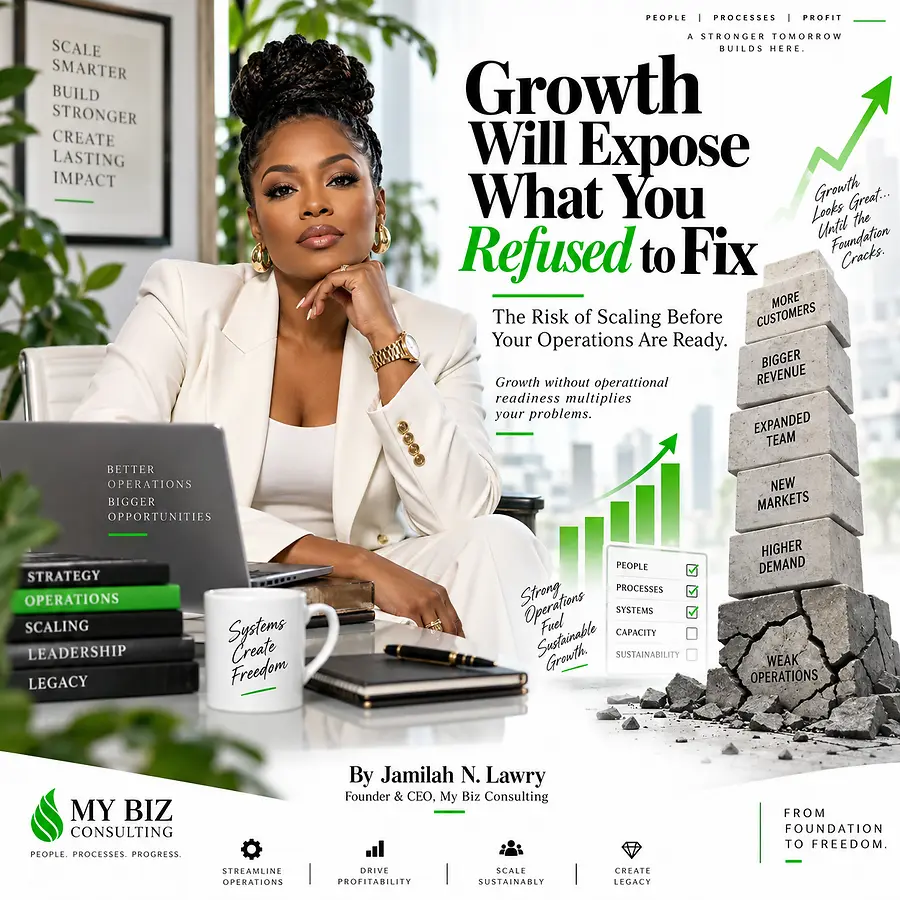
Everybody wants to scale.
More customers. More contracts. More locations. More employees. More followers. More money.
I get it. Growth is exciting. Revenue is exciting. Saying your company is expanding sounds good.
But here comes the part a lot of small business owners do not want to hear:
You do not need to scale everything you built. Some things need to be fixed first.
And yes, I said it.
Over the years, working with clients, I have seen businesses try to put a penthouse on top of a shaky foundation and then wonder why everything starts cracking when the money comes in.
That is because growth does not magically fix operational problems.
Growth exposes them.
If your customer service is inconsistent with 30 customers, imagine it with 300.
If you are already answering every email, approving every decision, handling every complaint, following up with every lead, managing your own marketing, and fixing every emergency yourself, what exactly do you think happens when you double the business?
You do not magically become Superwoman.
You become tired.
And eventually, expensive mistakes start getting made.
This is something I have seen repeatedly while working with growing companies. The owner is focused on getting more business when the real question should be:
Can your operation successfully handle more business?
Because those are two completely different conversations.
You can have demand and still not be ready for growth.
You can have money coming in and still have a poorly structured company.
You can have a beautiful website, strong marketing, a great reputation, and absolutely no operational infrastructure behind any of it.
And baby, Canva cannot save you from that.
Neither can another social media campaign.
Neither can AI.
Neither can hiring five people and hoping somebody figures it out.
That is where we have to sprinkle a little Black Girl Magic on the conversation—because we are going to make it look good, but we are also going to make it make sense.
At My Biz Consulting, when I talk about scaling, I am not simply talking about getting bigger.
I am looking at whether your business can grow without becoming more chaotic.
Do you have documented processes?
Does your team understand their responsibilities?
Do you have technology supporting repetitive work?
Can information move through the company without everything having to come through the owner?
Do you know where money is being made—and where it is quietly leaking out?
Can you onboard ten new customers without creating ten new emergencies?
Can you hire someone without keeping the entire job description stored in your head?
Can you step away from the company for a few days without your phone looking like a crime scene?
Those are scaling questions.
Because scalability is not about how much business you can attract.
It is about how much business your infrastructure can consistently support.
One of the most dangerous situations I have seen with clients is when a small business finally receives the opportunity it has been praying for before the organization is prepared to deliver.
That big contract comes in.
The viral moment happens.
The major retailer calls.
The corporate partnership lands.
The referrals start pouring in.
And suddenly, the business discovers that invoicing is manual, inventory is inaccurate, responsibilities are unclear, customer follow-up is inconsistent, nobody knows the process, and the owner has become the human operating system holding the entire thing together.
Now the blessing feels like a burden.
That is not because growth was bad.
It is because the infrastructure was not ready for it.
There is another hard truth here.
Sometimes the fastest way to scale is to stop trying to scale for a minute.
Go back inside the business.
Clean up the workflows.
Document what works.
Eliminate what does not.
Identify the bottlenecks.
Fix your customer journey.
Review your technology.
Understand your numbers.
Build accountability.
Automate strategically.
Delegate intelligently.
Then grow.
Because when operations are strong, growth does not have to create panic.
It creates leverage.
Your people can perform because they understand the system.
Your technology can support the workload.
Your customers can receive a consistent experience.
Your leadership team can actually lead instead of spending every day putting out fires.
And the owner can finally start operating like a CEO instead of the company’s most exhausted employee.
That is the part of scaling we do not glamorize enough.
Real growth requires discipline before expansion.
Sometimes, based on what I have seen working with clients over the years, I have to tell business owners something they do not necessarily want to hear:
You do not have a marketing problem. You have an operations problem.
And sending more customers into a broken process is not strategy.
It is just sending more people into the confusion.
Before you ask, “How do I get more customers?”
Ask:
“What happens if they actually come?”
If that question makes you nervous, good.
That is probably where your next phase of business development needs to begin.
Because your next level should not just make your business bigger.
It should make your business stronger.
Build the operation.
Strengthen the infrastructure.
Then scale it.
Because growth looks a whole lot better when the business underneath it can actually carry the weight.
And that, ladies and gentlemen, is the small-business truth nobody wants to hear—but somebody needed to say it.
Jamilah N. Lawry
Founder & CEO, My Biz Consulting
Consultant-Led • AI-Powered • Results-Driven