The Intelligence–Execution Gap: Why Knowing More Doesn't Always Mean Achieving More
Bridging the Gap Between Understanding and Creation Through Bayesian Learning and Meaningful Action

Knowledge, Action, and the Art of Creating Something Meaningful
We live in an age when knowledge has never been more accessible.
We can learn sophisticated theories, explore business strategies, analyze complex problems, and develop ambitious plans with unprecedented ease. Yet despite having access to more information than ever before, many of us continue to experience the same frustration: we know what we want to accomplish but struggle to translate that understanding into meaningful action.
We read, research, plan, and prepare. We develop strategies, anticipate obstacles, and search for better solutions.
But how often do our ideas become something tangible?
How much of what we learn eventually becomes a project, a product, a decision, or a contribution to the world?
As someone studying engineering, statistics, and risk management, I have become increasingly interested in the relationship between knowledge and execution. Recently, studying decision science introduced me to a perspective that fundamentally challenged how I think about intellectual growth.
What if action is not simply the final step after acquiring knowledge but an essential part of how knowledge itself is created?
The answer lies in two concepts: Bayesian learning and sequential decision-making.
Together, they offer a powerful framework for moving beyond endless preparation toward meaningful creation.
1. The Illusion of Knowing Enough
Intellectually curious people often enjoy the process of learning.
We find satisfaction in understanding sophisticated ideas, discovering new connections, and developing comprehensive strategies.
However, there is a subtle distinction between intellectual progress and practical progress.
Imagine someone who wants to become an entrepreneur.
They spend months researching industries, studying competitors, learning financial modeling, and developing business plans. Eventually, they understand the theoretical foundations of running a business.
Yet they have never spoken to a potential customer, tested a product, or attempted to generate revenue.
Their knowledge has expanded considerably, but important uncertainties remain unresolved.
Would customers actually pay for the product?
Which features would they value most?
Would the proposed business model work in practice?
These questions cannot be answered through preparation alone.
They require interaction with reality.
This is where I began to appreciate a central lesson from decision science:
Some knowledge can only be acquired after we act.
Learning is not always a process that must be completed before execution begins. Sometimes execution is precisely what makes further learning possible.
2. Bayesian Thinking: Why Our Knowledge Should Never Be Considered Final
One of the most fascinating concepts I encountered in decision science is Bayesian updating.
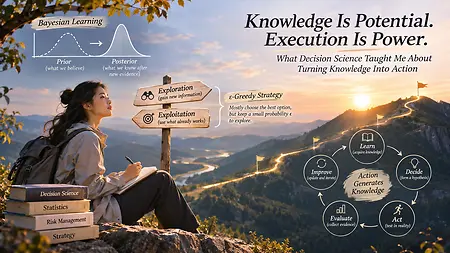
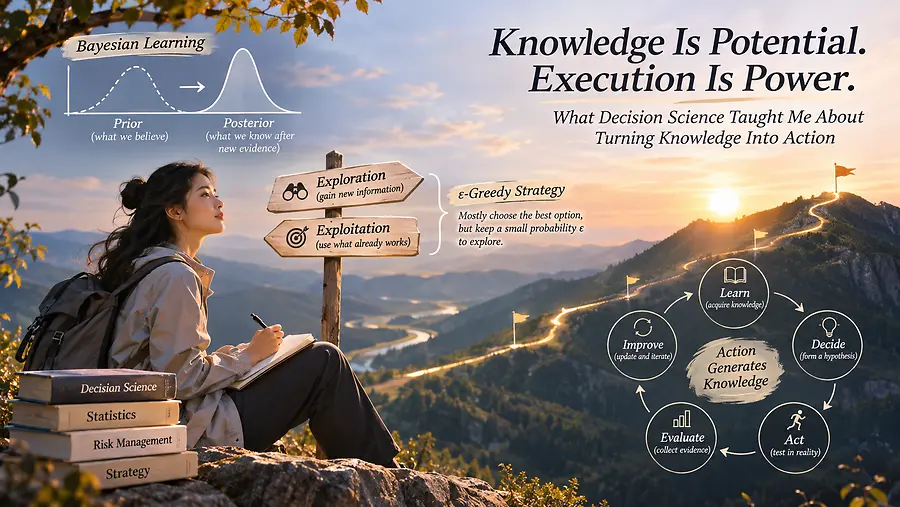
At its core, Bayesian reasoning describes how our beliefs should change as we encounter new evidence.
At its simplest, the idea can be expressed as:
Prior Knowledge + New Evidence → Updated Knowledge
Our prior represents what we believe before gaining new information. Our posterior represents what we believe after considering that information.
Consider someone who believes they lack the ability to become a successful writer.
That belief represents an initial assessment shaped by previous experiences, assumptions, and limited information.
But what happens if they publish an article?
They receive feedback.
Some readers find the article meaningful. Others suggest improvements. Perhaps the article reaches an audience they had never anticipated.
The experience provides new evidence.
Their understanding of their writing ability can now be updated.
They may discover strengths they previously underestimated, weaknesses they had not recognized, or opportunities they had never considered.
Importantly, one successful article does not prove that they are an exceptional writer, just as one unsuccessful article does not establish that they lack ability. Evidence must be interpreted with appropriate attention to its quality and limitations.
Nevertheless, the experience changes what they know.
The prior represents what we believed was possible. The posterior reflects what we have learned from reality.
This idea transformed how I think about personal development.
We often treat our existing knowledge as though it provides a sufficiently accurate picture of what we can accomplish.
But our understanding is always incomplete.
Without taking action, we may continue refining our beliefs using essentially the same information.
Action creates opportunities to collect new evidence.
And new evidence allows us to make better decisions.
3. Action Is a Form of Information Acquisition
The deeper lesson connecting Bayesian learning and exploration-exploitation strategies is that actions can have both immediate value and informational value.
An action might produce a tangible result.
But it can also reveal something that improves our future decisions.
Suppose you want to develop an educational product.
You could spend six months researching the ideal platform, pricing model, target audience, and marketing strategy.
Alternatively, you could create a simple prototype, share it with a small group of potential users, and observe how they respond.
The prototype might not be perfect.
It might not generate immediate revenue.
But it produces information that planning alone could not provide.
You discover which features users appreciate, which problems remain unresolved, and whether your assumptions about customer needs were reasonable.
The result is not merely a prototype.
It is a more informed understanding of the problem.
This is sometimes described in decision-making as the value of information.
Information is valuable because it may enable better decisions. However, obtaining information also requires time, resources, and sometimes risk.
Therefore, the goal is not to experiment endlessly.
It is to identify actions whose potential learning benefits justify their costs.
This creates a more productive relationship between thinking and doing.
Instead of asking, "Have I learned enough to begin?"
We can ask:
"What is the smallest meaningful action I can take to learn something that I do not yet know?"
4. Turning Knowledge Into Outputs and Products
Understanding these principles is useful, but applying them requires a practical framework.
I have come to view meaningful execution as a continuous process:
Knowledge → Hypothesis → Action → Evidence → Updated Knowledge → Improved Action
Consider how this framework applies to developing a research project.
First, we acquire foundational knowledge by reading existing literature and understanding established theories.
Next, we identify a hypothesis or question worth investigating.
We then design an experiment, build a model, or analyze data.
The results provide evidence that may support, challenge, or refine our initial assumptions.
With this updated understanding, we improve our methodology and begin the next iteration.
Eventually, this process can produce a research paper, analytical tool, software application, or practical solution.
The same framework can be applied to entrepreneurship, writing, leadership, and career development.
It also helps distinguish three stages of intellectual creation.
An idea is a possibility. An output is evidence of execution. A product is an output that creates value for someone.
Reading about artificial intelligence expands our understanding.
Building a functioning model demonstrates technical execution.
Developing a reliable tool that helps others solve a meaningful problem creates practical value.
Each stage requires a different form of commitment.
And each stage generates opportunities for further learning.
5. Why Intelligent People Sometimes Struggle With Execution
There is another important question worth exploring:
Why do people with strong analytical abilities sometimes struggle to act?
One possible explanation lies in our relationship with uncertainty.
The more deeply we understand a problem, the more complexities we recognize.
We identify potential risks, consider alternative strategies, and anticipate possible failures.
These abilities are extremely valuable.
In fields such as risk management, they are essential to responsible decision-making.
However, analytical thinking can become counterproductive when we begin treating uncertainty as something that must be eliminated before action is possible.
We search for the perfect strategy.
We wait until we possess sufficient expertise.
We continuously improve our plans.
Yet many uncertainties cannot be resolved through additional thinking alone.
They can only be reduced through observation, experimentation, and experience.
Decision science offers a more constructive approach.
We do not need to act recklessly.
We need to distinguish between decisions that require extensive preparation and those where small, reversible experiments can generate valuable information.
A useful question is:
"Am I continuing to research because the next piece of information will materially improve my decision, or because further preparation feels safer than taking action?"
Answering this question requires intellectual honesty.
Sometimes additional research is necessary.
Other times, the most valuable next step is simply to begin.
6. The Real Goal: Becoming Both a Thinker and a Creator
I do not believe that the solution to overthinking is to think less.
Deep thinking, intellectual curiosity, and strategic reasoning remain among our greatest assets.
The challenge is learning how to connect them with the real world.
Bayesian reasoning reminds us that our understanding should evolve as evidence accumulates.
Sequential decision-making reminds us that every meaningful action can influence not only our immediate outcomes but also the quality of our future decisions.
Together, these ideas suggest a different definition of intellectual growth.
Perhaps growth is not simply about accumulating more knowledge.
Perhaps it is about developing a greater capacity to learn, decide, create, evaluate, and improve.
A person who reads ten books may acquire valuable insights.
But a person who applies one idea, evaluates the results, and uses that experience to create something meaningful has also acquired a different kind of knowledge: knowledge grounded in experience.
The most powerful form of learning may emerge when theory and practice continuously reinforce each other.
Final Thoughts: Let Reality Become Part of Your Education
We often imagine personal growth as a sequence:
First, acquire knowledge.
Then, develop a strategy.
Finally, take action.
But real learning is rarely so linear.
Sometimes we must act before we fully understand.
Sometimes an unsuccessful experiment teaches us more than an elaborate plan.
Sometimes the most valuable information is discovered only after we begin creating something.
Knowledge allows us to formulate hypotheses about the world.
Action allows us to test them.
Evidence helps us revise our understanding.
And execution transforms that understanding into something meaningful.
The goal is not to abandon preparation or embrace uncertainty without judgment.
It is to recognize that knowledge and execution are not competing forces.
They are complementary parts of an ongoing learning process.
Think deeply enough to make informed decisions. Act deliberately enough to generate new evidence. Reflect carefully enough to improve. And create consistently enough to turn your knowledge into value.
Because ultimately, the power of knowledge is not limited to what it allows us to understand.
Its greatest power lies in what it enables us to discover, build, and change.

Debbie Shen is a risk analytics professional pursuing a Master of Engineering at Duke University with a BS in Actuarial Science and three years of risk management experience. She previously worked as a Credit Risk Analyst analyzing 200,000+ loan applications and building automated reporting systems. Her expertise spans financial mathematics, credit risk, AI systems, and quantitative analytics. As a student leader…