LaGuardia, New York's forgotten airport (Airport Analysis #3)
Exploring the History, Operations, and Modern Transformation of New York's Most Overlooked Major Airport

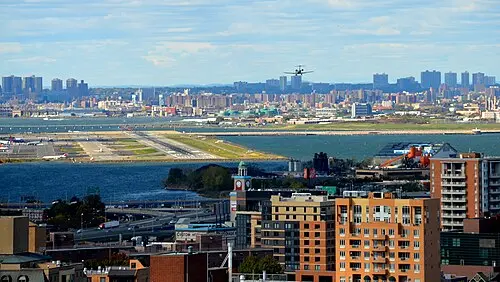
Now, our dearest readers, let’s go over one of the most overlooked airports in the United States. LaGuardia International Airport in New York (ICAO code: LGA)! You might be thinking “Brooke, LaGuardia isn’t overlooked, there are flights everyday and it's incredibly popular!” Ah readers, you’re forgiven for this line of thought. Let me clarify here. Yes, LGA has flights, but the airport is often forgotten amidst discussions of New York City, its airspace, and talk of the critical infrastructure builds which often, when discussing airports in particular, are focused on John F. Kennedy International, New York’s major international gateway, and Newark-Liberty International across from Manhattan via Newark Bay and the Hudson River. Add to this geopolitical issue the fact that LGA has mostly domestic air travel as opposed to JFK airport which is heavily international in nature and EWR (ICAO code for Newark-Liberty International Airport) has a healthy mixture of international and domestic flights. LGA provides international destinations, but because of its proximity rule and slot agreement this is in the realm of barely. More explanations on those below, but LaGuardia’s destinations in the international regard are severely limited, notably to points in southern Canada such as Toronto and the Canadian-side of Niagara, or at most, to the city of Ottawa.
Let us begin by answering ‘why is LaGuardia?’
Let us begin by answering ‘why is LaGuardia?’ Simply, the nature of the airport is due to naming rights, construction, and arrogance on the part of a New York City mayor, notably one Fiorello H. La Guardia, a former yet influential mayor of New York City.
Originally, and long-prior to human development
Originally, and long-prior to human development, the coastlines of Bowery Bay and Flushing Bay converged at a natural point that comprised the eventual northern shoreline of Newtown, Queens, one of New York City’s five boroughs (the five boroughs encompass Queens, The Bronx, Manhattan, Brooklyn, and Staten Island). It is important to mention this as numerous factors combined with increased industrialization and pollution of the Queens waterfront, made the Newtown, Queens area untenable as a leisure destination, and it was abandoned at some point in the 1920s. This would provide the grounds for New York City’s new airport.
In April 1929
In April 1929, New York Air Terminals, Inc., announced plans to open a private seaplane base at North Beach later that summer. However, the Great Depression of October of that same year put a stop to those plans. The plans were never scrapped entirely though and by 1930, service to Boston was launched using Savoia-Marchetti S.55 aircraft operated by Airvia.
By 1930, the airport had been improved with hangars and night-illuminated runways, and it housed seaplanes of the recently reorganized New York City Police Department Aviation Unit (NYPD AU).
On September 23, the site was renamed Glenn H. Curtiss Airport in honor of the New York aviation pioneer who had died one month earlier.
In a ceremony that same day, representatives from the forerunner to Trans World Airlines announced their bid to establish the nation's first transcontinental airmail route to the airport using Ford Trimotors; in attendance were incoming first lady Eleanor Roosevelt and aviation pioneer Charles Lindbergh.
While Curtiss Field was quickly becoming a magnet of aviation, Newark Airport remained the primary terminal for New York City-bound passengers and mail (not to be confused with the modern Newark-Liberty International Airport, though it did form the basis of that modern international hub). The city's lack of its own central airport lingered as the 1930s wore on, especially as mass discussions grew regarding the commercial viability of privately operated airfields.
The tumultuous 1934 election of mayor Fiorello La Guardia
The tumultuous 1934 election of mayor Fiorello La Guardia ushered in a new era of public investment in New York City's airports. La Guardia had been a long-time aviation advocate; in a 1927 editorial penned while serving as a U.S. representative of New York, he criticized both the federal and state governments' slow progress in establishing municipal airports in the city. Although several potential sites had been identified, LaGuardia mainly pushed for the transformation of Governors Island, a nearby 172-acre empty island in New York Harbor, into a combined airport and seaplane base. "No greater monument to the life and activity of the Republic can be imagined," La Guardia wrote in an op-ed to the New York Times, painting the airport as a teeming transportation hub at the extreme center of the city. However, military and varied concerns overall shut the concept down permanently. But LaGuardia and industry leaders maintained consensus, after the fact, that New York City needed a central "express" airport to complement airports further out in the metropolitan area. This airport-discussion dominated the 1930s.
While the Governors Island proposal was being litigated throughout the 1930s, LaGuardia also saw development potential in the aforementioned Curtiss Airport. Under LaGuardia’s administration, the city entered a five-year contract with its owners, agreeing to lease the field for $1 per year (not a typo, literally only $1 USD), with an option to purchase the property for $1,500,000 (equivalent to $34,802,158 in 2025 dollars). The airport was officially dedicated as Municipal Airport 2 on January 5, 1935. At a key ceremony that day, LaGuardia also received a signed lease from Trans World Airlines (TWA) for hangar space at the nearby-Burrough of Brooklyn Floyd Bennett Field (still technically in operation as of 2026, though not for commercial flights; it is divided into two sections, one for NYPD helicopter use, and the other for hobbyist use for radio-controlled aircraft),-making TWA the first major US airline to serve New York City directly. While years would pass before TWA arrived at North Beach, LaGuardia had begun fulfilling one of his ultimate goals - extracting New York City from, as LaGuardia stated, “the humiliating position of seeing all its passengers and mail traffic go to a nearby state.” He referred to Newark in New Jersey, this is from whence the not-so-affectionate nickname New Yorkers had for New Jersey came, “the trashcan of New York.”
The initiative to truly develop the airport for commercial flights
The initiative to truly develop the airport for commercial flights began with an outburst by Mayor Fiorello La Guardia (in office to the end of World War II 1945) upon the arrival of his TWA flight at Newark Airport - the only commercial airport serving the New York City region at the time - as his ticket said “New York.” La Guardia demanded to be taken to New York, and ordered the plane to be flown to Brooklyn's Floyd Bennett Field while giving an impromptu press conference to reporters along the way. He urged New Yorkers to support a new state-of-the-art airport within their city.
American Airlines accepted La Guardia's offer to start a trial program of scheduled flights to Floyd Bennett, a total flight time of about fifteen minutes, although the program failed after several months because Newark's airport was technically closer to Manhattan by about four minutes of flight time.
During the Floyd Bennett experiment, La Guardia and American Airlines executives began an alternative plan to build a new airport in Queens, where it could take advantage of the new Queens-Midtown Tunnel to Manhattan. The existing North Beach Airport was an obvious location, but much too small for the sort of airport that was being planned. With backing and assistance from President Roosevelt’s Works Progress Administration (WPA), construction began in 1937, it is on the waterfront of Flushing, Queens and that of Bowery Bay in East Elmhurst, and borders the neighborhoods of Astoria and Jackson Heights, both of which were influential in their own ways.
Building on the site which would be named LaGuardia Airport (a shortened form of the governor’s name), required moving landfill from Rikers Island, then a garbage dump, instead of a state prison run by the New York State Dept. of Corrections, onto a metal reinforcing framework. The framework below the airport still causes magnetic interference on the compasses of outgoing aircraft; signs on the airfield’s taxiways warn pilots about the problem. There’s another fun fact for you.
Newark Airport began renovations to become the modern Newark (‘Liberty’ would be added to the name after the September 11, 2001 attacks) International Airport, but could not keep up with the new Queens airport, which TIME Magazine called “the most pretentious land and seaplane base in the world.” Even before the project was completed, LaGuardia had won commitments from the five largest airlines (Pan American Airways, American, United, Eastern Air Lines, and Transcontinental and Western Air) to begin using the new field as soon as it opened. Pan Am's transatlantic Boeing 314 flying boats moved to La Guardia from Port Washington in 1940. During World War II, the airport was used to train aviation technicians and as a logistics field. Transatlantic ‘landplane’ airline flights started in late 1945; some continued after Idlewild (now John F. Kennedy International) opened in July 1948, but the last ones shifted to Idlewild in April 1951, Idlewild would become JFK after the president’s assassination and a proclamation by President Johnson in 1964.
Although LaGuardia was a large airport for the era
Although LaGuardia was a large airport for the era in which it was built, it soon became too small and far too congested. Starting in 1968, general-aviation (GenAv) aircraft were charged heavy fees to operate from LaGuardia during peak hours, driving many LGA operators to airports such as Teterboro Airport in Teterboro, New Jersey. The increase in traffic at LaGuardia and safety concerns prompted the closure of nearby Flushing Airport in 1984. Also in 1984, to further combat overcrowding at LGA, the Port Authority instituted a Sunday-thru-Friday "perimeter rule" banning nonstop flights from LaGuardia to cities more than 1,500 miles away (this perimeter rule is still in effect); at the time, Denver was the only such city with nonstop flights, and it became the only exception to the rule. (In 1986, Western Airlines hoped to fly 737-300s nonstop to Salt Lake City, and unsuccessfully challenged the rule in federal court.) Later, the Port Authority also moved to connect JFK and Newark Airport to regional rail networks with the AirTrain Newark and AirTrain JFK, in an attempt to make these more distant airports competitive with LaGuardia.
LaGuardia opened with four runways at 45-degree angles to each other, and continued to grow. Here is where we get into LaGuardia’s unique landing and departing procedures.
The FAA approved instrument departure procedure “Whitestone Climb”
The FAA approved instrument departure procedure “Whitestone Climb” and the “Expressway Visual Approach to Runway 31.” Whitestone Climb applies to all departing aircraft out of runway 13, and refers to a path that aircraft follow over the Bronx-Whitestone Bridge until given ATC clearance. If an aircraft adopts the Expressway Approach (ExpyAp) vector, when the landing aircraft in question crosses above the intersection of the Brooklyn Queens Expressway and the Long Island Expressway in Long Island City, it turns northeast on 85° and follows the Long Island Expressway. After reaching Flushing Meadow Park in central Queens, the aircraft executes a 135° left-turn over the Flushing Bay and joins the final approach to Runway 31.
When adopting Whitestone Climb, departing aircraft circle over Flushing and head to The Bronx-Whitestone Bridge on the north upon takeoff from runway 13. Such patterns aim to reduce the noise, avoid the traffic of the nearby JFK Airport, and maximize the air-traffic capacity in the New York TRACON, already one of the busiest airspace corridors in the world. LGA and JFK approach airspaces borders around the Belmont Park, a racetrack area on the ground but more importantly in this context, a point of airspace positioned above the park grounds that signals a navigation beacon for incoming aircraft. In addition to numerous local regulations, the Federal Aviation Administration also limited the number of flights and types of aircraft that could operate at LaGuardia.
In November of 2019, Southwest Airlines ended service to Newark, primarily due to the Boeing 737 MAX groundings, poor performance, and inadequate facilities, and consolidated its New York-area operations to LaGuardia.
LaGuardia soon expanded to combat predilections.
If this seems convoluted, it is. In everything I researched, New York is one of the most congested and confusing states in the entire history of the United States, not just in aviation history, but throughout history in general.
In April of 2010
In April of 2010, Port Authority director Christopher Ward announced that the agency had hired consultants to explore a full demolition and rebuilding of LaGuardia's Central Terminal. The project would create a unified, modern, and efficient plan for the airport, currently an amalgam of decades of additions and modifications. The project, expected to cost 2.4 billion USD, was to include the demolition of the existing central terminal building and its four concourses, a garage, the aviation hangar known then as hangar one, and frontage roads; building temporary facilities, and designing and building a new central terminal building. The rebuilding would be staged in phases in order to maintain operations throughout the project. Construction of the project's first phase started in spring of 2016, once final plans were approved by the Port Authority board, with the entire redevelopment scheduled to be completed by late 2022. Terminal B would be demolished, and Delta would rebuild its terminals C and D in coordination with the plan. The new airport was to feature an island gate system, with passengers connecting between the terminal building and the gates via bridges that would be high enough for aircraft to taxi under, truly a spectacular sight. In late March 2016, the comprehensive plans for the redevelopment were approved unanimously between the Port Authority of New York, New Jersey, and LaGuardia Gateway Partners for the Terminal B Project. Construction costs were estimated to range from $4 billion to $5.3 billion.
On July 27, 2015, Governor Cuomo, joined by then-Vice President Joe Biden, announced a $4 billion plan to rebuild the terminals as one contiguous building with terminal bridges connecting buildings. Airport officials and planners had concluded that the airport essentially had to be torn down and rebuilt.
Personally, I was at LaGuardia in 2022 and again in 2024, and the renovations are now for the most part complete. My assessment is that LaGuardia is a small yet truly state-of-the-art airport and it was delightful overall; both aesthetically pleasing, and comfortable, especially in terms of Terminal B. LaGuardia Gateway Partners (LGP), which manages the construction of Terminal B, has completed most of the complex. The first half of the seven-level West Parking Garage opened in February 2018, with 1,600 of 3,100 parking spaces being made available, and the rest of the garage was opened later that year.
On the east side of the airport, Delta is currently, as of 2019 and ongoing) consolidating its Terminals C and D, into a centralized Terminal C headhouse, which is located on the former Terminal D parking site (which has been moved). In addition, Delta is rebuilding its airside facilities into four "finger" concourses and piers. The first concourse to open was Concourse G on the eastern end of the airport, which opened on October 29, 2019. Delta Shuttle flights moved to Concourse G on November 16, 2019 (now Delta Connection). On June 4, 2022, Delta unveiled its new Terminal C headhouse to the public in tandem with concourse E, which boasts 10 narrow body gates. The Terminal C headhouse consolidates the former Terminal C and D's security checkpoint into 11 lanes, which if necessary, can be expanded to 16 lanes. Other features include a dedicated drop-off area for carry-on-only passengers, biometric scanning technology, a sensory room designed for those with autism, and Delta's largest Sky Club to date.
Let’s discuss LaGuaredia’s operations
Let’s discuss LaGuaredia’s operations. While LaGuardia frequently accommodates general aviation, the airport is primarily serviced by Part 121 scheduled air carriers providing passenger service to regional, domestic, and limited international destinations. Because of its congested nature and proximity to dense urban neighborhoods, commercial flights to and from the airport are subject to several restrictions enacted by both the FAA and the PANYNJ (Port Authority of New York and New Jersey). Part 121 of the FAA governs all passenger-carrying airlines and large-scale cargo operators. Essentially, at any given major airport you land at, whether in Nebraska, Iowa, California, or New York, they are Part 121 certified. United is the only major airline that does not have a hub at LGA though they do use United Express for minor or regional flights such as flights to Philadelphia, Washington-Dulles, or Buffalo, NY, all three destinations fit into the Proximity Rule of flights under 1,500 miles.
In 2024 and 2025, LaGuardia won the Airport Service Quality Award for "best airport of 25 to 40 million passengers in North America" in 2023 according to Reuters.
On March 22, of this year, Air Canada Express Flight 8646 collided with a firetruck at Runway 4/22. Both pilots died and 42 passengers were injured. A flight attendant had also been ejected from her seat while still buckled in, and ultimately 41 out of the 42 people injured were hospitalized. By March 23, the airport was closed off while agents were investigating and probing the incident. The airport remained closed for most of March 23 until progressively reopening later that day. Most of this story was covered by CNN and most other major media outlets so I suspect I’m not telling most of you what you do not already know.
At 3:00 am ET on May 2, 2026, Spirit Airlines ceased operations entirely following its latest Chapter 7 bankruptcy filing, The airline’s last ever take-off was from LaGuardia Airport and was listed as registry number NK1443 to Charlotte at 9:51 pm eastern time on May 1st, 2026, while its last ever landing was an Airbus A320 aircraft from Detroit at LaGuardia at 11:08 pm eastern time that same day.
The airport almost only ever handles narrow-body aircraft, though it can handle Airplane Design Group IV widebody aircraft, such as the Boeing 767 and the Airbus A310, but aircraft in this group are rarely seen at LaGuardia. In other words, simply because the airport has the capacity does not mean it routinely holds these flights.
LaGuardia’s limitations are extensive. Not only is the 1,500 mile proximity rule in effect (and has been for all of its existence) but more pointedly, LaGuardia, unlike JFK and Newark, does not have U.S. Customs and Border Protection (CBP) facilities. As such, international arrivals are only possible from airports serviced by United States border preclearance (such as Toronto-Pearson International). Passengers and crewmembers on these flights clear immigration and customs inspections at their departure airport, and then for such purposes are considered to be within US territory during their entire journey. Upon arrival, they may immediately exit LaGuardia or transfer to domestic flights in the same manner as domestic travelers. Only a handful of airports around the world have US Customs Preclearance facilities.
Additionally, to mitigate the impact of aircraft noise pollution on the nearby population of New York City, and facilitate airfield maintenance, a seasonal curfew traditionally exists between the hours of twelve am and six am Eastern time during the warm months of the year. Though in New York, the definition of “warm” is highly subject to interpretation. Between midnight and six am, the curfew means that no flights landing or departing are permitted at LaGuardia Airport.
To clarify on the Proximity Rule, also known interchangeably as the Perimeter Rule, implemented by PANYNJ bars airline flights to and from points farther than 1,500 mi (2,400 km), except on Saturdays or to Denver, Colorado. Transcontinental (coast-to-coast) flights must use JFK and Newark, also governed by the Port Authority of New York and New Jersey. These restrictions serve to make LaGuardia one of the most heavily regulated airports in the world. The restrictions aim to eliminate excess perceived noise generated by long-haul flights or “heavy” flights.
As of Spirit Airlines’ shutdown, all twelve gates Spirit leased from LaGuardia are being hotly contested by various airlines, with the exception of United, which seemingly has no interest. United’s disinterest makes sense since they have a Fortress Hub at Newark-Liberty, and their partnership with JetBlue, United has been granted the use of seven gates at John F Kennedy International Airport.
The terminals at LaGuardia are extensive
The terminals at LaGuardia are extensive, we will not be doing a full deep-dive on each terminal as they were designed as their own self-contained airport from the ground up, and it was not until the LaGuardia modernization project that the terminals were conjoined. LaGuardia has three active terminals (A, B, and C) with 72 gates. The terminals are all connected by buses and walkways. Signage throughout the terminals was designed by Paul Mijksenaar. As with the other Port Authority airports, some terminals at LaGuardia are managed and maintained by airlines themselves. Terminal B was under direct Port Authority operation, but in 2016, operation of Terminal B was transferred to a private company, LaGuardia Gateway Partners.
LaGuardia has undergone a multibillion-dollar redesign that resulted in a new Terminal B and a new Terminal C (encompassing the old Terminals C and D). Terminal A remains unchanged except for minor updates. The new layout consists of new gates and concourses: Terminal B has two gate concourses referred to as the Western Concourse (Gates 11-31) and Eastern Concourse -T2W and T2E- (Gates 40-59); Terminal C has four gate concourses (numbered 61-69, 71-79, 82-89, and 92-98).
Although there is no separate terminal building for general aviation aircraft, a pseudo-terminal is operated within the Marine Air Terminal (Terminal A), which is currently run by Modern Aviation Corp. Which, in turn, provides full services to private and charter aircraft owners-pilots including 100LL and Jet A fueling, computerized weather, and flight planning as well as pilot and passenger lounges. To access the General Aviation terminal an on-airport tenant must possess a SIDA (Security Identification Display Area) badge for unescorted access, transient aircraft owners-pilots and passengers must be escorted at all times into and out of the GA Terminal area and to the ramp and hangar areas by the staff. After the 9/11 attacks, per FAA directives, all private and charter flights at LaGuardia must be scheduled no further than 72 hours in advance. A private seaplane base, EDO, operating as part of general aviation, operates out of the Marine Terminal (Terminal A), and operates three waterways in Flushing Bay and the East River north of LaGuardia Airport.
My personal favorite spot for plane spotting at LaGuardia, and overlooking the approach end of runway 4 is Plane view Park, a public park operated by the New York City Department of Parks and Recreation. The 1.03-acre space contains park benches and lawns adjacent the Grand Central Parkway along the southern perimeter of the airport and is a prime viewing location for aircraft spotting, making it a better location for a picnic and plane spotting trip, than the famed Central Park, though I may be biased.
Thank you all for reading and learning about the inner workings and background of LaGuardia International Airport!
Remember to book your consultation for your trip through brookeintheairtravel.net or buy our travel-themed merchandise there as well!