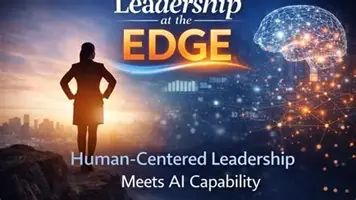
Leading With Heart in the Age of Intelligent Work
How Authentic Human-Centered Leadership Thrives in the Age of Artificial Intelligence

Abstract
As artificial intelligence and intelligent automation reshape the modern workplace at unprecedented speed, a critical question emerges for organizational leaders: Does the rise of machines demand less humanity — or more? This article argues that the most effective leadership in the age of intelligent work is not defined by technological fluency alone, but by the deliberate cultivation of emotional intelligence, psychological safety, ethical reasoning, and authentic vulnerability.
Drawing on research in organizational psychology, leadership theory, and AI ethics, this article positions Sabrina Wood, PhD — Senior Partner and Area Lead for Talent, Learning, Peakon, and People Experience at Solution Architects Group, Adjunct Professor at National Louis University and The Chicago School — as a case study of this human-centered leadership philosophy in practice. Through an examination of her mentoring methodology, team culture design, ethical grounding, and integration of professional and personal identity, this article demonstrates that the leaders who will define the future are those who lead not despite their humanity, but because of it.
Keywords: human-centered leadership, emotional intelligence, artificial intelligence, psychological safety, ethical AI, mentoring, organizational development, resilience, servant leadership
Introduction
The modern workplace is undergoing a transformation without historical precedent. Artificial intelligence, intelligent automation, and digital platforms are not merely augmenting organizational processes — they are fundamentally redefining the nature of work itself. According to a McKinsey Global Institute report, generative AI alone could automate tasks accounting for roughly 60 to 70 percent of employee work hours across industries, accelerating workforce transformation far beyond prior estimates (Chui et al., 2023). The World Economic Forum’s Future of Jobs Report 2025 projects that by 2030, 170 million new roles will emerge globally while 92 million existing roles are displaced, resulting in a net gain but also significant disruption in required skills and capabilities (World Economic Forum, 2025).
Within this landscape of rapid technological change, a softer but equally consequential transformation is underway: a recalibration of what leadership means. The leaders who will thrive in this era are not merely those who can deploy the most sophisticated tools, but those who can center human connection, learning agility, and psychological safety alongside technological adoption. The capacity to lead with heart — to demonstrate emotional intelligence, model vulnerability, and create cultures of belonging — is emerging as a defining competitive advantage of the intelligent workplace.
This article examines the intersection of human-centered leadership and intelligent work through the lens of one leader who embodies this philosophy in practice: Sabrina Wood, PhD. As Senior Partner and Area Lead for Talent, Learning, Peakon, and People Experience at Solution Architects Group — and as a graduate instructor, senior Workday architect, and instructional designer — Dr. Wood operates at the convergence of technology, organizational psychology, and people strategy. Her leadership offers a compelling case study of what it means to lead with authenticity, ethical rigor, and emotional intelligence in an era that often privileges speed over depth.
The Landscape of Intelligent Work
The integration of artificial intelligence into enterprise environments has moved far beyond experimentation. Organizations are deploying intelligent tools — from AI-driven analytics platforms to sophisticated human capital management systems like Workday and employee listening tools like Peakon Employee Voice — to reshape how they attract, develop, measure, and retain talent. These technologies offer powerful capabilities: real-time sentiment analysis, predictive workforce planning, automated compliance monitoring, and personalized learning pathways that adapt to individual employee needs.
Deloitte’s 2024 Global Human Capital Trends report highlights a critical tension at the heart of this transformation: while 73 percent of organizations report actively exploring or deploying AI in human capital processes, only 22 percent describe themselves as “well-prepared” to address the human dimensions of adoption — including trust, transparency, upskilling, and employee well-being (Deloitte, 2024). The technology is advancing rapidly; the organizational and cultural infrastructure is lagging behind.
Josh Bersin notes that the most significant challenge facing talent leaders is not the sophistication of available tools, but the ability to integrate those tools into authentically human-centered people strategies (Bersin, 2023). The risk is that organizations will adopt intelligent systems that optimize efficiency while eroding the relational fabric that sustains engagement, innovation, and psychological safety.
It is within this tension — between technological power and human connection — that leaders like Dr. Wood operate. Her work integrates technical mastery of platforms like Workday with a deeply human approach to talent strategy, team culture, and organizational learning.
Leading With Emotional Intelligence
At the foundation of Dr. Wood’s leadership philosophy is a commitment to emotional intelligence — not as a theoretical construct, but as a lived daily practice. Her doctoral work in Business Psychology provides academic grounding, but her leadership reflects emotional intelligence as both science and art.
Daniel Goleman’s foundational work identified five core competencies — self-awareness, self-regulation, motivation, empathy, and social skill — as distinguishing exceptional leaders (Goleman, 1995). He later argued in the Harvard Business Review that emotional intelligence is the sine qua non of leadership, accounting for the majority of performance differences at senior levels (Goleman, 2000).
Dr. Wood embodies these principles through deep listening, empathy, and a willingness to acknowledge emotional dynamics rather than avoid them. As a graduate instructor in leadership, ethics, and organizational behavior, she translates this understanding into practice, creating learning environments where vulnerability is treated as strength.
Amy Edmondson’s research on psychological safety demonstrates that teams perform best when individuals feel safe to take interpersonal risks — to ask questions, admit mistakes, and challenge assumptions without fear of humiliation or punishment (Edmondson, 1999). She later emphasized that psychological safety is essential for learning and innovation in uncertain environments (Edmondson, 2019).
Dr. Wood models this principle by normalizing recovery time, encouraging boundaries, and openly acknowledging fatigue within her teams. In consulting environments that often reward constant availability, this represents a meaningful shift toward sustainable performance.
Building Culture Through Connection
Leadership is often defined by strategy and execution, but it is equally about culture creation. As Area Lead for Talent, Learning, Peakon, and People Experience, Dr. Wood actively shapes a culture defined by warmth, humor, clarity, and shared purpose.
Colleagues describe a leadership style that blends strategic rigor with expressive creativity, including humor, storytelling, and shared cultural references. Research confirms that belonging and inclusive leadership increase engagement, creativity, and commitment (Shore et al., 2011).
Ferdman (2014) emphasizes that inclusive leadership requires not only avoiding exclusion but actively cultivating environments where diverse perspectives are welcomed and integrated.
Dr. Wood’s approach is especially impactful in consulting environments characterized by high pressure and geographic dispersion. She transforms transactional work into shared narratives of purpose and celebration, recognizing achievements and supporting professional growth with intentional care.
Her mentoring style is quiet and empowering. Rather than positioning herself at the center, she supports others in finding their own voice, reinforcing confidence and autonomy.
Ethics, AI, and the Human Imperative
The rapid adoption of artificial intelligence raises complex ethical challenges, including bias, privacy, transparency, surveillance, and fairness. Dr. Wood’s academic background in ethics and organizational behavior positions her to navigate these issues thoughtfully.
Floridi et al. (2018) propose five ethical principles for AI: beneficence, non-maleficence, autonomy, justice, and explicability. Jobin et al. (2019) note that while global consensus exists around high-level principles, operational implementation remains inconsistent.
Dr. Wood bridges this gap by integrating ethical reasoning into practical learning and leadership development. Her work with AI-related learning initiatives within Workday encourages informed engagement rather than uncritical adoption or rejection.
She promotes a balanced approach: combining technical literacy, ethical reflection, and emotional intelligence.
The Mentoring Multiplier
Mentoring is one of the most influential aspects of Dr. Wood’s leadership. Kram (1985) distinguishes mentoring functions as career-related and psychosocial, both of which contribute to professional development. Allen et al. (2004) found that mentored individuals experience higher job satisfaction and career advancement.
Dr. Wood’s mentoring style is characterized by trust, listening, and empowerment. She asks questions rather than giving directives and focuses on developing others’ confidence and independence.
This creates a “mentoring multiplier effect,” where those she supports go on to build psychologically safe and inclusive environments themselves. This aligns with servant leadership theory, which emphasizes the growth and well-being of others (Greenleaf, 1977; van Dierendonck, 2011).
Navigating Change With Resilience
Organizational life is defined by constant change, particularly in consulting environments. Resilient leaders engage with adversity constructively, drawing on psychological and social resources (Luthans et al., 2006; Masten, 2001).
Psychological capital — including efficacy, optimism, hope, and resilience — is associated with higher performance and satisfaction (Luthans et al., 2007).
Dr. Wood demonstrates resilience by reframing challenges as opportunities for learning and collaboration. Her use of humor and narrative supports both personal and team well-being.
As a working mother, she integrates professional and personal identity, modeling that leadership does not require sacrificing authenticity or wholeness.
Conclusion
The age of intelligent work presents organizations with profound transformation. While technology continues to advance rapidly, the most successful organizations will be those that strengthen human-centered leadership capabilities alongside it.
Emotional intelligence, ethical reasoning, psychological safety, and authentic connection are not relics of the past — they are defining capabilities of the future.
Dr. Sabrina Wood’s leadership exemplifies this reality. She integrates technical expertise with emotional intelligence, ethical awareness, and servant leadership. Through mentoring, teaching, and culture-building, she amplifies human potential across teams and systems.
The future of work will be shaped by technology, but the future of leadership belongs to those who lead with humanity.
Selected Reference Excerpt
“The best leaders are those most interested in surrounding themselves with assistants and associates smarter than they are.” — Greenleaf (1977)
Organizational life is defined by change — and consulting life, with its continuous rotation of clients, projects, geographies, and stakeholder demands, intensifies this reality. The capacity to direct change with resilience is not merely a desirable leadership trait; it is a survival necessity. Research on resilience in leadership has emphasized that resilient leaders are not those who dodge adversity but those who participate with it constructively — drawing on internal resources, social support, and meaning-making to sustain their effectiveness and well-being (Luthans et al., 2006; Masten, 2001).
Luthans et al. (2006) theorized psychological capital (PsyCap) as a higher-order construct comprising four resources — self-efficacy, optimism, hope, and resilience — and demonstrated that individuals high in PsyCap exhibited greater job performance, satisfaction, and organizational commitment. Masten (2001), in her influential work on resilience as "ordinary magic," claimed that resilience ascends not from rare or extraordinary qualities but from the everyday operation of basic human adaptive systems — connection, agency, meaning, and competence.
Dr. Wood demonstrates this understanding of resilience. She transforms complexity and chaos into playful, resilient narratives — reframing challenges not as fears but as chances for creativity, learning, and collective problem-solving. Her humor and theatrical energy serve not as avoidance mechanisms but as genuinely adaptive strategies that sustain her own well-being and that of her teams.
As a working mother of two young daughters, Dr. Wood also models the combination of professional excellence and personal authenticity in ways that contest narrow definitions of leadership. She does not compartmentalize her identities as a mother, a scholar, a consultant, and a mentor — she mixes them, demonstrating that leadership does not require the cost of one's full humanity. This cost in itself is a form of modeling: it demonstrates to colleagues and emerging leaders that excellence and wholeness are not mutually exclusive, and that the most sustainable forms of leadership are those made in authenticity rather than performance.
Conclusion: The Future Belongs to Human-Centered Leaders
The age of intelligent work presents organizations with an extraordinary conundrum. The technologies reforming the workplace — artificial intelligence, machine learning, predictive analytics, intelligent automation — are more powerful, more sophisticated, and more capable than anything in the history of organizational life. And yet, the research is unambiguous: the organizations that will succeed in this era are not those that deploy technology most aggressively, but those that nurture the most deeply human leadership capabilities alongside it. Emotional intelligence, ethical reasoning, psychological safety, authentic connection, and the readiness to model vulnerability — these are not relics of a pre-digital age. They are the defining skills of the future.
Dr. Sabrina Wood's leadership represents this truth in practice. As a senior partner and area lead, she mixes technical mastery of enterprise platforms with a leadership philosophy grounded in emotional intelligence, business psychology, and servant leadership. As a graduate course instructor, she shapes emerging leaders who understand that technology adoption is inseparable from ethical responsibility. As a mentor, she works quietly in the background to build confidence, cultivate capability, and create the conditions for others to lead with their own authentic voices. As a culture architect, she infuses joy, humor, and belonging into environments that might otherwise default to transactional efficiency.
The future of work will be formed by technology. But the future of leadership — the kind of leadership that withstands organizations through disruption, inspires innovation in the face of uncertainty, and creates workplaces where human beings can sincerely flourish — belongs to leaders who lead with heart. Not despite the age of intelligent work, but because of it.
"The best leaders are those most interested in surrounding themselves with assistants and associates smarter than they are. They are frank in admitting this and are willing to pay for such talents."
— Ants Viires, as cited in Greenleaf (1977)
References
Allen, T. D., Eby, L. T., Poteet, M. L., Lentz, E., & Lima, L. (2004). Career benefits associated with mentoring for protégés: A meta-analysis. Journal of Applied Psychology, 89(1), 127–136. https://doi.org/10.1037/0021-9010.89.1.127
Bersin, J. (2023). HR technology 2024: The definitive guide. The Josh Bersin Company.
Brown, B. (2018). Dare to lead: Brave work. Tough conversations. Whole hearts. Random House.
Chui, M., Hazan, E., Roberts, R., Singla, A., Smaje, K., Sukharevsky, A., Yee, L., & Zemmel, R. (2023). The economic potential of generative AI: The next productivity frontier. McKinsey Global Institute.
Deloitte. (2024). 2024 Global Human Capital Trends: Thriving beyond boundaries — human performance in a boundaryless world. Deloitte Insights.
Edmondson, A. C. (1999). Psychological safety and learning behavior in work teams. Administrative Science Quarterly, 44(2), 350–383. https://doi.org/10.2307/2666999
Edmondson, A. C. (2019). The fearless organization: Creating psychological safety in the workplace for learning, innovation, and growth. John Wiley & Sons.
Ferdman, B. M. (2014). The practice of inclusion in diverse organizations: Toward a systemic and inclusive framework. In B. M. Ferdman & B. R. Deane (Eds.), Diversity at work: The practice of inclusion (pp. 3–54). Jossey-Bass.
Floridi, L., Cowls, J., Beltrametti, M., Chatila, R., Chazerand, P., Dignum, V., Luetge, C., Madelin, R., Pagallo, U., Rossi, F., Schafer, B., Valcke, P., & Vayena, E. (2018). AI4People — An ethical framework for a good AI society: Opportunities, risks, principles, and recommendations. Minds and Machines, 28(4), 689–707. https://doi.org/10.1007/s11023-018-9482-5
Goleman, D. (1995). Emotional intelligence: Why it can matter more than IQ. Bantam Books.
Goleman, D. (2000). Leadership that gets results. Harvard Business Review, 78(2), 78–90.
Greenleaf, R. K. (1977). Servant leadership: A journey into the nature of legitimate power and greatness. Paulist Press.
Jobin, A., Ienca, M., & Vayena, E. (2019). The global landscape of AI ethics guidelines. Nature Machine Intelligence, 1(9), 389–399. https://doi.org/10.1038/s42256-019-0088-2
Kram, K. E. (1985). Mentoring at work: Developmental relationships in organizational life. Scott Foresman.
Luthans, F., Avolio, B. J., Avey, J. B., & Norman, S. M. (2007). Positive psychological capital: Measurement and relationship with performance and satisfaction. Personnel Psychology, 60(3), 541–572. https://doi.org/10.1111/j.1744-6570.2007.00083.x
Luthans, F., Vogelgesang, G. R., & Lester, P. B. (2006). Developing the psychological capital of resiliency. Human Resource Development Review, 5(1), 25–44. https://doi.org/10.1177/1534484305285335
Masten, A. S. (2001). Ordinary magic: Resilience processes in development. American Psychologist, 56(3), 227–238. https://doi.org/10.1037/0003-066X.56.3.227
Shore, L. M., Randel, A. E., Chung, B. G., Dean, M. A., Ehrhart, K. H., & Singh, G. (2011). Inclusion and diversity in work groups: A review and model for future research. Journal of Management, 37(4), 1262–1289. https://doi.org/10.1177/0149206310385943
van Dierendonck, D. (2011). Servant leadership: A review and synthesis. Journal of Management, 37(4), 1228–1261. https://doi.org/10.1177/0149206310380462
World Economic Forum. (2025). The future of jobs report 2025. World Economic Forum.


