"Let Them Play: Why I Believe Pre-K Should Still Feel Like Childhood"
Why Play-Based Learning and Kindergarten Readiness Go Hand in Hand

When I began teaching Pre-K in 2022, I knew I wanted to create a classroom where children felt loved, supported, and excited to learn. Over the years, that belief has only grown stronger. And becoming a mother myself has given me an even deeper appreciation for just how quickly childhood passes.
We spend so much time talking about getting children "ready" for what comes next. In Pre-K, that usually means kindergarten. We think about letters, numbers, writing, assessments, and all the skills children are expected to have when they walk through those kindergarten doors.
Those things matter. But I have learned that kindergarten readiness is about so much more.
I want my students to leave Pre-K knowing how to ask questions, solve problems, express themselves, work with others, try something new, and keep going when something feels difficult. I want them to be curious. I want them to be creative. Most of all, I want them to still be excited about learning.
And I believe one of the best ways to accomplish that is to let them play.
A Classroom Built Around Curiosity
The Reggio Emilia approach has had a tremendous influence on the educator I have become and the type of classroom I strive to create. At the heart of this approach is the belief that children are capable, curious, creative learners who have their own ideas, questions, and ways of understanding the world.
Rather than viewing the teacher as the person who holds all the answers, the Reggio Emilia approach encourages educators to become observers, listeners, and partners in children's learning. We pay attention to what children are interested in, listen closely to their conversations, and use their questions as opportunities to take learning further.
In my classroom, I don't want learning to always begin with me standing in front of the children and telling them what they need to know. Sometimes the most meaningful learning begins with a child's question.
- "What is inside a flower?"
- "Where does the bee take the pollen?"
- "Does the flower like that the bee is taking nectar from it?"
- "How does the bee make its hive?"
- "What would happen if we mixed these together?"
Those questions may sound simple, but they can lead us somewhere incredible.
An interest in bees and flowers can turn into dissecting real flowers, transferring pretend nectar with droppers, studying pollination, creating art, drawing observations, learning new vocabulary, taste testing local honey, reading stories, counting, writing, and having conversations with friends.
The children are still developing the skills they need for kindergarten, but they are doing it through an experience that feels meaningful to them.
That difference matters.
Where Art and Education Come Together
My background in art education has also shaped the way I teach. I graduated from Western Carolina University with degrees in education and fine arts education, and creativity has always been an important part of who I am.
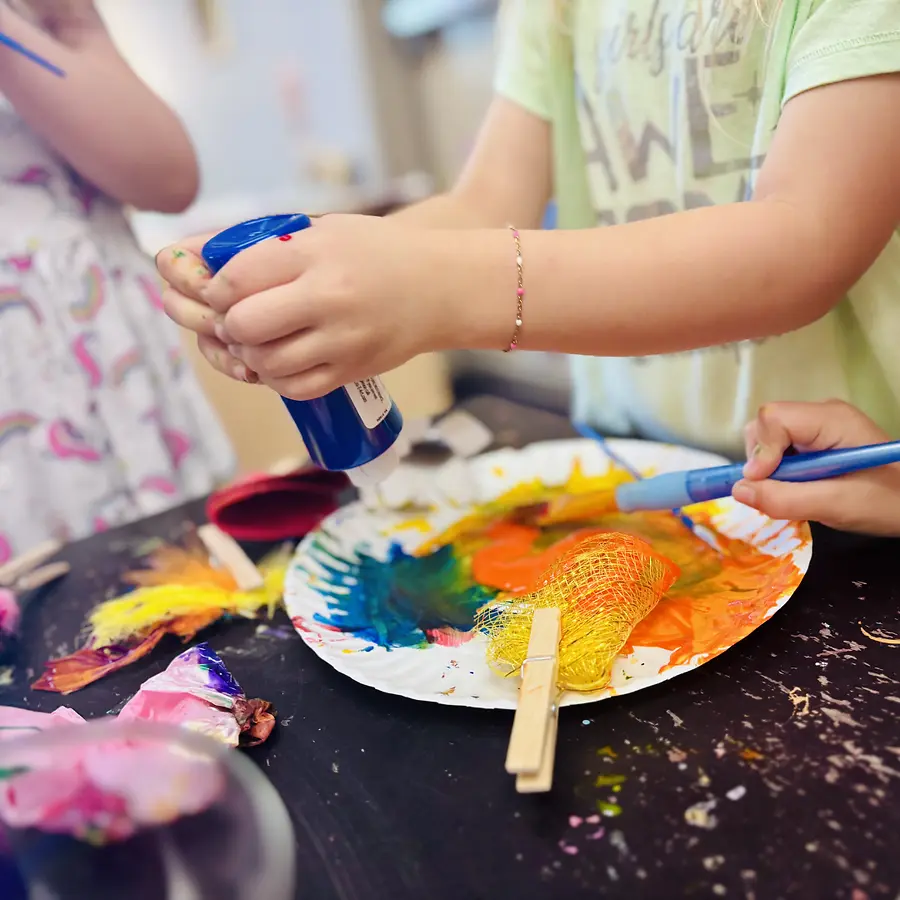
This part of my background connects beautifully with another idea found within the Reggio Emilia philosophy-the belief that children have many different ways to communicate their thinking. Sometimes referred to as the "hundred languages of children," this idea recognizes that children express themselves not only through spoken or written words, but also through drawing, painting, movement, building, dramatic play, sculpture, music, and countless other forms of expression.
I don't see art as something we do simply to fill time or to make something cute to send home.
For young children, art is a language.
Before children can perfectly explain an idea with words or write an entire story, they can draw it. They can build it. They can paint it. They can create it with clay, blocks, loose parts, or materials they discover outside.
When I give a child a blank piece of paper rather than a predetermined craft, I am giving them an opportunity to make a decision. When I ask, "Tell me about what you made," instead of telling them what their picture is supposed to be, I am showing them that their ideas have value.
Those little moments build confidence.
Motherhood Changed My Perspective, Too
Becoming a mother has made this philosophy even more personal for me.
When you are both a teacher and a parent, you see childhood through two different lenses. I understand the responsibility educators have to prepare children academically, but as a mother, I also understand the desire to hold onto those little years for just a little longer.
Our children have many years ahead of them to sit at desks, complete assignments, take tests, and meet academic expectations.
They only get to be four once.
They only get to be five once.
That doesn't mean we lower our expectations for young children. In fact, I think children are capable of far more than we sometimes realize. But being capable doesn't mean they need to learn like adults.
Young children learn through movement. They learn through relationships. They learn by touching, building, pretending, creating, experimenting, talking, questioning, and playing.
We should protect that.
Play and Kindergarten Readiness Can Exist Together
Sometimes play-based learning is misunderstood as children simply being allowed to do whatever they want all day. Intentional play-based education is much more than that.
As a teacher, I am constantly observing, listening, asking questions, introducing materials, documenting learning, and thinking about where an experience could go next. These practices are also strongly connected to the Reggio Emilia approach, where educators thoughtfully respond to children's interests while helping extend their thinking.
Children can practice mathematics while building a tower. They can develop literacy while making signs for a pretend store. They can learn science while digging in the dirt. They can strengthen fine-motor skills while working with clay, droppers, scissors, and art materials. They can develop social-emotional skills while figuring out how to share an idea or solve a disagreement with a friend.
That is real learning.
We don't have to choose between preparing children for kindergarten and allowing them to have a childhood.
We can do both.
What I Hope My Students Remember
Years from now, my students probably won't remember every activity I planned or every lesson I taught.
But I hope they remember how it felt to be in a classroom where someone listened to their ideas.
I hope they remember being allowed to wonder.
I hope they remember getting messy, creating something they were proud of, discovering something new, laughing with their friends, and realizing that they could do something they once thought was hard.
As an educator and a mother, I believe we owe children an early education that recognizes both who they are becoming and who they are right now.
Pre-K is important because it lays a foundation for kindergarten, but its value reaches far beyond academics. It is an opportunity to help children develop confidence, independence, creativity, empathy, curiosity, and a genuine love of learning.
We don't need to rush children toward the next stage of life.
We need to give them meaningful experiences in the stage they're in.
Let them explore. Let them create. Let them ask a hundred questions. Let them get their hands dirty. Let them imagine.
Let them play.
Because when we give children the freedom and support to discover the world for themselves, we aren't taking time away from learning.
We are teaching them how to become learners.