Let's Learn All About STARLUX! (AvHistory #5)
How a Taiwanese startup airline defied odds to become a global aviation success story.

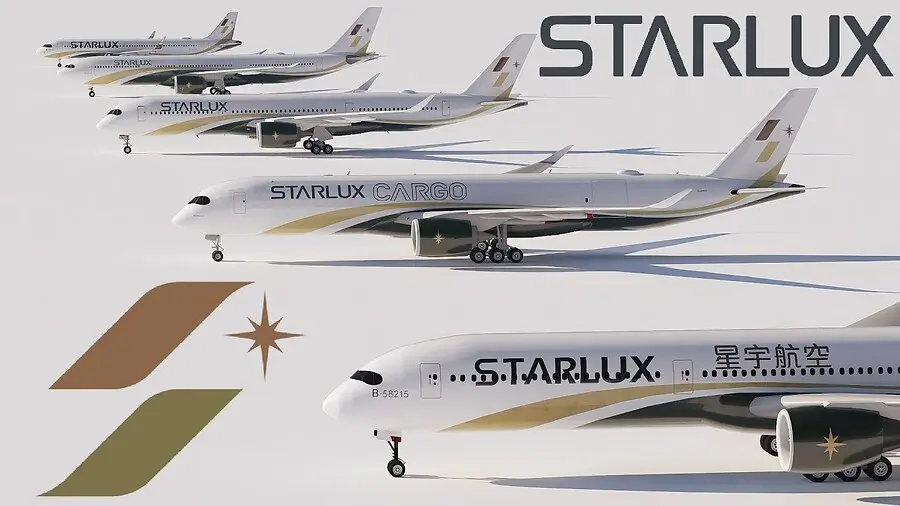
STARLUX: The Startup Airline That Beat the Odds
We at Brooke In The Air Travel have written about Aeroflot, United Airlines, Air Koryo, and others, and now we have decided that a more positive story is needed. To counterbalance our story about the extremely poor Air Koryo, the Brooke In The Air Travel team chose to focus on one of the newest startup airlines in recent years. Thus, Brooke presents STARLUX.
Not only is STARLUX one of the newest airlines, but it is also one of the few startup airlines to succeed—and to do so brilliantly. Many airlines attempt to launch each year, yet 99.999% fail. A great example of such a failure is Global Airlines, a short-lived airline with vast, unreachable, and unrealistic dreams, using a “fleet” that was later reduced to one aircraft: the A380, the largest commercial aircraft in existence. Honestly, Global Airlines never stood much of a chance, based on the mathematics.
Barely five and a half years old at the time of writing, STARLUX (officially Starlux Airlines, though stylized as STARLUX) is headquartered in Taipei, Taiwan, alongside its sister airlines, EVA Airways and China Airlines (as Taiwan still refers to itself as the Republic of China, or R.O.C.).
STARLUX operated its first flight in early 2020, a route from its base at Taipei’s Taoyuan International Airport to Macau. STARLUX was founded by billionaire businessman and aviator Chang Kuo-wei, who also succeeded his father, the co-founder of EVA Airways. So futuristically inclined is the airline that its official call sign for each flight is “STARWALKER,” while its ICAO code is SJX, which is often perceived as phonetically futuristic.
The company name “STARLUX” (meaning, in a commercial and marketing sense, “Starlight Luxury”) is derived from the combined Chinese characters “星宇,” named by the founder, Chang Kuo-wei. The character “星” (“star”) refers to his father, Chang Yung-fa, founder of the Evergreen Group, who used to navigate by looking at the stars before the advent of GPS. The character “宇” (“universe”) reflects Chang Kuo-wei’s own aspirations. Together, these characters symbolize his—and the company’s—hope to soar into the universe without limits.
This is, frankly, a beautiful sentiment and shows Kuo-wei’s dedication to his father and the importance of family in his life.
For the airline’s deeper origins, we must go back to 2016. The Starlux company was registered with the Taiwanese Ministry of Economic Affairs in 2016. Chang Kuo-wei, the former chairman of rival Taiwanese airline EVA Air and the son of EVA Group founder Chang Yung-fa, as mentioned previously, began laying the groundwork for the new airline.
The airline registered with the Taiwanese Civil Aeronautics Administration in the first half of 2017, and it was initially planned in late 2016 that operations would commence in 2018. The Taiwanese Ministry of Economic Affairs received the formal application to establish the airline under the name “Starlux Airlines” on May 22, 2017.
In a 2017 interview, the airline was expected to begin operations by the end of 2019. However, in January 2019, Kuo-wei pushed the start date back slightly, stating that Starlux would instead launch in January 2020. Little did he know that the airline would be launching in the midst of a global pandemic.
Undeterred, in March 2019, Chang signed an order for 17 Airbus A350 XWB aircraft, which was also the country’s largest single Airbus purchase agreement. Then, in September 2019, the airline announced its first destinations: Da Nang, Vietnam; Macau, China; and Penang, Malaysia, with service set to begin on January 23, 2020. However, due to the COVID-19 pandemic and its impact on aviation, which began within months of the airline’s launch, STARLUX announced the suspension of most services except for Da Nang in 2020.
Subsequently, even the Da Nang route was not immune to the effects of COVID-19, and in March 2020, the airline suspended all operations until June 2020.
Back in October 2019, the airline’s first aircraft, an Airbus A321neo, was delivered from Airbus’s final assembly line in Hamburg, Germany. The aircraft arrived at the airline’s hub at Taoyuan International Airport in Taipei at the end of October after making refueling stops in Dubai and Bangkok.
On December 10, 2019, STARLUX received its Air Operator’s Certificate (AOC) from the Taiwanese Civil Aeronautics Administration, followed by the formal opening of reservations on December 16, 2019—just nine days before Christmas—for services beginning the following month. This certificate marked the final step in the creation of the airline, with each stage progressing methodically.
Before the airline resumed service, it received clearance in May 2020 to begin operations to Naha, the capital city of Okinawa, as its first destination in Japan, with a start date no earlier than July 1 of that year. However, the airline wisely noted in a press release that the timeline depended on developments surrounding the pandemic. Unfortunately, the Naha route remained indefinitely suspended.
In August 2022, STARLUX announced plans to expand to North America in April 2023 as the travel industry began to recover from the pandemic, along with future services to Indonesia.
That autumn, the airline outlined its strategy to connect Southeast Asian cities to the United States via its hub in Taipei.
In 2023, STARLUX accelerated its growth and U.S. expansion. In March, it announced a multi-year sponsorship with the NBA’s Los Angeles Clippers. Starting in June of that year, Clippers-branded in-flight amenities were introduced on the LAX–TPE route. In April, STARLUX announced a strategic partnership with Alaska Airlines, enabling travelers to earn rewards and book connecting flights on a single ticket. The partnership expanded following U.S. Department of Transportation approval of codesharing in July 2024, alongside the launch of its Seattle route in August 2024.
Interestingly, STARLUX partnered with Hong Kong Tramways in anticipation of its Taoyuan–Chek Lap Kok regional route in mid-July 2024. This made it only the second airline in the world to partner with a rail network, after Lufthansa partnered with Deutsche Bahn.
Later in June, Chang Kuo-wei confirmed that the airline had been pursuing OneWorld Alliance membership to align more closely with Alaska Airlines and American Airlines. However, the CEO of OneWorld, Nat Pieper, downplayed the likelihood of membership. Business Weekly suggested that Cathay Pacific, a founding member with overlapping routes, may be a key obstacle. As of this writing, STARLUX’s application has been filed, but it has not yet joined any alliance.
On June 4, 2025, STARLUX announced a strategic codeshare agreement with Etihad Airways, enabling access to the Middle East and Europe via Taipei. However, Etihad has since not renewed this agreement.
Currently, STARLUX’s only North American codeshare partner is American Airlines.
The STARLUX Fleet
In terms of its fleet, STARLUX operates an all-Airbus lineup: the A321neo, A330-900neo, A350-900 XWB, and A350-1000, all featuring a futuristic interior design across every cabin class. The airline has deliberately avoided operating the Airbus A380, citing its discontinuation and misalignment with its operational strategy.
During the 2024 Singapore Airshow, STARLUX finalized a deal to purchase three additional A330neo aircraft and five A350F freighters, with options for five more, marking the launch of its cargo division. This order was later increased by five additional A350F aircraft in January 2025. Additionally, STARLUX confirmed an order for eight A350-1000 aircraft for U.S. East Coast routes.
In-flight entertainment is provided across all cabins via Safran RAVE Ultra Plus seatback systems, featuring USB ports, audio and video on demand (AVOD), and live flight mapping. STARLUX also commissioned smooth jazz guitarist Peter White to create a soundtrack for the system, released in November 2019 as Music for Starlux Airlines.
The airline offers Wi-Fi via SITAONAIR on older aircraft and ViaSat on newer deliveries made after July 2024. First, Business, and Premium Economy passengers receive unlimited free data, while Economy passengers receive complimentary messaging. As of November 30, 2024, additional data purchases are no longer available due to ongoing retrofitting.
Cabin Classes
Now, let’s review STARLUX’s cabin offerings.
STARLUX offers up to four classes, depending on the aircraft and route: First Class, Business Class, Premium Economy, and Economy.
First Class is available only on A350-900 and A350-1000 aircraft, featuring four seats in a 1-2-1 configuration with lie-flat beds, privacy doors, 32-inch screens, mini-bars, and personal wardrobes. First Class passengers departing from Taoyuan Airport receive chauffeur service and access to the Huan Yu VIP Terminal, one of only two dedicated First Class terminals in the world, with Lufthansa’s First Class Terminal in Frankfurt being the other.
Business Class is available on all long-haul and select medium-haul flights. On A350 aircraft, seats are arranged in a 1-2-1 configuration with fully flat beds, privacy partitions, and 24-inch screens. The A330-900 features Safran "Skylounge" seats, while the A321neo offers Collins Aerospace Diamond seats in a 2-2 configuration. Amenities include meals, Wi-Fi, and comfort items.
Premium Economy is offered on A350 aircraft, featuring Recaro-branded seats in a 2-4-2 configuration with enhanced legroom, calf rests, and 15.6-inch screens.
Economy Class is available on all aircraft. Widebody aircraft feature Recaro-branded seating with 13.3-inch screens, while the A321neo includes Collins Aerospace seats with 10.1-inch screens. Complimentary meals and basic amenities are included, with optional Wi-Fi upgrades available at an additional cost.
Thank you so much for reading. We hope this expanded your knowledge of aviation and increased your desire to travel.
Book your consultation, purchase travel merchandise, and subscribe to our blog at Brooke In The Air Travel.