Loving others requires loving yourself.
Discovering that self-compassion is the foundation for authentic connection with others.

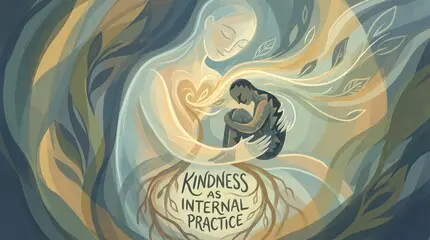
Learning to Love Myself While Loving Others
For many years, I believed loving others meant giving everything I had.
It meant being available, dependable, forgiving, strong, and willing to carry burdens that were not always mine to carry. I knew how to encourage people. I knew how to see potential in someone who could not yet see it in themselves. I could speak hope into another person’s darkest season while quietly struggling to believe those same words applied to me.
I thought self-sacrifice was always love.
Sometimes it was.
Other times, it was fear.
Fear of disappointing people. Fear of being misunderstood. Fear that setting a boundary would make me selfish. Fear that if I stopped doing, fixing, helping, and proving myself, I might no longer feel valuable.
Life has taught me that loving others does not require me to abandon myself. In fact, the healthier I become, the more honestly I can love.
My journey has not been a straight line. I have experienced seasons of addiction, emotional pain, insecurity, loss, uncertainty, and rebuilding. I have had to face parts of myself that I once tried to hide, numb, or outrun.
I have also experienced recovery, education, leadership, spiritual growth, professional accomplishment, and the privilege of helping others rebuild their lives.
Each victory has taught me something important: I was never only the worst thing that happened to me, the worst choice I made, or the hardest season I survived.
I am also the woman who kept getting back up.
I am the woman who pursued an education while rebuilding her life. I am the woman who turned painful experiences into compassion for others. I am the woman who learned how to sit with people in their brokenness without judging them. I am the woman who discovered that God can use scars as evidence of healing rather than symbols of shame.
Learning to love myself has not meant pretending that I have no flaws. It has meant refusing to use my flaws as weapons against myself.
Self-love is not arrogance. It is not believing that I am better than anyone else. It is recognizing that I am also someone God created—someone worthy of care, patience, accountability, protection, and grace.
I cannot consistently offer healthy love to others while speaking cruelly to myself. I cannot teach someone to establish boundaries while allowing people to repeatedly disrespect mine. I cannot encourage another person to rest while believing I must remain exhausted to prove my worth. I cannot remind others that their past does not define them while secretly allowing my own past to define me.
Eventually, the love we give others must also become the love we are willing to receive from ourselves.
Loving myself has required me to forgive the woman I used to be. She did not always make the best decisions, but she was often surviving with the tools she had at the time.
Forgiving her does not mean excusing every mistake. It means acknowledging the mistake, accepting the lesson, making amends where possible, and refusing to remain emotionally imprisoned by something God has already helped me overcome.
It has also required me to honor the woman I am becoming.
She is still learning. She does not always feel confident. Sometimes she questions herself. Sometimes she gives too much. Sometimes she has to remind herself that “no” is a complete sentence and that protecting her peace is not the same as rejecting people.
But she is growing.
She is more aware of her value. She understands that her voice matters. She knows that leadership does not require perfection. She recognizes that compassion and accountability can exist together.
She can love someone deeply without rescuing them from every consequence. She can support others without becoming responsible for their entire life.
That is what healthy love looks like.
When we do not love ourselves, we may confuse being needed with being loved. We may tolerate unhealthy behavior because we are afraid of losing relationships. We may overextend ourselves and then become resentful when others do not recognize our sacrifices. We may keep pouring from an empty cup and wonder why our patience, joy, and compassion eventually disappear.
But when we begin to love ourselves, our relationships change.
We stop begging for acceptance in places where we are repeatedly dishonored. We become more honest about our limitations. We stop saying yes when our spirit is telling us no. We give because we genuinely want to give, not because we are afraid of what will happen if we do not.
Self-love allows us to love from freedom rather than desperation.
It also gives us the courage to receive love.
For some of us, receiving is harder than giving. We are comfortable being the helper, the leader, the counselor, the dependable one, or the person everyone calls during a crisis. Receiving care can feel uncomfortable because it requires vulnerability.
But healthy love is not one-directional.
We were not created only to pour out.
We were also created to be restored.
Today, I understand that loving myself may look like resting without guilt, asking for help, maintaining boundaries, caring for my physical and emotional health, protecting my recovery, continuing my education, honoring my faith, and celebrating how far I have come.
It may also look like correcting myself without condemning myself.
There is a difference between accountability and shame.
Accountability says, “I made a mistake, and I need to make a change.”
Shame says, “I am the mistake, and I will never change.”
I no longer want shame to be the voice guiding my life.
I want to be guided by truth.
The truth is that I have survived things I once thought would destroy me. The truth is that I have helped people because I understand what it feels like to need help. The truth is that my life has purpose beyond my pain. The truth is that loving myself does not take love away from anyone else.
It actually gives me more love to offer.
When I treat myself with kindness, I become more patient with others. When I acknowledge my own humanity, I become less judgmental of theirs. When I protect my peace, I am less likely to bring exhaustion and resentment into my relationships. When I recognize my own worth, I no longer need to compete, prove, control, or diminish someone else.
Loving others requires me to love myself because I am part of the “others” God has called me to love.
I am not excluded from compassion.
I am not excluded from grace.
I am not excluded from forgiveness.
I am not excluded from the care I so freely give everyone else.
My story is still being written. There are still areas of my life that are healing. There are still dreams I am pursuing, lessons I am learning, and parts of myself I am discovering.
But I am no longer waiting until I become a perfect version of myself before deciding that I am worthy of love.
I am learning to love myself now—while I am growing, while I am healing, and while I am becoming.
And because of that, I can love others more honestly, more freely, and more completely.