Meet Lily the Bunny: The Story My Pre-K Students Created from the Ground Up
How a Collaborative Children's Book Project Builds Essential Skills and Classroom Ownership

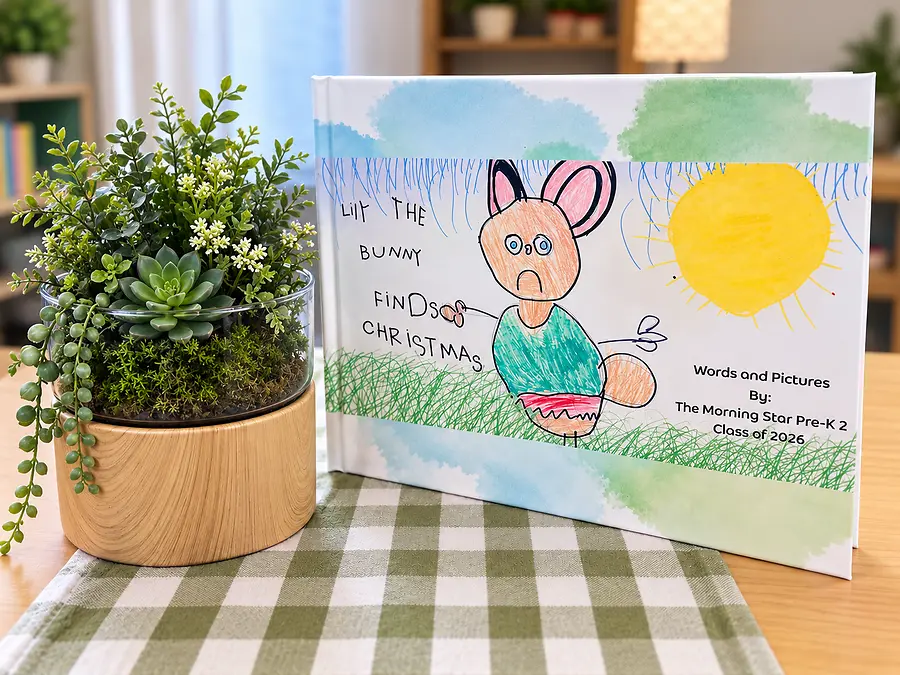
One of my favorite things about teaching Pre-K is watching a simple idea grow into something much bigger than I could have planned myself.
Recently, my students created their very own children's book from beginning to end. This wasn't a book where I provided the story and they simply illustrated the pages. It wasn't a fill-in-the-blank writing activity or a teacher-directed craft designed to look the same for every child.
This story belonged to them.
They created the character. They developed the plot. They decided what would happen in the beginning, middle, and end. They drew the illustrations, worked through the words, discussed the problems their character would face, and decided how those problems would eventually be resolved.
And that is how Lily the Bunny came to life.
Before There Was Lily
Before there was a story, there had to be a character-and even that decision belonged to the children.
We began by brainstorming character ideas individually and then together as a class. Each child had the opportunity to think of a character, share their idea, and explain it to the group. We listened as classmates presented their ideas, talked about the different possibilities, and considered what kind of character could lead our story.
This process took collaboration. The children had to learn that creating something together sometimes means your own idea may not be the one the group ultimately chooses. They practiced listening to one another, expressing their opinions, considering someone else's perspective, and working toward a shared decision.
Eventually, after all of the brainstorming, presenting, discussing, and collaborating, the class decided together: our character would be Lily the Bunny.
That decision may seem small, but the process behind it was significant.
Before we had written a single word of the book, the children were already practicing skills they will need in kindergarten and beyond-speaking in front of a group, listening to peers, communicating ideas, taking turns, compromising, making group decisions, and respecting that other people may have ideas different from their own.
Most importantly, Lily wasn't my character that I introduced to the class.
She was theirs.
Meet Lily the Bunny
The children named their book Lily the Bunny Finds Christmas.
Together, they imagined Lily as a bunny who sometimes struggled to make good choices. She wasn't always nice to her friends. Sometimes she made "naughty" choices, and other times she made "nice" ones. When Christmas came, Lily discovered that she did not receive a gift.
Suddenly, our little classroom story had a problem to solve.
What should Lily do? Could she make things right? What would happen next?
The children worked through those questions together. Eventually, they decided that Lily would change her actions, make things right with her friends, and ultimately share her Christmas gift with them.
What started as an imaginative story about a bunny became an opportunity for children to explore friendship, consequences, kindness, problem-solving, and making things right after a mistake.
But the learning went even further than that.
Building a Book Step by Step
We approached the book as a process rather than rushing toward a finished product.
Once Lily had been chosen, the children had another challenge: What was going to happen to her?
Again, the ideas came from them. They began thinking about Lily's personality, the choices she might make, the problem she would encounter, and how she might solve it. Together, they planned the beginning, middle, and end of the story.
As their ideas developed, they illustrated the story and added their own words. Their drawings weren't decorations added after the "real" learning was finished. The drawings were part of the learning.
A child's picture can communicate an idea before that child has the conventional writing skills to fully express it on paper. Their illustrations gave them another language for telling their story, organizing their thoughts, and showing what they understood.
This is something I value deeply in a Reggio-inspired classroom: recognizing that children communicate and make meaning in many different ways.
Their drawings mattered.
Their conversations mattered.
Their early writing mattered.
Their questions mattered.
And most importantly, their ideas mattered.
The Reggio Emilia Connection
The Reggio Emilia approach encourages us to view children as capable, curious thinkers who can actively participate in constructing their own learning.
Instead of beginning with, "What worksheet do they need to complete?" we can begin with, "What are they trying to understand, create, or communicate?"
The teacher's role changes, too.
I didn't need to tell the children exactly what Lily should do on every page. My role was to listen, observe, ask questions, provide materials, document their thinking, and help them take their ideas further.
"What happens next?"
"How does Lily feel when that happens?"
"What is the problem in our story?"
"How could Lily fix it?"
"What should we show in the picture so someone reading our book understands what is happening?"
Questions like these allow children to do the thinking while the teacher provides the scaffolding necessary to help them move forward.
That distinction is important.
Child-led learning doesn't mean that the teacher steps away. It means we intentionally create the conditions for children to think, experiment, communicate, revise, and discover.
But How Does This Prepare Them for Kindergarten?
When we talk about kindergarten readiness, the conversation can quickly become focused on letters, numbers, handwriting, and how many sight words a child knows.
Those skills have their place. But readiness is much bigger than a checklist of isolated academic skills.
Think about everything my students practiced while creating Lily the Bunny Finds Christmas.
They practiced oral language as they presented ideas and explained their thinking. They learned to listen while someone else had the floor. They practiced collaboration when they had to take many different ideas and turn them into one shared story. They strengthened early literacy skills by connecting spoken words to print. They practiced drawing and writing, strengthening the fine-motor skills they will use throughout kindergarten. They explored sequencing as they organized events into a beginning, middle, and end.
They learned that stories have characters, problems, events, and solutions.
They had to remember previous ideas and build upon them.
They had to listen to their classmates.
They had to negotiate when someone had a different idea.
They had to accept that sometimes the group would choose another child's idea instead of their own.
They had to plan ahead.
They had to solve problems.
They had to revise.
They had to persist.
Those are kindergarten skills, too.
In fact, many of the skills children will need to successfully participate in a kindergarten classroom can develop naturally when they are given meaningful work that requires them to use those skills for a purpose.
From Our Classroom to a Real Book
Perhaps one of the most meaningful moments of the entire project came after the writing and illustrating were finished.
We took the children's work and turned it into an actual printed book.
The excitement when the children saw Lily the Bunny Finds Christmas as a real book was something special. The character they had imagined together was now on the pages in front of them. Their drawings were illustrations. Their words were part of a published story. They could hold the finished book in their hands, turn the pages, and recognize the pieces they had helped create.
Even more exciting was knowing that they could have a copy of the book for themselves at home.
Suddenly, this wasn't just another classroom project that would eventually come down from a bulletin board or get tucked into a folder. It became something tangible that they could take home, read with their families, and proudly say, "We made this."
For young children, I think there is something incredibly powerful about seeing their work treated as something worthy of being preserved and shared.
Their ideas were important enough to print.
Their pictures were important enough to become illustrations.
Their words were important enough for someone else to read.
And the story they created together was important enough to become a book.
Giving Children Ownership
Watching the children hold the finished book brought the entire project full circle.
Their brainstorm became Lily.
Their conversations became a plot.
Their drawings became illustrations.
Their early writing became pages.
Their individual ideas became one shared story.
And that shared story became a real book they could hold in their hands and bring into their homes.
There is something powerful about giving young children the opportunity to see an idea through from beginning to end. They begin to understand that their thoughts have value while also learning that someone else's idea can add value to their own.
The finished book gave them a visible reminder of what they were capable of accomplishing together.
That sense of ownership and pride is something I want my students to carry with them into kindergarten.
I want them to enter their next classroom knowing how to wonder, ask questions, share ideas, listen to others, collaborate, solve problems, make mistakes, try again, and take pride in something they created.
More Than a Children's Book
Lily the Bunny Finds Christmas may look like a simple children's book created by a group of Pre-K students.
But when I look at it, I see much more.
I see children becoming writers.
I see artists becoming storytellers.
I see children learning to stand in front of their peers and say, "I have an idea."
I see classmates learning how to listen, compromise, and turn many individual ideas into one shared creation.
I see children thinking about friendship, choices, consequences, and kindness.
I see early literacy developing naturally through something they cared about creating.
And then I see the pride on their faces when they hold the finished book-their finished book-and realize that something that once existed only in their imaginations is now something they can hold, read, share, and keep.
That moment captures so much of what I love about a Reggio-inspired classroom.
We trusted the children with an idea.
We gave them the time and space to develop it.
We listened to their voices.
We provided the tools to help them bring it to life.
And in the end, they were able to see exactly what their ideas could become.
That, to me, is what kindergarten readiness can look like.
Sometimes preparing a child for the next step doesn't mean pushing them toward it faster.
Sometimes it means giving them the time, materials, trust, and freedom to discover just how much they are already capable of doing-and then giving them the opportunity to hold that accomplishment in their own two hands.