More Than One Way In: Differentiation in the Pre-K Classroom
Meeting Every Child Where They Are: The Power of Differentiation in Early Childhood Learning

One of the most important lessons I have learned as a Pre-K teacher is that children do not enter the classroom at the same starting point - and they should not be expected to learn in exactly the same way.
In a single Pre-K classroom, one child may already be writing their name independently while another is still developing the fine motor strength needed to comfortably hold a pencil. One child may confidently count objects and recognize numerals, while another is just beginning to understand that numbers represent quantities. Some children express themselves through detailed conversations, while others communicate their ideas more naturally through drawing, building, movement, or play.
That is where differentiated instruction becomes so important.
What Differentiation Looks Like in Pre-K
Differentiating instruction does not mean creating an entirely different lesson for every child. Instead, it means understanding where each child is developmentally and providing opportunities that allow them to participate, grow, and experience an appropriate level of challenge.
In my classroom, this often happens naturally through the materials, questions, visual tools, classroom spaces, and choices available to children.
During our own Writer's Workshop, for example, one child may draw a picture and dictate their story to a teacher. Another may be ready to begin adding letters or recognizable words to their drawing. A child who is ready for an additional challenge may work on adding details, sequencing events, or developing the beginning, middle, and end of their story.
All of these children are participating in the same writing experience. The expectation simply meets each child where they are and encourages them toward their next step.
Meeting individual needs does not always mean changing what children are learning. Sometimes it means changing how they are able to access the learning.
The Classroom Environment as a Teaching Tool
One of the most valuable tools we have is something children interact with all day long: the classroom environment itself.
In early childhood education, the environment can do some of the teaching for us. The way materials are displayed, the accessibility of learning tools, the organization of classroom spaces, and the visual information available to children can provide multiple ways for them to navigate the classroom and engage in learning.
Visual tools are especially helpful in a Pre-K classroom. Picture schedules, labels with words and images, number lines, alphabet references, step-by-step picture directions, name cards, emotion visuals, and examples of children's work give children something concrete to reference when they need it.
For one child, a visual may simply reinforce something they already understand. For another, that same visual may be what allows them to participate more independently.
A child who cannot yet read the words on a classroom label can recognize the picture beside it. A child learning to write their name can reference a name card, while another child may no longer need it. A child who has difficulty remembering the steps of a routine can look at a visual sequence rather than relying on an adult to repeat the directions.
The tools are available to everyone, but each child can use them differently.
This allows us to respond to individual needs without singling children out. Visuals, manipulatives, sensory materials, writing tools, and other resources can be available to the entire class. Children can begin to recognize and choose the tools that help them participate and make sense of their learning.
Observation Comes Before Differentiation
Meeting children where they are begins with knowing our students.
In early childhood education, observation is one of our most valuable assessment tools. Watching a child build a structure, negotiate with a friend, tell a story, investigate something from nature, or attempt to write their name can tell us a great deal about their development. But observation is not only about noticing what a child can or cannot do. It is also about paying attention to what children communicate without words.
Sometimes a child may be interested in an activity or classroom provocation but hesitant to approach it. They may stand nearby and watch other children before joining, reach toward a material and then pull away, or repeatedly return without participating.
Those moments are communication too.
Rather than assuming a child is uninterested, we can become curious about what their behavior is telling us. Maybe they need time to observe before participating. Maybe they would feel more comfortable alongside a familiar friend. Maybe the amount of materials feels overwhelming, or perhaps they simply need to see someone else explore first.
Instead of immediately deciding what a child needs, we can watch, make a small adjustment, and continue observing their response.
Meeting individual needs is not always about making an activity academically easier or more challenging. Sometimes it is about changing how a child enters the experience.
Creating Different Entry Points Within the Same Environment
Once we have observed what children are communicating to us, we can begin thinking about how the environment might respond.
Creating an accessible classroom does not mean limiting an opportunity for everyone because it may not work for one child. Instead, we can create multiple entry points into the same learning.
Loose parts are a great example.
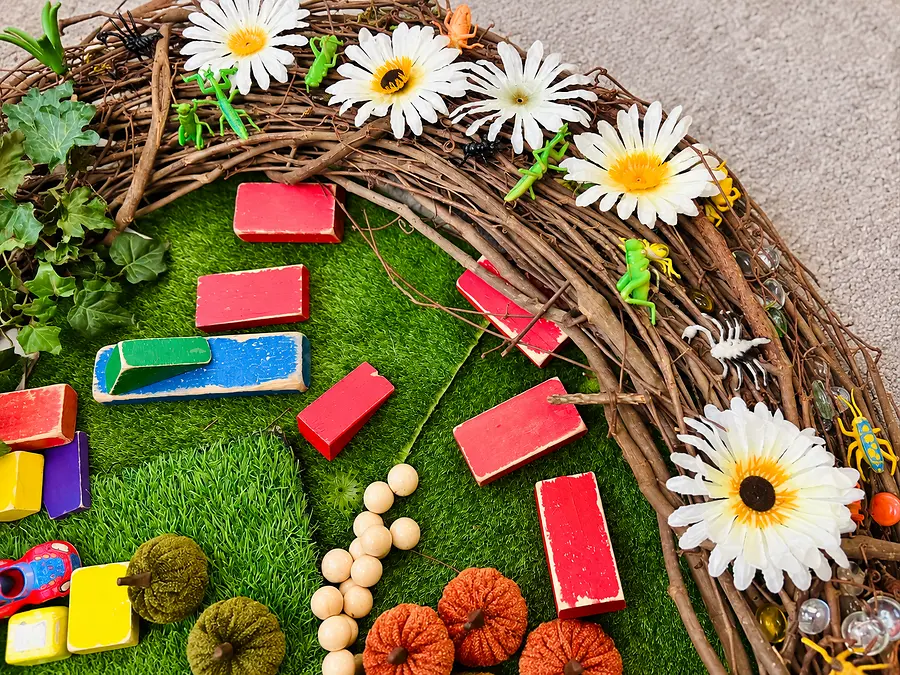
A large collection of loose parts spread across a table may be exciting and inspiring for one child. They may immediately begin exploring, building, sorting, or creating in ways we never anticipated. For another child, that same table may feel visually overwhelming. Faced with so many choices, they may have difficulty deciding where to begin or may choose not to engage at all.
The answer does not have to be removing materials from the children who thrive with that abundance.
Instead, we can provide another way in. A smaller tray containing a few intentionally selected loose parts might be available alongside the larger collection. A child could begin with three or four materials and add more when they are ready, while another child is free to explore the entire collection from the beginning.
Both children are engaging with the same provocation. Neither approach is the "easier" or "better" version. We are simply recognizing that what feels inspiring to one child may feel overwhelming to another.
The same thinking can extend beyond loose parts. A child might benefit from a visual nearby, a quieter place to explore, a familiar material alongside something new, or the opportunity to observe a peer before beginning.
Open-ended materials such as blocks, clay, paint, loose parts, and dramatic-play materials naturally make room for this. They do not require every child to reach the same outcome. Children can experiment, problem-solve, create, and communicate at their own developmental level while still sharing the same classroom experience.
We do not have to take something away from one child in order to make it accessible to another. We can create space for both.
Differentiating the Question, Not Just the Activity
Sometimes meeting children where they are can be as simple as changing the question we ask.
While exploring the same collection of materials, I might ask one child, "What do you notice?" Another might be asked, "How are these two objects different?" A child ready for deeper thinking might hear, "What do you think would happen if we changed this?" or "How could you test your idea?"
The materials have not changed. The classroom community has not changed. What has changed is the invitation to think.
We can also give children multiple ways to respond. A child may point to an object instead of verbally explaining it. Another may draw their thinking. Another may use materials to demonstrate an idea, while another is ready to explain their reasoning in words.
When children have multiple ways to understand a question and communicate what they know, we recognize that learning does not look the same for every four- or five-year-old.
Different Does Not Mean Less
Providing children with what they need does not mean lowering expectations.
Every child deserves to be viewed as capable.
Our role is to create the conditions that allow each child to demonstrate that capability. A child who uses a picture cue, hands-on material, teacher model, smaller selection of materials, or additional time is not necessarily capable of less. They may simply need another pathway into the learning.
A child who needs more guidance today may independently accomplish the same task weeks or months later. Development in early childhood can happen quickly, and it does not always follow a perfectly predictable path.
Instead of asking, "Can this child do what everyone else is doing?" I believe a more meaningful question is, "What can this child do now, and what can I change, add, or provide to help them take the next step?"
Preparing Children for What Comes Next
There can be tremendous pressure in Pre-K to prepare children academically for kindergarten. School readiness matters, but readiness is about much more than completing worksheets or mastering a checklist of academic skills.
Children are also learning how to communicate their needs, persist when something is difficult, solve problems, collaborate with others, make choices, develop independence, and become confident in their own ideas.
A responsive classroom allows us to build those skills while also developing foundations in literacy, mathematics, science, fine motor development, and other areas of learning.
The goal should not be to make every Pre-K child look like the same learner by the end of the year. The goal is to help every child make meaningful progress from where they began.
When we intentionally use our questions, materials, visual tools, observations, and even the physical classroom itself to meet children where they are, differentiated instruction becomes less about creating separate lessons and more about creating a classroom where every child has an entry point into learning.
Sometimes the most meaningful adjustment begins not with what we say to a child, but with how carefully we notice what they are already telling us.
And perhaps that is one of the most important things we can give young children before kindergarten: the experience of knowing that there is more than one way to learn, more than one way to participate, more than one way to show what you know, and a place in the classroom for exactly where you are today.