Leading Through the AI Era: Building Resilient Organizations for Continuous Change
Balancing Innovation, Human-Centered Governance, and Organizational Resilience in an Age of Intelligent Transformation

Introduction
Artificial intelligence is rapidly evolving from a productivity-enhancing technology into operational infrastructure capable of shaping cybersecurity, enterprise systems, institutional decision-making, and critical global operations. Frontier AI systems are increasingly being embedded into the operational core of governments, Fortune 500 enterprises, financial institutions, and infrastructure ecosystems, fundamentally reshaping how organizations operate, defend, and adapt.
Anthropic's Project Glasswing - developed alongside organizations including Amazon Web Services, Apple, Cisco, CrowdStrike, Google, JPMorgan Chase, Microsoft, NVIDIA, and Palo Alto Networks - reflects how advanced AI systems are becoming integrated into enterprise-scale resilience and cyber defense strategies.
At the same time, Stanford Human-Centered AI's 2025 AI Index and McKinsey & Company's State of AI research show that governance systems, workforce readiness, and institutional adaptation are struggling to evolve at the same pace as technological capability.
Leaders are now being asked to manage continuous disruption while simultaneously addressing cybersecurity exposure, workforce transformation, operational redesign, regulatory pressure, and institutional trust. Harvard Kennedy School and Microsoft increasingly frame AI transformation not solely as a technology challenge, but as a governance, resilience, and societal leadership challenge.
The organizations most likely to succeed in the next decade may therefore not be those that automate the fastest, but those capable of balancing innovation with stewardship, operational acceleration with governance maturity, and automation with human-centered leadership.
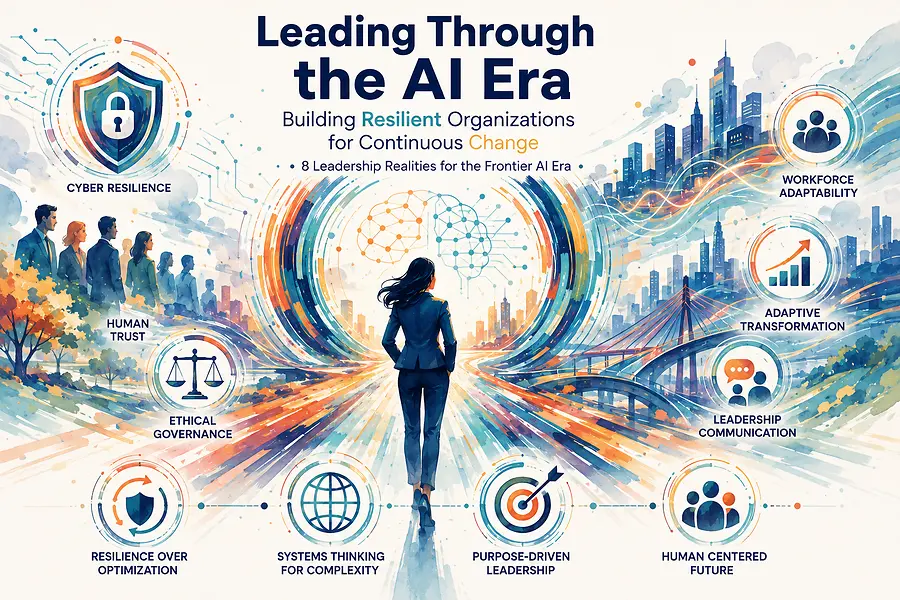
8 Leadership Realities for the Frontier AI Era
1. Human Trust Determines Transformation Success
Technology transformation succeeds when employees trust the systems, leadership structures, and institutional intentions guiding change. Deloitte's Global Human Capital Trends research found that workforce trust, transparency, and leadership credibility increasingly influence long-term organizational stability during periods of accelerated transformation.
Organizations that prioritize workforce inclusion, communication, and adaptability are often better positioned to sustain operational continuity and maintain resilience during enterprise AI integration.
2. Governance Must Evolve as Fast as Technology
As AI systems become embedded into operational infrastructure, governance can no longer remain secondary to deployment speed. Stanford Human-Centered AI reported substantial growth in AI-related legislation, oversight activity, and regulatory engagement across governments, reflecting rising concern surrounding accountability, transparency, and systemic risk.
Organizations that scale AI capabilities without governance maturity may unintentionally increase operational instability, cybersecurity exposure, and institutional vulnerability.
3. AI Amplifies Organizational Strengths and Weaknesses
Artificial intelligence does not automatically solve operational dysfunction. It amplifies existing systems, leadership structures, and organizational conditions.
MIT Sloan Management Review emphasized that successful AI implementation depends heavily on leadership alignment, operational discipline, and organizational readiness rather than technology capability alone.
Enterprises with fragmented operational systems may therefore scale instability instead of efficiency when deploying advanced AI into weak institutional architectures.
4. Workforce Adaptability Is a Strategic Asset
AI transformation is fundamentally a workforce transformation challenge. PwC's Global AI Jobs Barometer found that AI-related skills are rapidly reshaping workforce value, compensation, and adaptability across industries.
Leadership communication, workforce adaptation, and organizational alignment increasingly determine long-term transformation outcomes, making human readiness as strategically important as technical capability during enterprise AI deployment.
5. Ethical Governance Is Now Competitive Strategy
Ethical oversight is increasingly becoming a strategic operational requirement rather than simply a compliance function.
Microsoft's Responsible AI framework emphasizes fairness, transparency, accountability, privacy, and human oversight as foundational components of sustainable AI deployment.
Stanford Human-Centered AI similarly argues that institutional trust is becoming inseparable from responsible AI governance as advanced AI systems become integrated into enterprise infrastructure and public systems.
Organizations that operationalize ethical governance early may strengthen resilience, workforce trust, and long-term institutional credibility.
6. Leadership Communication Shapes Organizational Stability
Periods of technological disruption create uncertainty across organizations. Employees increasingly look to leadership for strategic clarity, emotional stability, and institutional confidence during transformation cycles.
Research from Korn Ferry and McKinsey & Company shows that leadership communication quality strongly influences workforce adaptability and organizational resilience during periods of accelerated change.
Organizations that communicate transparently and consistently are often better positioned to sustain trust and maintain operational coherence under pressure.
7. Resilience Is Becoming More Valuable Than Optimization
Highly optimized systems often prioritize efficiency over adaptability. However, frontier AI environments increasingly reward resilience engineering, recovery capability, segmentation, and operational redundancy.
IBM Security's Cost of a Data Breach research emphasized the growing importance of resilience and recovery readiness as organizations become more dependent on AI-enabled operational systems.
In highly interconnected digital ecosystems, resilience may ultimately become more strategically valuable than optimization alone.
8. Responsible Innovation Creates Sustainable Advantage
The future of leadership is not defined solely by deploying technology faster. It is defined by balancing innovation with stewardship, automation with human dignity, and operational acceleration with accountability.
Harvard Kennedy School, Microsoft, and Stanford Human-Centered AI increasingly frame sustainable AI advantage as dependent on governance maturity, institutional trust, and long-term systems thinking.
Organizations that integrate AI responsibly may therefore build stronger resilience, workforce trust, and more sustainable competitive advantage over time.
3 Real-World Examples
Example 1: Estonia Cyberattacks (2007) - Resilience Through Systems Thinking
Following the 2007 cyberattacks, Estonia redesigned its national digital infrastructure around resilience, redundancy, segmentation, and societal cyber literacy rather than relying solely on prevention.
Researchers from the NATO Cooperative Cyber Defense Center of Excellence later cited Estonia as one of the world's strongest examples of resilience-centered digital governance.
Estonia demonstrated that resilience is not only a technical capability, but also a leadership philosophy rooted in preparedness, adaptability, and institutional trust. The country's response showed that future-ready systems must be designed to survive disruption - not merely prevent it. (NATO Cyber Defense)
Example 2: SolarWinds Cyberattack - Governance and Systemic Vulnerability
The SolarWinds cyberattack exposed how interconnected digital ecosystems can create cascading operational vulnerability from a single compromised layer.
Governments, Fortune 500 firms, and critical infrastructure institutions were simultaneously affected because centralized dependencies amplified systemic exposure.
Brad Smith described the attack as evidence of a new era of systemic cyber vulnerability requiring governance redesign and stronger resilience frameworks.
The breach reinforced that technology alone cannot compensate for weak governance architecture or over-centralized operational ecosystems. (Microsoft - A Moment of Reckoning: The Need for a Strong and Global Cybersecurity Response)
Example 3: CrowdStrike Global Outage (2024) - Operational Dependency and AI-Era Risk
The CrowdStrike outage demonstrated how deeply interconnected modern operational ecosystems have become.
Airlines, healthcare systems, financial institutions, and enterprises experienced simultaneous disruption because of their dependency on centralized digital infrastructure.
Gartner and Harvard Business Review later emphasized that operational dependency risk will intensify as AI systems become increasingly embedded into enterprise environments.
The outage reinforced the growing importance of segmentation, diversification, resilience engineering, and operational redundancy within highly interconnected digital systems. (Gartner - What You Need to Know About the CrowdStrike Outage)
Conclusion
Leadership in the frontier AI era is no longer defined solely by operational efficiency or the speed of technology adoption. It is increasingly defined by stewardship during continuous technological acceleration. As frontier AI becomes more deeply embedded into enterprise infrastructure and societal systems, leaders must balance innovation with accountability, automation with human-centered governance, and operational speed with long-term resilience.
Research from Harvard Kennedy School, Stanford Human-Centered AI, McKinsey & Company, IBM, and Microsoft increasingly frames AI transformation not simply as a technology challenge, but as a governance, workforce, and institutional resilience challenge. Organizations and nations that thrive in the age of frontier AI will not necessarily be the most technologically aggressive. They will be the ones capable of strengthening workforce trust, governing ethically, adapting intelligently, protecting human dignity, and building resilient systems that can evolve continuously without losing operational coherence.
The future of leadership is therefore not technology alone, but the intelligent integration of people, systems, innovation, governance, trust, and sustainability. Sustainable transformation is built through responsible leadership grounded in resilience, governance maturity, stewardship, and long-term systems thinking-creating organizations that remain adaptive, trustworthy, and prepared for continuous technological change.
People first. Systems strong. AI smart.