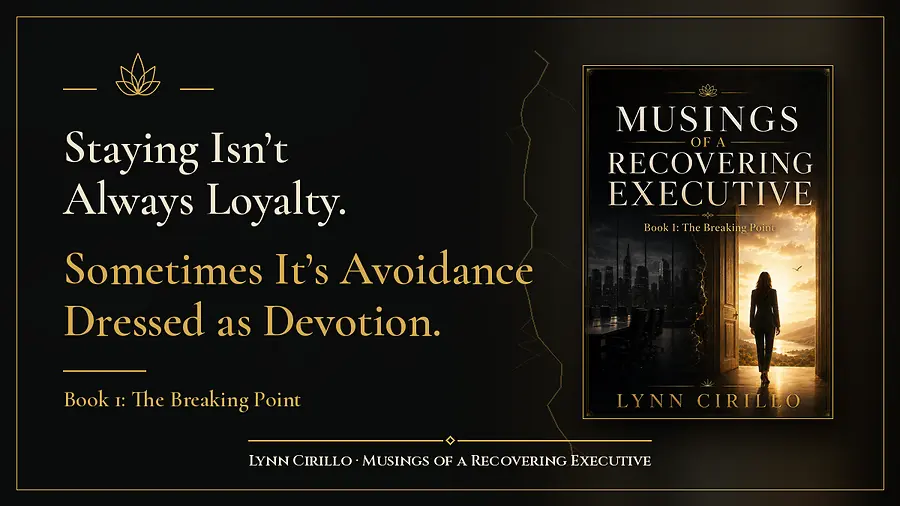
Staying Isn't Always Loyalty. Sometimes It's Avoidance Dressed as Devotion.
When stepping back from leadership is actually stepping into wisdom.

What capable leaders rarely say out loud about knowing when it is time to step back.
By Lynn Cirillo
We have a lot of language for getting to the top of something.
Ambition. Promotion. Growth. Arrival.
We have far less language for the moment a role stops fitting, even though you are still very good at it.
That moment rarely arrives with certainty. It comes quietly, through a sense of misalignment that no longer resolves and effort that no longer restores.
And for high performers, it is remarkably easy to ignore. Nothing is technically wrong. You are still delivering. Still trusted. Still the person people call.
Capable Is Not the Same as Aligned
When I stepped away from corporate executive life, it was not because I could no longer do the job.
I did not leave because I could not perform. I left because performance was being used in ways that no longer aligned with how I wanted to lead, and I could no longer pretend not to see it.
That distinction matters because many of us use capability as the test for whether we should stay. If I can still do it, I should keep doing it.
But a role can stop fitting the person you have become while you are still excellent at it. The work that once stretched you begins to constrain you. The environment that once challenged you begins to exhaust you.
That is not failure. It is growth.
Outgrowing a role does not diminish what you contributed. It confirms that you did.
Why Good Leaders Stay Too Long
Most leaders who stay past their season are not lacking courage. They care.
They stay because people rely on them. Because walking away feels like abandonment. Because they remember what it was like before things stabilized, and they do not want to be the reason it destabilizes again.
I know that pull well. I have stayed out of loyalty. I have stayed out of responsibility. I have stayed because leaving felt selfish, even when staying felt misaligned.
Commitment is admirable. But staying past alignment is not always leadership.
Sometimes it is avoidance dressed as devotion.
That is a hard sentence to sit with, especially if you have built your reputation on being the steady one. Devotion can be genuine and still be the thing keeping you from a harder question.
The Fears Underneath the Decision
Stepping back surfaces fears we did not realize we were carrying:
Who am I if I am no longer the one holding this together?
What happens if they realize they do not need me?
Will my value disappear when my role does?
Those questions are deeply human. They deserve compassion, not dismissal.
They are also worth naming because unnamed fear has a way of disguising itself as duty. It is much easier to say, "They need me," than, "I am afraid of who I am without this."
Leadership teaches us to manage uncertainty for others. It does not always prepare us to sit inside our own.
When Your Presence Becomes Pressure
Here is the part that took me longest to see.
Sometimes your presence, once stabilizing, becomes constraining.
Not because you are doing something wrong, but because systems and people have adapted around you. Decisions slow. Initiative narrows. Growth waits for your approval, even when you never asked for it.
That is not a personal failure. It is a structural signal.
One of the leadership metrics in The Breaking Point flips a familiar question. Instead of asking, "Who is indispensable?" ask, "What would break if someone stepped away?" If the honest answer is "a lot," the problem is not that you are too valuable to leave. It is that too much has been concentrated in one place, and that place is you.
Stepping back allows leadership to redistribute. It creates room for others to grow into responsibility rather than orbit around it.
You Are Allowed to Grieve What You Outgrow
Even when stepping back is the right choice, it carries grief.
Grief for the version of yourself who worked so hard to get there. Grief for the relationships built inside the role. Grief for an identity that fit so well it felt inseparable from who you were.
We talk about succession, transition, and next steps. We talk far less about what it feels like to loosen your grip on something that once gave your days meaning.
Relief and fear can arrive at the same time. That is not confusion. It is honesty.
Stepping Back Is Rarely One Decision
I want to be realistic here. Not everyone can walk out of a role, and stepping back does not have to mean resigning.
Letting go is rarely one decision. It is a series of small, intentional releases.
You pause before stepping in. You allow others to struggle a little longer. You resist solving problems that are no longer yours to solve.
When effort stopped working for me, listening did not mean walking away immediately. It meant stopping the reflex to push and starting the discipline of inquiry.
That work is quiet. It is often unseen. It is deeply courageous.
For Leaders: Leaving Well Is an Act of Care
Leaving well is one of the most underdeveloped leadership skills we have.
It requires honesty without accusation. Planning without control. Care without ownership.
It means preparing people for continuity, not dependency. Sharing context rather than instructions. Resisting the urge to linger as a safety net.
Leaving well is not about protecting your legacy. It is about protecting the people who remain.
It also changes what you offer. Your value shifts from doing to enabling. From directing to advising. From carrying to trusting. If you are used to being central, that can feel disorienting. It asks you to tolerate being less visible without equating that with being less valuable.
Questions to Sit With
If you are standing near this edge, you do not need to decide anything today. But consider:
- Where am I staying out of loyalty rather than alignment?
- How much of my identity is tied to being needed?
- Where might my continued presence be limiting someone else's growth, even unintentionally?
- What would leaving well look like in my situation?
- What would it mean to honor what this role gave me without clinging to it?
Your answers may not point toward the door. They may point toward handing something off, or finally saying out loud what you have been carrying.
Either way, you are not failing. You are listening.
And listening has always been one of the most important leadership skills.
I explore this, and the slow recognition that comes before it, in The Breaking Point, Book 1 in my Musings of a Recovering Executive series. Each chapter closes with Questions for Reflection meant to be sat with, not rushed. You can learn more at https://MusingsOfaRecoveringExecutive.com/the-book/.
About the Author
Lynn Cirillo is an author, leadership mentor, and founder of Grounded Leadership LLC, based in Cheyenne, Wyoming. A former Executive Vice President who oversaw people, technology, data, research, systems, and organizational change, she spent more than three decades in commercial real estate and executive leadership. She writes the Musings of a Recovering Executive series about leadership, identity, boundaries, reinvention, and neurodiversity. Learn more at https://MusingsOfaRecoveringExecutive.com/.