Why Sustainable Leadership Matters in the AI Economy
Building Resilient Organizations That Create Long-Term Value Through People, Systems, Governance, and Responsible AI

Introduction
In today's AI-driven economy, organizations face increasing pressure to deliver immediate financial returns. Quarterly earnings expectations, investor demands, and competitive pressures often encourage leaders to prioritize rapid return on investment over long-term resilience.
Yet systems designed only for short-term profitability rarely withstand the pace of technological transformation. As artificial intelligence, automation, and digital ecosystems accelerate innovation cycles, organizations must build systems that are durable, scalable, and capable of adapting to continuous change.
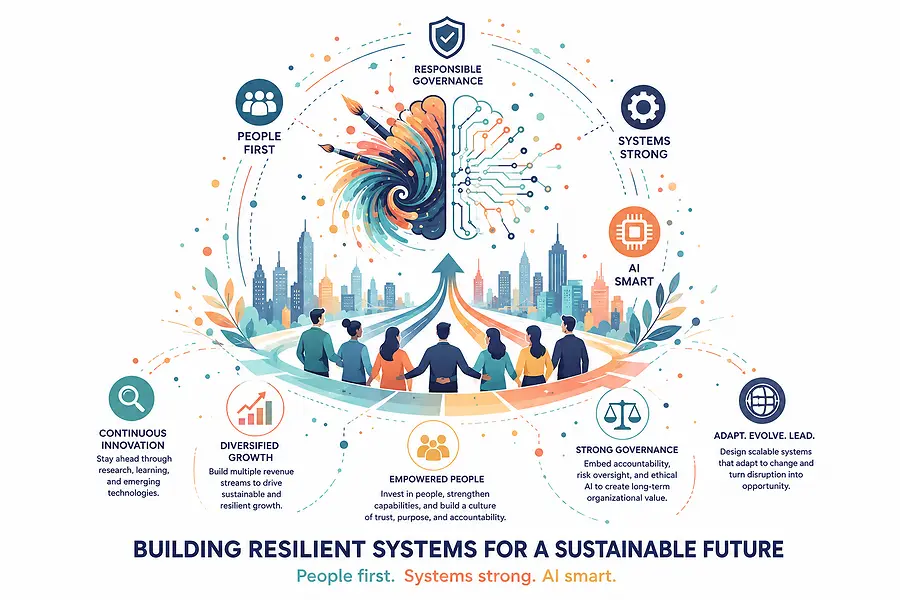
Responsible leadership requires a broader perspective-one that places people at the center, strengthens organizational systems, and applies AI strategically. Sustainable organizations recognize that lasting success is built through resilience, governance, and continuous innovation rather than immediate financial gains alone.
Eight Risks of Building Systems Only for Immediate ROI
1. Short-Term Profitability Creates Temporary Success
Systems designed solely to maximize immediate returns may generate early financial gains, but they rarely create lasting value. Organizations that prioritize quick wins often underinvest in research, innovation, workforce development, and infrastructure that support long-term growth.
2. Lack of Sustainability and Scalability
Without strategic planning, systems eventually become difficult to scale. Processes that work during the early stages of growth frequently become barriers as organizations expand into new markets, technologies, and business models.
3. Vulnerability to Larger Competitors
Organizations focused primarily on short-term returns often lack the strategic depth required to compete with larger, better-capitalized competitors. Over time, they become more vulnerable to market disruption, consolidation, or acquisition.
4. Inability to Keep Pace with AI Innovation
Artificial intelligence is accelerating technological change across every industry. Organizations that focus only on immediate financial performance often struggle to invest in the research, governance, and operational transformation necessary to remain competitive as innovation cycles continue to shorten.
5. Workforce Disruption and Organizational Instability
When short-term strategies fail to produce sustainable growth, organizations frequently respond through layoffs, restructuring, or reactive cost reductions. These decisions disrupt employees, weaken institutional knowledge, and reduce organizational resilience.
6. Declining Competitive Advantage
Organizations that fail to invest continuously in innovation gradually lose relevance. Competitors that strengthen research capabilities, technology ecosystems, and organizational systems are better positioned to create sustainable competitive advantage.
7. Erosion of Stakeholder Trust
Investors, partners, employees, and customers increasingly evaluate organizations based on long-term vision rather than quarterly performance alone. Repeated short-term decision-making can weaken confidence in leadership and reduce institutional credibility.
8. Employee Uncertainty and Reduced Engagement
Constant strategic changes driven by short-term priorities create uncertainty throughout the workforce. Employees perform best when organizations communicate a clear long-term vision supported by stable leadership and resilient systems.
Three Examples of Long-Term System Thinking
NVIDIA's Long-Term Innovation Strategy
Long before artificial intelligence became mainstream, NVIDIA invested heavily in research, computing infrastructure, and advanced semiconductor technologies. Those long-term investments positioned the company to become a global leader in AI computing and created multiple opportunities for sustainable revenue growth. NVIDIA's official Research platform highlights its continued work across artificial intelligence, computing, robotics, graphics, and related technologies.(NVIDIA Research)
Google's Continuous Investment in Research and Development
Alphabet continues to invest in artificial intelligence, cloud computing, digital infrastructure, and emerging technologies. These investments support an interconnected ecosystem capable of generating diversified revenue streams while adapting to technological change. Alphabet's official investor-relations materials provide access to its financial results, annual filings, earnings information, and AI-related corporate disclosures.(Alphabet Investor Relations)
Deloitte's Governance Perspective on AI Transformation
Deloitte emphasizes that artificial intelligence should be approached as an enterprise-wide transformation rather than a standalone technology investment. Its current AI governance guidance focuses on accountability, operating models, decision rights, lifecycle controls, risk oversight, and the redesign of work and business processes. (Deloitte AI Governance Roadmap)
Conclusion
The future of business will belong to leaders who think beyond the next quarter. In an era of accelerating technological change, relying on a single product, service, or revenue stream creates increasing strategic risk. As product lifecycles shorten, emerging technologies reshape markets, and artificial intelligence transforms how organizations create value, sustainable growth depends on building resilient systems that can continuously adapt.
Organizations that succeed will continuously evaluate evolving products and services, diversify revenue streams, strengthen governance, invest in innovation, and design scalable systems capable of responding to technological change. By preparing their people, strengthening their systems, and applying AI strategically, leaders create organizations that remain resilient, competitive, and positioned for long-term success.
The organizations that shape the future will not simply build successful products-they will build resilient systems that empower people, embrace responsible innovation, adapt continuously, and create sustainable value for generations to come.
People first. Systems strong. AI smart.