Technology Moves Faster Than Systems
Why Organizational Readiness Must Come Before AI Deployment

Introduction
Artificial intelligence is advancing at a pace that few organizations, institutions, and governance systems have experienced before. As improvements in computing power, algorithmic efficiency, data availability, and autonomous AI capabilities continue to accelerate, organizations face increasing pressure to adopt new technologies rapidly. Yet successful AI transformation depends not only on technological capability but also on the readiness of people, systems, governance, and organizational resilience. Leaders who prepare their organizations before deploying AI will be better positioned to create sustainable value while reducing operational risk.
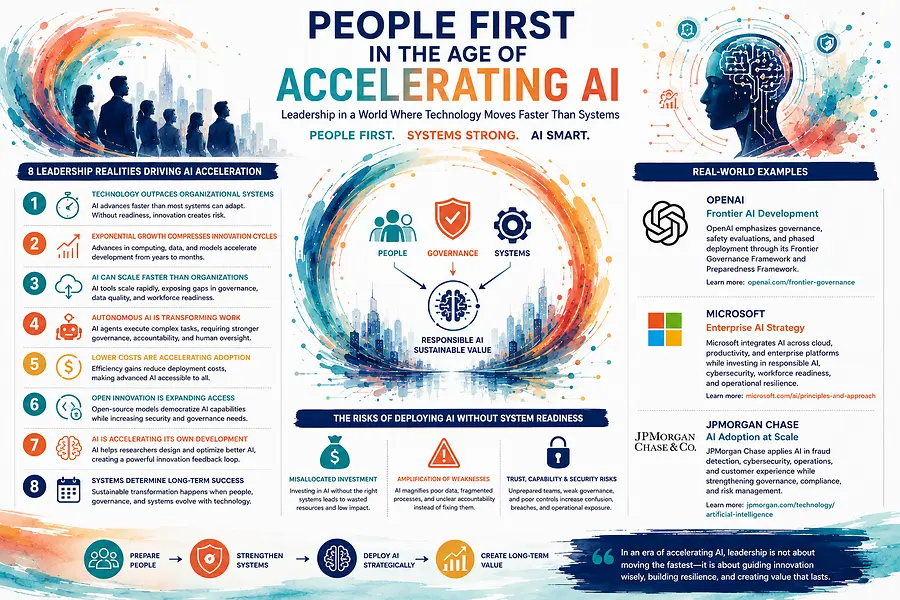
8 Leadership Realities Driving AI Acceleration
1. Technology Is Advancing Faster Than Organizational Systems
AI capabilities are evolving more rapidly than many organizational systems can adapt. Without modern governance, infrastructure, and operational readiness, introducing advanced technologies can increase complexity, inefficiency, and organizational risk.
2. Exponential Growth Is Compressing Innovation Cycles
Advances in computing power, model architectures, and algorithmic efficiency are accelerating AI development at an unprecedented pace. Technologies that once required years to mature are now moving from experimentation to enterprise deployment within months.
3. AI Can Scale Faster Than Organizations
Unlike many previous technologies, AI can often be deployed across organizations with remarkable speed. While this creates significant opportunities, rapid scaling can also expose weaknesses in governance, data quality, operational processes, and workforce readiness.
4. Autonomous AI Is Transforming Work
AI is evolving beyond decision-support tools into increasingly autonomous systems capable of executing complex workflows. As AI agents assume greater operational responsibility, organizations must strengthen governance, accountability, and human oversight.
5. Lower Costs Are Accelerating Adoption
Improvements in AI inference and model efficiency are reducing deployment costs and making advanced capabilities accessible to organizations of all sizes. As barriers to adoption decrease, leadership must focus on responsible implementation rather than rapid deployment alone.
6. Open Innovation Is Expanding Access
Open-source AI models and collaborative research are democratizing access to advanced AI capabilities. While this accelerates innovation, it also increases the importance of cybersecurity, governance, and responsible risk management across interconnected ecosystems.
7. AI Is Accelerating Its Own Development
AI is increasingly assisting researchers in designing, optimizing, and improving future AI systems. This feedback loop has the potential to accelerate technological advancement even further, requiring organizations to continuously adapt their governance and operational strategies.
8. Systems Determine Long-Term Success
Technology alone cannot create sustainable transformation. Organizations achieve long-term success when people, governance, operational processes, and organizational systems evolve alongside technological innovation.
These realities demonstrate that AI transformation is not simply a technology challenge-it is fundamentally a leadership, governance, and systems challenge.
Real-World Examples
OpenAI and Frontier AI Development
As frontier AI capabilities continue to accelerate, organizations developing advanced AI models increasingly emphasize governance, safety evaluations, and phased deployment alongside technological innovation. OpenAI's Preparedness Framework, Model Spec, and Safety Evaluations Hub demonstrate that responsible AI development depends not only on model capability but also on governance, risk management, and organizational oversight. (OpenAI - Frontier Governance Framework).
Microsoft's Enterprise AI Strategy
Microsoft has integrated AI across productivity, cloud, and enterprise platforms while simultaneously investing in responsible AI governance, cybersecurity, workforce readiness, and operational resilience. Through its Responsible AI Principles and Approach, Microsoft emphasizes governance, transparency, accountability, and human oversight as essential components of successful AI adoption. (Microsoft - Responsible AI: Principles and Approach).
JPMorgan Chase's AI Adoption
JPMorgan Chase continues to expand its use of AI across fraud detection, cybersecurity, operational efficiency, and customer service while strengthening governance, compliance, and risk management. The firm's Artificial Intelligence Research program highlights explainable AI, synthetic data, secure AI computation, and AI governance as foundational capabilities for scaling AI responsibly in a highly regulated environment. (JPMorgan Chase - Artificial Intelligence Research).
Conclusion
Artificial intelligence is reshaping every industry at an unprecedented pace, but technology alone does not determine organizational success. Sustainable transformation depends on leaders who prepare their workforce, strengthen governance, modernize operational systems, and build resilience before accelerating AI adoption.
Organizations that invest in people first, strengthen systems second, and deploy AI strategically will be better positioned to adapt continuously, innovate responsibly, and create lasting value in an increasingly intelligent world.
People first. Systems strong. AI smart.