The Accountable Plan: A Simple Strategy Every Woman Business Owner Deserves to Know
How to Reclaim What Your Business Owes You: The Accountable Plan Strategy

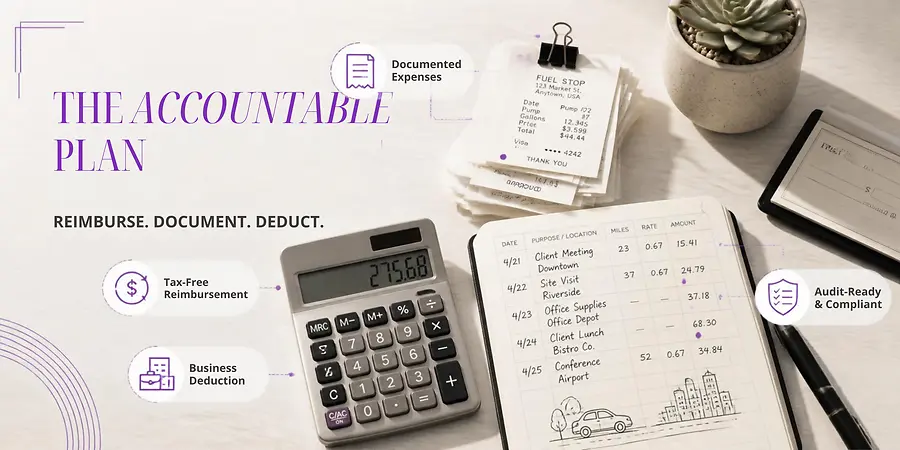
I still remember the first time I sat across from a woman who had been running a six-figure business for years and had never once been reimbursed for the mileage, the home office, or the supplies she'd been quietly paying for out of her own pocket. She wasn't careless. She was busy building something. Nobody had ever told her there was a proper, IRS-recognized way to pay herself back for it-tax-free.
That conversation has stayed with me because it's a pattern I see constantly among women in business. We are so used to absorbing costs quietly, covering the gap, and making it work that we forget to ask whether the business itself should be the one covering it. An Accountable Plan is one of the simplest ways to correct that, and I want every woman reading this to know it exists.
What an Accountable Plan Actually Is
An Accountable Plan is a formal, written reimbursement arrangement between a business and the people working in it-including you, if you're the owner. Instead of business expenses quietly disappearing from your personal bank account, the business reimburses you directly, and that reimbursement isn't treated as taxable income to you.
To hold up, the plan has to meet three requirements the IRS is specific about: the expense has to have a genuine business connection, it has to be properly documented (receipts, mileage logs, expense reports), and any excess reimbursement has to be returned within a reasonable window. Meet those three conditions, put the policy in writing, and you have a clean, defensible way to move money out of the business to you-without it counting as wages.
Why This Matters Beyond the Tax Savings
Yes, there's a real tax benefit here-reimbursed expenses are deductible to the business and aren't subject to payroll tax, and you don't report the reimbursement as personal income. But I want to speak to something underneath that because I think it matters more.
So many women I work with have a habit of minimizing what their work costs them. We absorb the mileage, the extra square footage of the home turned into an office, the supplies bought "real quick" on a personal card-and we rarely stop to add it up, let alone ask to be paid back for it. An Accountable Plan is a structural way of saying: this cost is real, it belongs to the business, and I deserve to be made whole for it. That's not a loophole. That's just accurate accounting for the true cost of running what you've built.
What It Takes to Do This Right
This isn't a strategy you talk yourself into casually-it has to be documented properly to hold up, and that's exactly why it's worth doing with guidance rather than guessing:
- A written policy, adopted before reimbursements start, spelling out what qualifies and how it will be handled.
- Real documentation behind every reimbursement-receipts, logs, and records kept as they happen, not reconstructed later.
- A regular reimbursement rhythm, rather than one lump sum that raises questions.
- Bookkeeping that records these correctly, so the deduction is clean on the business return and nothing shows up as wages that shouldn't.
Skip any of these, and what should be a clean, tax-free reimbursement can be recharacterized as taxable income. The upside is real, but so is the discipline it requires.
A Word to the Woman Reading This
If you take one thing from this, let it be this: you are allowed to ask whether the way your business handles money is actually serving you-not just this quarter, but as a habit you carry forward. So much of what I do isn't really about tax strategy. It's about giving women permission to take their own businesses seriously enough to run them properly. An Accountable Plan is a small, structural piece of that. Claiming it isn't aggressive, and it isn't complicated once it's set up right. It's just you, finally being paid back for what you've already given.