The Historical Impact of the SBD!
Exploring the Douglas SBD Dauntless, the rugged dive bomber that became the backbone of the U.S. Navy's carrier force and helped turn the tide of the Pacific War.

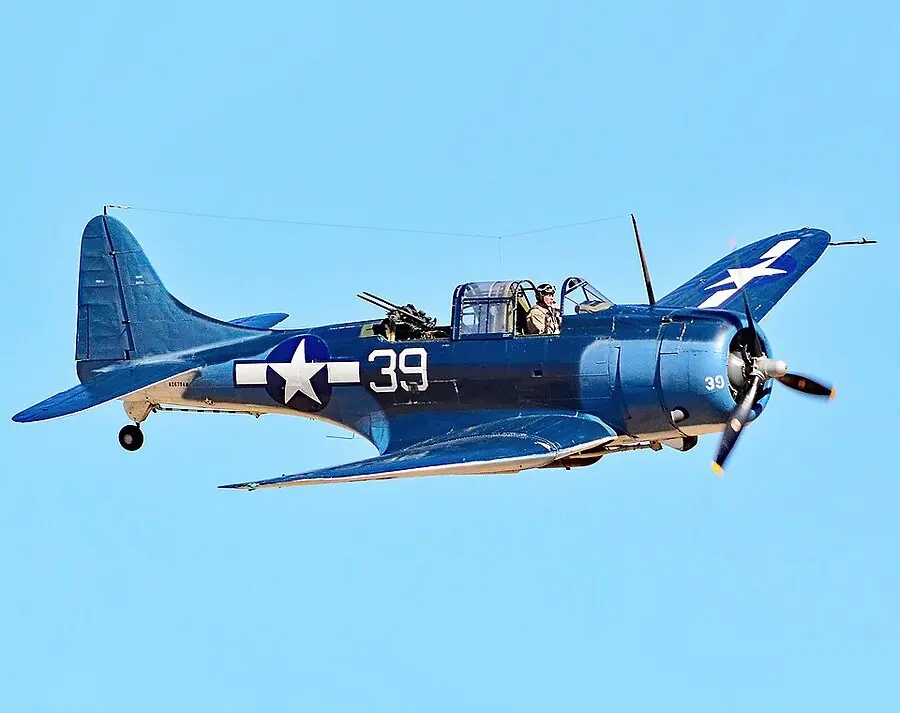
We are taking a brief departure from our usual material in this article. Drawing on Brooke’s knowledge and experience in military aviation history—and its connection to modern aviation—we examine the infamous dive bomber that helped turn the tide of the Pacific War. Brooke In The Air Travel presents the background and story of the Douglas SBD Dauntless.
Sources for this article include the U.S. Navy Historical Archives in Annapolis, Maryland (at the Naval Academy), the National Archives and Records Administration (NARA) in Washington, D.C., the Smithsonian Institution historical archives (1935–1945), and Jane’s WWII Guide to Aircraft – Allies.
Designed by the Douglas Aircraft Company in the late 1930s, the “SBD” stood for Scout Bomber–Douglas. However, it became better known by its nickname, given by U.S. Navy pilots: “Slow But Deadly.” The aircraft served with distinction in U.S. service from 1940 to 1944.
As a brief historical aside, Douglas Aircraft would later merge with McDonnell Aircraft to form McDonnell Douglas, which was ultimately acquired by and merged into Boeing in the late 1990s. Many of Boeing’s more recent structural and cultural challenges are often traced back to that merger. However, in the early and mid-20th century, both McDonnell and—especially—Douglas were widely regarded as leaders in redundancy, ruggedness, reliability, and survivability.
The SBD was developed from the Douglas-Northrop BT-1, an early but ultimately unsuccessful dive bomber prototype. Rather than being an entirely new aircraft, the SBD evolved gradually from the BT-1 between 1935 and 1940. Components were refined, structural improvements were introduced, and final modifications transforming the BT-1 into the SBD-1 were completed at Douglas’s El Segundo, California, plant.
One of the most distinctive features—the perforated split flaps, or “dive brakes”—was introduced to eliminate tail buffeting during steep dives. In an unusual design choice for a carrier-based aircraft, engineers opted not to include folding wings, prioritizing fuselage strength and survivability instead.
Both the U.S. Navy and the U.S. Marine Corps ordered the aircraft, designated the SBD-1 and SBD-2 (the latter featuring increased fuel capacity and revised armament). The SBD-1 entered Marine Corps service in late 1940, followed by the SBD-2 with the Navy in early 1941, replacing aircraft such as the Vought SBU Corsair and the Curtiss SBC Helldiver—the latter being the last operational biplane used by the U.S. Navy.
The SBD-3 marked a major improvement and was the first widely produced combat variant. Along with the SBD-4, it featured increased armor, self-sealing fuel tanks, and twin forward-firing .50-caliber machine guns, along with additional rear defensive armament. These aircraft were built at Douglas’s Tulsa, Oklahoma, facility.
Although not as fast or maneuverable as dedicated fighters, the SBD proved surprisingly capable in combat. Under certain conditions, it could even hold its own against the Mitsubishi A6M Zero.
This capability was dramatically demonstrated by U.S. Navy pilot Stanley “Swede” Vejtasa during the Battle of the Santa Cruz Islands. Attacked by three A6M Zeros, he shot down two and destroyed a third in a head-on pass—earning the distinction of “Ace in a Day” and highlighting the SBD’s rugged construction and combat effectiveness.
In terms of operational history, the SBD became the backbone of the U.S. Navy’s dive bomber force.
Its first combat exposure came during the Attack on Pearl Harbor. Many Marine Corps SBDs from VMSB-232 were destroyed on the ground at Ewa Mooring Mast Field. Similarly, numerous Navy SBDs were lost before they could be deployed effectively.
On December 10, 1941—just three days after the United States entered the war—SBDs from USS Enterprise sank the Japanese submarine I-70, marking an early success.
In early 1942, SBDs from USS Lexington, USS Yorktown, and USS Enterprise participated in raids across the Pacific, targeting Japanese installations in the Gilbert Islands, Marshall Islands, New Guinea, Rabaul, Wake Island, and Marcus Island.
Their first major carrier engagement came at the Battle of the Coral Sea. There, SBDs and TBD Devastators sank the Japanese light carrier Shōhō and damaged the fleet carrier Shōkaku. Though Lexington was ultimately lost, the battle marked a turning point in carrier warfare.
The SBD’s most decisive contribution came during the Battle of Midway. In a matter of minutes, SBD squadrons crippled or destroyed four Japanese fleet carriers—Akagi, Kaga, Sōryū, and later Hiryū. This devastating strike fundamentally shifted the balance of naval power in the Pacific.
A key factor in this success was coordinated timing. Unlike earlier piecemeal attacks, multiple squadrons arrived simultaneously from different directions, overwhelming Japanese defenses.
SBDs continued to play a vital role throughout the Guadalcanal campaign, operating from both carriers and Henderson Field. They proved especially effective against Japanese shipping, sinking vessels that failed to escape under cover of darkness.
In the Atlantic, the SBD saw action during Operation Torch in 1942 and later during Operation Leader, marking its European combat debut.
By 1944, during the Battle of the Philippine Sea—often referred to as the “Great Marianas Turkey Shoot”—the SBD’s frontline role was nearing its end. Although newer aircraft like the Curtiss SB2C Helldiver offered improved performance on paper, many pilots preferred the SBD for its reliability and superior low-speed handling, especially during carrier landings.
In one notable long-range twilight strike, 26 SBDs participated—and all returned safely, a remarkable contrast to the heavy losses suffered by other aircraft in the same mission.
From December 1941 through April 1944, SBDs flew over 1.18 million operational hours, accounting for roughly 25% of all carrier-based flight time. Their combat record included the destruction of six Japanese carriers, fourteen cruisers, six destroyers, fifteen transports, and numerous smaller vessels.
The U.S. Army Air Forces operated a land-based variant known as the A-24 Banshee. Early deployments were hampered by logistical challenges, including aircraft stranded in transit during the outbreak of war. Later variants, such as the A-24B, featured improved engines and performance and saw limited service in the Pacific and Aleutian campaigns.
Ultimately, the SBD-5 became the most widely produced variant, with nearly 3,000 units built. It also saw limited service with Allied nations, including the Royal New Zealand Air Force and Free French forces.
Without the impact of the SBD during World War II, Douglas Aircraft’s legacy—and its eventual evolution into McDonnell Douglas—might have looked very different. That lineage helped shape the development of modern commercial aviation, influencing aircraft families that would eventually lead to icons like the Boeing 747 and even competitors such as the Airbus A380.
History, after all, is deeply interconnected.
Thank you for reading. Explore more aviation history at brookeintheairtravel.net.