The Job Underneath the Job: What ADHD Awareness Month Asks Leaders to See
The invisible labor behind professional competence: understanding the gap between what people see and the work it takes.

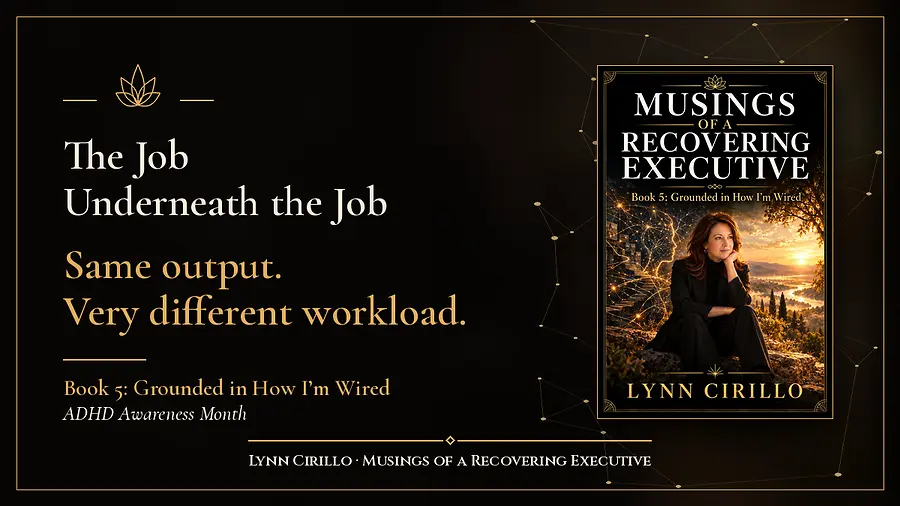
Same output. Very different workload.
By Lynn Cirillo
October is ADHD Awareness Month, so I'll start with the basics.
I have ADHD. I also have OCD and dyslexia. I spent decades in operations and executive leadership building workarounds, compensating, and adjusting long before I had the language for why I needed to.
That gap between what people see and what it takes is exactly what I want to talk about.
"But You Can Focus When You Want To"
People hear attention deficit and understandably imagine a shortage of attention. Then they watch someone become intensely absorbed in something for hours.
Case closed. Clearly, they can focus. So when they don't, they must not be trying.
Except attention regulation is more complicated than simply having or lacking attention. My brain can become extraordinarily engaged when something is interesting, urgent, challenging, novel, complex, or meaningful. Give me a problem worth solving, and you may have trouble getting my attention away from it.
Give me something my brain has determined is pointless, and we have entered negotiations.
Wanting to do something, knowing you should do it, and being able to start it are not the same thing. From the outside, that inconsistency can look like choice.
From the inside, it often looks like a great deal of invisible work.
The Job Underneath the Job
Imagine two employees doing the same job. They produce comparable work. They meet the same deadline. Their manager sees the same outcome.
One simply does the work.
The other does the work while also translating verbal instructions into something they can retain, monitoring their expressions, rehearsing what they're going to say in meetings, checking written communication repeatedly, and recovering from interruptions.
Same output. Very different workload.
That is what I think of as the job underneath the job: all the invisible labor required to appear as though you are simply doing the job.
Workplaces are particularly good at missing it. We measure deliverables, deadlines, responsiveness, and productivity. We don't always see the internal resources required to produce them.
Sometimes the mask works. That's the problem. It works well enough that other people don't see what's underneath it, and sometimes well enough that you don't either.
The effectiveness of the mask tells us nothing about its cost.
"But You've Always Been Able to Do It"
This sentence can do enormous damage.
Maybe. But what did doing it require?
Maybe I could tolerate the noise before. Maybe I could spend three hours preparing for a thirty-minute meeting before. Maybe I could go home and collapse afterward before. Maybe I had more support, more energy, or fewer demands. Maybe the cumulative cost simply hadn't arrived yet.
Past capacity does not guarantee permanent capacity.
And past silence does not prove the absence of difficulty. Sometimes it only proves that someone wasn't telling you.
Success doesn't erase wiring, either, though it is often used as evidence against difficulty. You built a career. You became an executive. You managed budgets. You handled complexity.
Therefore? My ADHD disappeared? My dyslexia resigned? My OCD reviewed my résumé and decided I had clearly outgrown it?
A person may be highly organized because forgetting has consequences. Someone may prepare excessively because being caught unprepared feels intolerable.
We Don't Only Mask Differences. We Mask Need.
Here is the part I suspect many professional women will recognize, whether or not they are neurodivergent.
If part of your identity becomes I'm the person who can handle anything, what happens when you can't?
If everyone knows you as the one who never needs help, asking for help can feel like failure. If you're the leader everyone relies on, saying I need a minute can feel inconsistent with who you're supposed to be.
The more competent someone appears, the less permission they may feel they have to need anything.
I know something about that.
It also raises an uncomfortable question: after decades of adapting, do you still know what you actually prefer? Do I like this, or am I good at it? Do I enjoy this environment, or do I know how to survive it?
Sometimes the honest answer is I don't know. That's an answer, too.
Explanation, Not Excuse
Understanding ADHD has not given me a free pass, and I don't want it to.
ADHD can make conversational timing interesting. A thought arrives. It feels immediately relevant. My brain knows there's a reasonable chance it will disappear if I don't say it. So out it comes.
From inside my brain: Yes! I'm engaged. This connects.
From the other person's chair: Would you let me finish?
Both experiences can be true. So I jot the thought down, or I consciously return the conversation: "Sorry, I jumped in. Finish what you were saying."
Understanding the behavior gives me tools. It doesn't give me permission to disregard its effect.
An excuse ends the inquiry: I have ADHD. I can't do this.
Information begins one: I have ADHD. Task initiation can be difficult for me under these conditions. What strategy could help me get started?
For Leaders: Ask How People Work Best
Long before I had the language of neuroinclusion, I asked people on my team how they learned. I wasn't asking for a diagnosis or a medical history. I needed to teach them, and it seemed rather important to understand how they learned the job.
I didn't call it neuroinclusive leadership. It was simply leadership.
I understand that question differently now. People don't fit neatly into one permanent learning style. Someone may need a demonstration for a physical task and written steps for a detailed process. So the better question is more specific:
How do you learn this?
And then: How will we know if the way we're teaching it is working?
Underneath that is a distinction I wish more leaders held onto. We often confuse the method with the standard. The standard might be "complete this process accurately." The method could be reading, watching, practicing, using a checklist, or some combination. Sometimes the method genuinely matters: safety, compliance, sequence. But sometimes the only reason is "because that's how we've always taught it."
Difficulty with the method is not automatically inability to achieve the outcome.
You also don't need anyone to disclose anything. People don't always need to explain a diagnosis to communicate how they work best. Ask about the work, and make it normal for everyone.
Questions Worth Asking This Month
For yourself:
- What is my job underneath the job, and who knows it exists?
- Where am I masking need, not just difference?
- What do I actually prefer, apart from what I've learned to survive?
For the people you lead:
- Am I measuring the output and assuming the cost?
- When I say "but you've always been able to," what am I not asking?
- Am I attached to the standard, or just to my method?
Awareness months come and go. The job underneath the job doesn't.
I write about ADHD, OCD, dyslexia, autism, and the hidden cost of looking fine in Grounded in How I'm Wired, Book 5 in my Musings of a Recovering Executive series. Every chapter includes Guidance Tools and Communication Tools for neurodivergent readers and the managers, partners, and colleagues who support them. You can learn more at https://MusingsOfaRecoveringExecutive.com/books/grounded-in-how-im-wired/.
About the Author
Lynn Cirillo is an author, leadership mentor, and founder of Grounded Leadership LLC, based in Cheyenne, Wyoming. A former Executive Vice President who oversaw people, technology, data, research, systems, and organizational change, she spent more than three decades in commercial real estate and executive leadership. She lives with ADHD, OCD, and dyslexia and writes the Musings of a Recovering Executive series about leadership, identity, boundaries, reinvention, and neurodiversity. Learn more at https://MusingsOfaRecoveringExecutive.com/.