The Mentor in the Machine Age
AI did not end mentorship. It made the honest kind harder to find, and more necessary than ever.

Influential WOMEN | Share My Voice. Inspire Others.
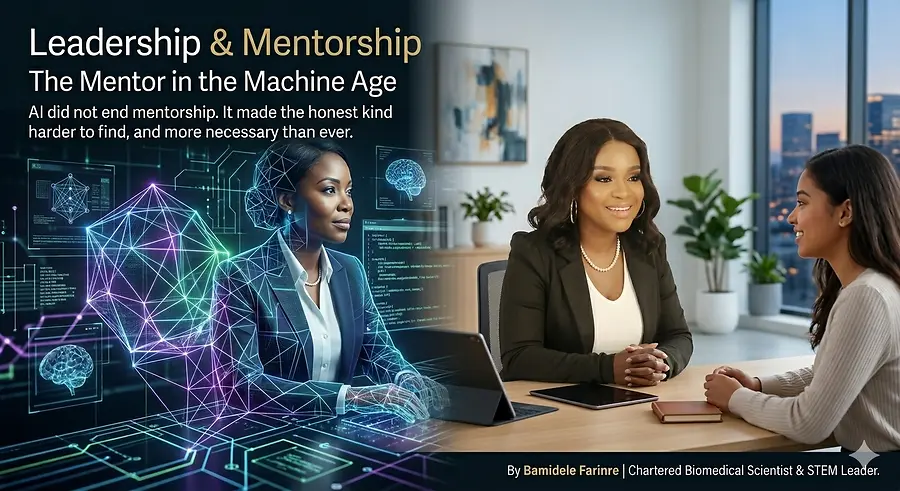
Leadership & Mentorship
The Mentor in the Machine Age
“AI did not end mentorship. It made the honest kind harder to find, and more necessary than ever.”
By Bamidele Farinre | Chartered Biomedical Scientist, Agilist & STEM Leader
I was once told that I did not have the head for science. I was young. The person who said it probably had no idea how long that sentence would sit with me, turning over in my mind, looking for a foothold. What pulled me through was not some inner certainty that they were wrong. It was a series of people, at different points, who saw something I could not yet see in myself and said so. That is what mentorship did for me. It gave me the evidence I needed to keep going.
I wrote about that in my first book, The Mentor’s Journey: From Learning to Leading. The feedback I received told me the same thing repeatedly: people recognised themselves in it—the self-doubt, the pivotal conversation, the mentor who changed their trajectory, and the promise made to themselves to become the person they once needed.
But here is what I could not have anticipated when I wrote that book in 2024: within months of its publication, the world would sharpen its focus on artificial intelligence in a way that would demand a whole new conversation—not a footnote, but a new chapter.
“The question is not whether AI belongs in our professional lives. It is already there. The question is what we do about the things it cannot do.”
Here is what I know for certain: AI cannot notice that a student is performing below their capability because they are exhausted from working night shifts. It cannot remember that you mentioned, eight months ago, that you were afraid of failing your people. It cannot sit with you in the specific discomfort of being the only person in the room who looks like you and say, with the weight of lived experience, “I know. Here is what I did.” No algorithm produces that. No chat interface holds that kind of weight.
And yet, right now, I am watching organisations quietly replace the budget they once spent on mentoring programmes with AI platforms. I am watching students who have never had a meaningful conversation with someone senior in their field spend hours asking chatbots for career advice. I am watching the gap between those with real human networks and those without grow wider, even as we congratulate ourselves on making information more accessible.
Information and guidance are not the same thing. That distinction matters enormously.
The Part Nobody Is Saying Loudly Enough
My work contributing to the All-Party Parliamentary Group on Diversity and Inclusion in STEM has brought me close to the AI equity conversation at a policy level. The inquiry has been examining how AI systems are perpetuating harm, particularly gendered harm, through biased training data, poor representation in design teams, and outputs that quietly disadvantage the very groups most in need of fair systems. When a hiring algorithm has been trained on a decade of promotion data from a sector that routinely overlooked women and people from minority ethnic backgrounds, it does not produce fair recommendations. It scales the original unfairness—efficiently and at speed.
This is not a warning about some future dystopia. This is happening in the same labs, hospitals, and institutions where real people are trying to build careers.
What does this have to do with mentorship? Everything.
Because mentorship has always been one of the ways people outside dominant networks found a way in. The senior figure who opened a door. The peer who shared unwritten rules. The sponsor who put your name in a room you did not know existed. Those relationships have historically compensated for structural disadvantage—imperfectly, but meaningfully. If we let those relationships thin out while AI systems with embedded bias fill the gap, we will not have modernised anything. We will have simply made exclusion harder to see.
“We cannot outsource the work of equity to machines that were not built with equity in mind.”
What I Am Asking of People Who Mentor
Be more specific. The world is full of warm encouragement right now. AI tools are excellent at generating it. What they cannot provide is the honest, sometimes uncomfortable observation that changes how someone sees themselves. “You are doing well” is not mentorship. “You consistently undervalue what you bring into the room, and I want to show you exactly where I see it happening” is mentorship. The specificity is everything.
Learn enough to ask the right questions. You do not need to become a data scientist. You need to know enough about how AI systems work to raise your hand when something looks wrong. When a tool is being used to evaluate performance, select candidates, or flag clinical risk, and the outputs seem to disadvantage certain groups consistently, that is a question worth asking loudly. Mentors help people develop the courage to ask those questions—model it yourself.
Stay visible. I mean this practically. Show up. Be the person who responds quickly because you are paying attention. Be the one who introduces someone in a meeting because you remembered they needed that connection. Technology can handle logistics. It cannot handle presence. Your presence, when it matters, is not replaceable.
And if you come from an underrepresented group in STEM, understand this: your experience of navigating systems that were not designed for you is not a personal anecdote. It is evidence. It is data the sector needs. Sharing it, with the people who need to hear it—including policymakers—is a form of mentorship that reaches further than any single conversation.
What I Am Writing Next, and Why
My forthcoming book, Mentorship in This AI Era: A STEM Leader’s Lenses, picks up exactly where The Mentor’s Journey left off. It examines, directly and practically, what mentorship looks like now: for students navigating AI-assisted learning, for educators recalibrating their role, for leaders building teams, for institutions designing fair systems, and for policymakers making decisions that will shape who belongs in STEM for the next generation.
It draws from my experience as a Chartered Biomedical Scientist, from my advocacy work, and from the policy conversations I have been part of. But mostly, it draws from the same place the first book did: real life—the moments that do not make it into the polished version of any career story, the ones that determine what happens next.
Because here is what I believe, without reservation: technology changes the pace. It does not change the question. The question, in every era, is: who is helping whom see what they cannot yet see? Who is holding the vision when someone else has lost theirs? Who is naming the truth when the room has gone quiet?
That is a human function. It has always been a human function. And right now, when machines are very good at giving confident-sounding answers, we need more humans willing to sit with the harder, less certain, more honest ones.
That is what mentorship is. That is what it has always been. And it is the most important thing I know how to write about.
Bamidele Farinre
Chartered Biomedical Scientist & STEM Leader
Bamidele Farinre is the author of The Mentor’s Journey: From Learning to Leading and a contributor to the UK APPG on Diversity and Inclusion in STEM’s AI equity inquiry. She is a STEM leader, mentor, and global advocate for equity in science and leadership. From early academic failure to becoming a recognised voice in STEM, her work focuses on resilience, ethical leadership, mentorship, and breaking systemic barriers. Her forthcoming book, Mentorship in This AI Era: A STEM Leader’s Lenses, continues the conversation on what human guidance looks like in the age of artificial intelligence.


