The One Leadership Strategy That Never Changed
How Your Attitude Shapes Leadership Success and Organizational Culture

Last week, while attending the Printers Row Lit Fest in Chicago, someone asked me a question that caused me to pause:
"What made you successful?"
After more than 20 years in educational leadership, I could have offered a long list of strategies, accomplishments, lessons, and credentials. I have experienced the highs, the lows, and nearly everything in between. I have led in different states, worked overseas, and served students, staff members, and communities with vastly different needs.
- Every leadership space required something different from me.
- The students were different.
- The staff members were different.
- The environments were different.
- The challenges were certainly different.
There was never one strategy that worked perfectly in every setting because leadership is not one-size-fits-all. What motivates one team may not motivate another. What builds trust in one environment may fall flat in the next. Effective leaders must be willing to listen, learn, adjust, and respond to the people and circumstances in front of them.
So, was my success the result of mastering countless strategies for countless variables?
Not exactly.
The one thing that remained consistent was my attitude.
My success began with how I chose to show up-especially on the difficult days.
Your Attitude Enters the Room Before Your Strategy
As leaders, we often focus on what we need to do: the plan we need to develop, the problem we need to solve, the goal we need to reach, or the conversation we need to have.
But before people experience our strategy, they experience us.
- They feel our energy.
- They notice our tone.
- They observe how we respond when something goes wrong.
- They learn whether we become reactive under pressure or remain grounded enough to lead.
Our attitude does not remain contained within us. It cascades.
It influences how our team communicates, how confidently people approach challenges, how safe they feel bringing forward concerns, and how willing they are to keep going when progress is slow.
- A leader's attitude can create stability-or uncertainty.
- It can encourage possibility-or reinforce defeat.
- It can strengthen a team-or slowly drain it.
That is why I believe leadership is emotional regulation in motion.
The Progression of Success
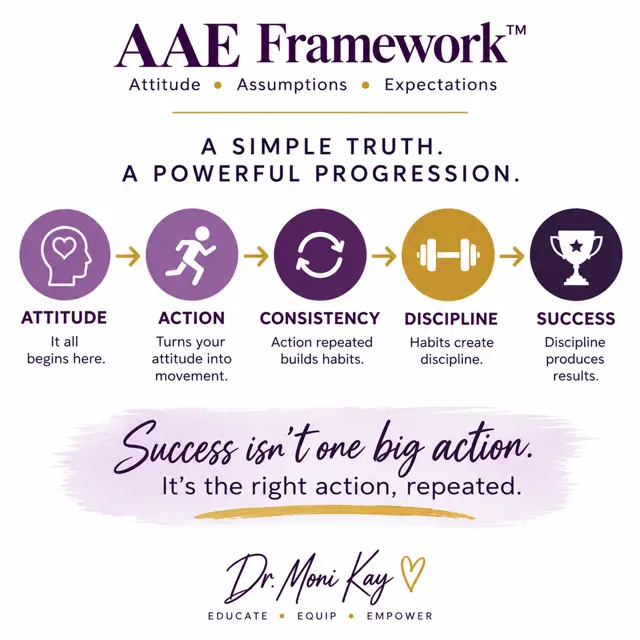
The image accompanying this newsletter illustrates a simple but powerful progression:
Attitude → Action → Consistency → Discipline → Success
Attitude is where it begins.
Your attitude shapes the actions you are willing to take. When those actions are repeated, they create consistency. Consistency develops discipline, and disciplined effort eventually produces results.
Success is rarely one dramatic decision or one extraordinary moment. More often, it is the outcome of making the right decision repeatedly-even when the results are not immediate.
- For me, success looked like continuing to show up.
- It meant making difficult decisions with integrity.
- It meant remaining committed when circumstances were discouraging.
- It meant adjusting my strategy without abandoning my purpose.
- It meant refusing to allow temporary setbacks to determine my permanent attitude.
A positive attitude did not mean pretending everything was easy. It did not mean ignoring problems or avoiding accountability. It meant believing that challenges could be addressed, solutions could be found, and progress was still possible.
There Is No Magic Bullet
Leadership will always contain variables.
People change. Teams change. Expectations change. Environments change. The strategy that worked yesterday may not be the strategy needed tomorrow.
There is no magic bullet.
There is no universal leadership formula.
But one truth remains: how you show up matters.
You may not control every circumstance facing your organization, but you are responsible for the attitude you bring into that circumstance. You help establish the emotional climate in which your team must work.
So, if you are waiting for the perfect strategy, the perfect conditions, or the perfect team before you lead with confidence, stop waiting.
- Begin with your attitude.
- Allow it to shape your actions.
- Repeat the right actions consistently.
- Let consistency develop discipline.
- Then give the process enough time to produce results.
Success is not one big action.
It is the right action, repeated.
What attitude are you bringing into the spaces you lead today?
Until next time, stay regulated.
-Dr. Moni Kay
Creator of the AAE™ Framework
Attitude • Assumptions • Expectations
#AAEFramework #Leadership #EducationalLeadership #LeadershipDevelopment #OrganizationalCulture #EmotionalIntelligence #Consistency #Success