They Asked 60 Executive Assistants What They Were Afraid Of. Nobody Said the Quiet Part Out Loud.
How Executive Assistants Can Thrive in the Age of AI While Fighting Invisibility and Ageism

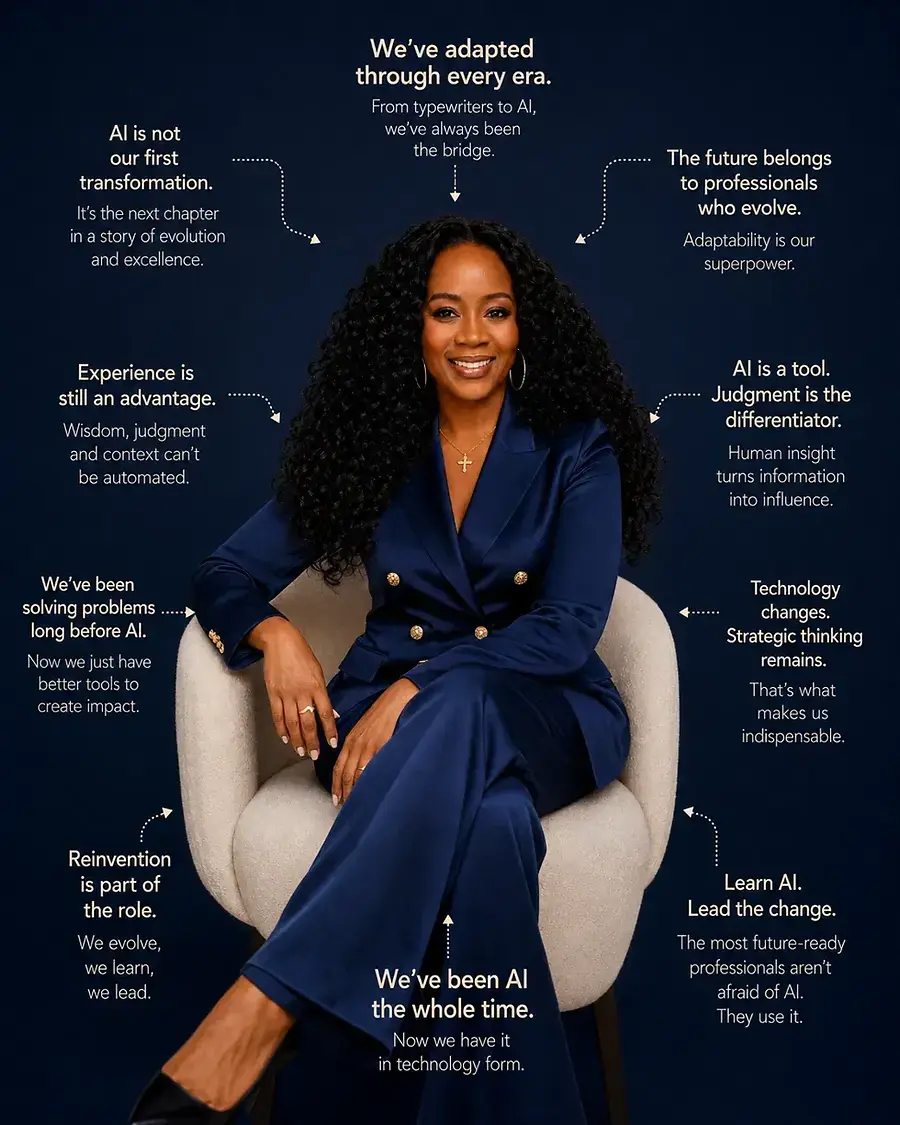
They asked 60 Executive Assistants what they were afraid of. Many mentioned AI. Few mentioned ageism. Yet for many women who have spent 20, 30, or 40 years evolving alongside this profession, the greater fear is not technology. It is becoming invisible.
Executive Assistants have been reinventing themselves for decades. We adapted from paper calendars to Outlook, from switchboards to smartphones, from administrative support to strategic partnership. AI is simply the next chapter in a story we have already been writing.
And the world is starting to pay attention to that story.
Earlier this year, sixty Executive Assistants gathered in Perth, Australia, for the first event in The EA Institute's Future of the Executive Assistant Profession Roundtable Series. Founded by Amanda Vinci, The EA Institute (www.theeainstitute.com.au) brought together Executive Assistants from across Western Australia to ask one simple question: What is the biggest challenge facing the Executive Assistant profession right now?
The answers were data-driven and consistent. Out of every concern raised in the room, AI and technology scored the highest by a significant margin, with twelve votes. Role evolution and risks and threats followed. Then recognition and value, workplace expectations, career progression, and skills and capability. You can read the full summary report from The EA Institute here (https://www.theeainstitute.com.au/wp-content/uploads/2026/06/Perth-Roundtable-Summary_compressed.pdf).
Important answers. But I want to go deeper, because I think we left something on the table.
Nobody said the quiet part out loud.
It Is About AI. And It Is About Age. Both.
Let me be clear: AI is a real concern, and we should not minimize it. The technology is moving fast. The landscape is shifting faster than most organizations can keep up with. And yes, it is changing the Executive Assistant profession in ways we are still figuring out.
The participants in Perth named some very specific fears inside that broader AI concern. They talked about managers setting unrealistic expectations based on AI speed. They talked about companies offshoring Executive Assistant roles. They talked about executives potentially self-serving tasks and questioning whether the role is even necessary anymore. Those are not abstract worries. Those are real threats showing up in real workplaces right now.
But when I read through everything those sixty seasoned professionals put on the table, I heard something underneath it all. Something that does not always make it onto the agenda at professional roundtables.
Ageism.
Think about who is sitting in those rooms. Think about who has been sitting in these roles for twenty, thirty, forty years. The same women who started as secretaries, then became admins, then became Executive Assistants, then became Executive Business Partners. Women who have carried organizations on their backs, managed C-suite calendars during mergers, coordinated global travel during crises, and kept entire leadership teams functioning at the highest level.
And now, at this stage of our careers-in our fifties and beyond-we are being asked to prove ourselves all over again. Not because we stopped performing. But because the tools changed.
That is not just a technology challenge. That is an ageism challenge wearing a technology costume.
We Are the AI of the Organization
One of the most powerful things to come out of the Perth roundtable was a statement from the professional identity discussion. One group wrote it plainly:
"We are the AI of the organization."
Read that again.
Before there were algorithms, there were Executive Assistants anticipating needs, synthesizing information, managing complexity, and making decisions that kept the organization moving. We have always done what AI is now being celebrated for doing. The difference is that nobody built a product around us. Nobody put us on a keynote stage. Nobody wrote headlines about our efficiency.
That needs to change. And it starts with us changing how we talk about ourselves.
The report also noted that the Executive Assistant role is still viewed through outdated stereotypes: "the glue," "the schedulers," "the timekeepers." One group named it directly: it is a female role, and maybe that is exactly why it has been viewed so negatively for so long.
That framing matters. Because when AI comes along and someone in leadership decides that a tool can replace what we do, part of what enables that decision is decades of undervaluing the role in the first place.
The Fear Is Real. So Is the Response.
I said it in my last article, and I will say it again: AI will not replace adaptable women. Adaptable women will use AI to create opportunities that did not exist before.
But I want to be more specific about what adaptability actually looks like right now, for the women who have been in this profession long enough to have watched it transform multiple times.
It looks like this: you are learning the tools. You are researching the tools. You are applying the tools in your daily work. There are thousands of AI platforms, courses, certifications, and resources available right now. If you are willing to stay curious, you have access to more professional development than any previous generation of administrative professionals ever had.
Do not just learn the tools. Get certified in them. Put it on your résumé. Put it on your LinkedIn. Make it visible. Because in a world where someone might look at your years of experience and see a liability instead of an asset, your certifications become your counter-argument.
The Perth report called out the need for proper AI training, capability building, and formal accreditation. I could not agree more. But do not wait for your organization to hand it to you. Go get it yourself.
You are not behind. You are building.
What The EA Institute's Roundtable Got Right
The participants named exactly what the Executive Assistant profession needs going forward:
- Advocacy and role visibility came in as the top requirement, with eleven votes
- Networking and community followed with eight
- Leadership, strategy, and stakeholder capability came in at seven
- Professional development and qualifications, role evolution and clarity, and organizational support and recognition all tied at six
- Self-belief and self-advocacy rounded it out with five
Every single one of those things is something we can take ownership of ourselves-right now-without waiting for our organizations to lead the way.
Advocate for your role. Do not assume people understand the scope of what you do. Educate them. Quantify it. Document it. Make the invisible visible.
Build your visibility beyond your desk. Speak at conferences. Write articles. Post on LinkedIn. Share what you know. You have decades of operational wisdom that other professionals are actively searching for, and you are sitting on it.
Develop your leadership voice. The future of this profession will not be defined by the people who stayed quiet and hoped for the best. It will be defined by the ones who showed up, said something, and helped shape what comes next.
Building Something That Cannot Be Laid Off
Here is the part the roundtable conversation may not have had time to get to.
In a tech-driven economy with ongoing layoffs, no role is guaranteed-not for any of us. And for women who have spent decades building expertise in a specific function, that reality hits differently.
The answer is not panic. The answer is parallel construction.
While you are still in your role, build something alongside it: a consulting practice, a personal brand, a service offering, a platform that showcases your expertise. Something that belongs to you, travels with you, and cannot be eliminated in a reorganization.
I am in my mid-fifties. I am an Executive Business Partner at a major tech company. I am also an entrepreneur, a magazine founder, a resume-writing service owner, a public speaker, and a published author. Not because I had extra hours lying around, but because I understood that in this season of life, waiting for security to come from outside of me was not a strategy.
Your decades of experience are not a liability. They are your foundation. The question is what you are building on top of them.
This Is Our Moment
The women who were in that room in Perth are asking the right questions. So are the women reading this right now. The conversation is happening everywhere because it needs to happen everywhere.
AI is real. Ageism is real. The pressure to prove yourself all over again at a stage in your career where you have already proven everything is real.
And so is your ability to respond to all of it.
Learn the tools. Get certified. Build your visibility. Advocate for your profession. Create something of your own. And refuse to let anyone, any technology, or any organizational shift define what your next chapter looks like.
You have been executing at the highest level for decades. This moment is not the end of that story. It is just the next chapter-and you get to decide how it reads.
Source: The EA Institute Future of the Profession Roundtable Series, Perth, Australia, June 2026. Founded by Amanda Vinci. Full summary report available at www.theeainstitute.com.au.
Charlotte M. Howard Executive Business Partner at ServiceNow Entrepreneur, and Founder of HER ERA
Based in Dallas, Texas, she is an advocate for career reinvention, women of color navigating menopause, and AI in the workplace for powerful women who refuse to shrink.


