Velocity Training: How The Global Training Association Redefines Speed, Precision, and Performance in Learning
Accelerating Workforce Capability Through Strategic Performance Engineering

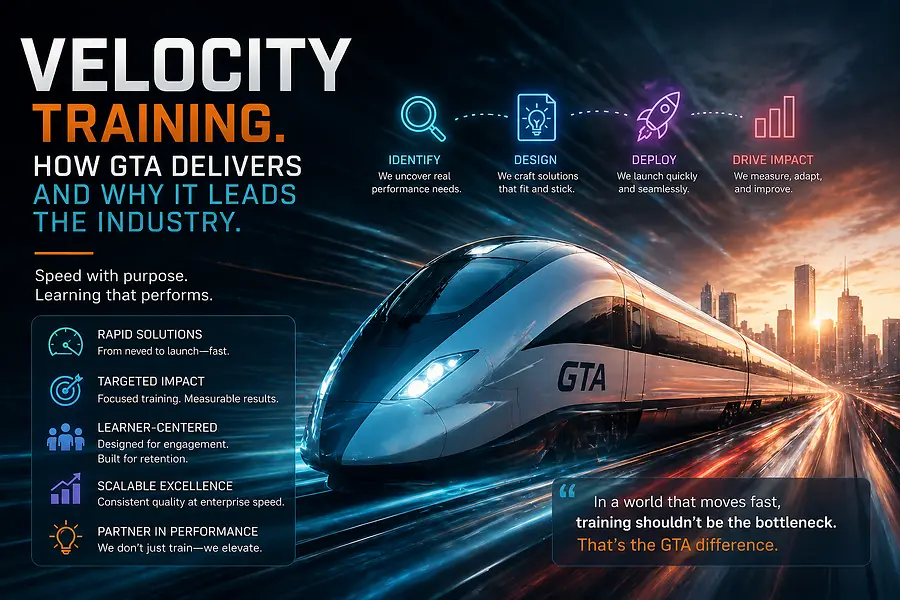
Velocity Training: How The Global Training Association Redefines Speed, Precision, and Performance in Learning
In today’s enterprise environment, speed is no longer a competitive advantage—it is a baseline expectation. Organizations are launching products faster, entering markets more rapidly, and evolving operations in real time. Yet one critical function often continues to lag behind: training.
Traditional learning models are frequently too slow, too fragmented, and too disconnected from measurable business outcomes to keep pace with modern demands.
Velocity Training changes that.
At The Global Training Association (GTA), Velocity Training is not about moving faster simply for the sake of speed. It is about accelerating learning with precision—delivering the right capabilities to the right people at exactly the moment they are needed to drive performance.
This is not training for information’s sake.
It is a system engineered for execution.
What Velocity Training Actually Means
Velocity Training is the strategic compression of the learning lifecycle without compromising quality, relevance, or business impact.
It removes unnecessary friction across:
- Analysis
- Design
- Development
- Deployment
All while maintaining rigorous alignment with organizational objectives.
Most organizations still operate with a linear training model:
- A need is identified
- Content is developed
- Reviews are delayed
- Deployment occurs
By the time training launches, the business may have already evolved beyond the original need.
GTA replaces this outdated model with a dynamic, performance-driven system that functions through parallel execution.
Instead of asking:
“What content do we need to build?”
Velocity Training asks:
“What behavior must change, and how quickly can we enable it?”
That shift fundamentally transforms learning strategy.
How GTA Executes Velocity Training
GTA’s model is built around a tightly integrated framework of performance engineering.
Precision Diagnosis
Rather than conducting prolonged, overly broad needs assessments, GTA isolates performance gaps quickly using targeted diagnostic frameworks.
This ensures:
- Root causes are identified rapidly
- Only necessary interventions are built
- Waste is eliminated from the beginning
Parallel Design and Development
Traditional sequential models create delay. GTA uses agile methodologies and modular architecture to design and develop simultaneously.
This enables:
- Rapid prototyping
- Immediate stakeholder feedback
- Continuous refinement
- Accelerated deployment timelines
Speed-Engineered Deployment
Learning solutions are designed to integrate directly into operational workflows, systems, and platforms.
This ensures:
- Learning occurs at the point of need
- Adoption rates increase
- Time-to-competence decreases
- Scalability improves
Embedded Measurement
Measurement is not treated as an afterthought. Every solution includes predefined metrics tied directly to business outcomes such as:
- Increased productivity
- Reduced operational errors
- Improved customer experience
- Faster onboarding
- Enhanced compliance
Data is used continuously to optimize performance—not merely to evaluate it after the fact.
Why This Model Is Disrupting the Industry
For decades, learning and development has been constrained by outdated assumptions:
Assumption 1: Quality Requires Time
Velocity Training demonstrates that speed and quality are not mutually exclusive. When design is strategically aligned to performance, faster delivery often increases relevance and impact.
Assumption 2: Training Must Be Perfect Before Deployment
GTA prioritizes iteration over perfection. High-impact solutions are deployed quickly, then continuously refined using real-world data.
Assumption 3: Learning Is Separate From Work
Velocity Training embeds learning directly into operational environments, transforming it from an isolated event into a real-time business tool.
This is why the model aligns so effectively with modern enterprise realities:
- Agile operations
- Digital transformation
- Continuous adaptation
- Performance accountability
The Business Case for Velocity Training
The financial implications are substantial.
Traditional training often suffers from:
- High development costs
- Extended production timelines
- Low utilization rates
- Delayed ROI
Velocity Training addresses all of these challenges.
Key Benefits:
- Reduced development costs through shorter cycles
- Lower unnecessary spend by targeting only critical performance gaps
- Increased utilization through just-in-time learning
- Faster employee competence
- Accelerated organizational performance
In high-stakes environments, these gains translate directly into:
- Revenue acceleration
- Cost savings
- Competitive advantage
Why the Workforce Needs This Now
Today’s workforce is operating in a state of perpetual change.
Employees must continuously adapt to:
- Emerging technologies
- Evolving responsibilities
- Market disruption
- Operational complexity
Yet employees often lack the time—or patience—for outdated, irrelevant, slow-moving training systems.
Velocity Training responds to this reality by:
- Respecting the pace of modern work
- Delivering actionable capability quickly
- Prioritizing relevance over volume
- Supporting immediate application
For organizations, this means employees are not simply trained.
They are ready.
The Future of Learning Is Velocity
As artificial intelligence, automation, and digital transformation continue reshaping industries, the demand for rapid capability development will only intensify.
Organizations that cannot train at speed will increasingly struggle to compete.
Velocity Training positions GTA at the forefront of this transformation.
It is not merely a methodology.
It is a redefinition of what learning must become:
A strategic engine for workforce performance.
In a business environment where execution determines success, training can no longer function as a bottleneck.
It must become the accelerator.