We Don't Succeed Alone
How opening doors for others transforms our own success into something greater and more meaningful.

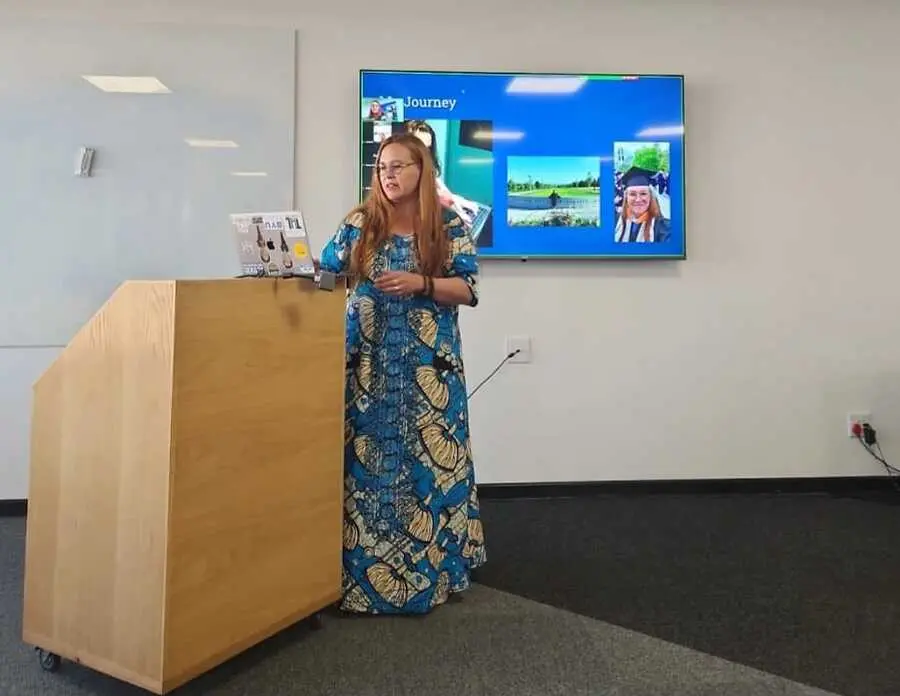
I remember standing at the front of a room at the BYU-Pathway Global Education Center in Johannesburg in 2025, wearing a beautiful traditional African dress, with about two dozen Applied Health students and graduates looking back at me, many of them women, some already finished and some still right in the middle of it. On the screen behind me was a slide with the word "Journey" at the top and a picture of me in my cap and gown on graduation day. I had put it there because I wanted them to see that the woman talking to them had once been exactly where they were.
I had come to encourage them. I wanted them to know that they could finish, that education was for them, too, and that even though the road is long, they have the strength to keep going. I meant every word of it. But by the end of that trip, which took our team through Zimbabwe, Malawi, and South Africa, I realized they didn't need me to teach them that we succeed together. They were already living it, and in their own quiet way, they reminded me how I had made it myself.
My own story started in Argentina in 2017. I was 40 years old, a stay-at-home mom with four girls who were 12, 10, 6, and 3, and I decided it was time to go back to school. I started online, taking one class after another until I had almost 60 credits and an associate degree, and then our family packed up and moved to Rexburg, Idaho, so I could finish my bachelor's in Public Health on campus. Those were full years: I was taking 15 to 18 credits every semester, working part-time, and taking care of my family. I graduated in 2020 and went straight into my master's degree. When people hear that, they sometimes ask me how I did it all, and my honest answer is that I did the work, but I never did it alone.
I think about my biostatistics professor a lot. I have to be honest: I was awful at biostatistics, and I knew it. One day, she was in the middle of explaining a concept when she sensed that the whole class was struggling, and instead of pushing through the lesson, she stopped and said something like, "Okay, let's stop for a minute. How are you all doing? I mean, how are you really doing, with your lives, with your studies?" It was such a simple question, and she asked it with so much kindness that I have never forgotten it. In that moment, I understood that she wasn't only there to teach us statistics; she really cared about our journeys.
I passed that class, but I didn't pass it by myself. I passed it because of Anastasia, a student from Ukraine who tutored me and who was so patient, explaining every concept step by step until it finally made sense, and because of a professor who cared enough to stop the whole class just to ask how we were doing. When I think about my success, I think about people like them: the women who encouraged me, the mentors who trusted me with opportunities before I felt ready, and the friends and colleagues who saw something in me long before I could see it in myself.
I thought about them again in Malawi, where I sat with a student who had spent an entire semester just trying to get into his online courses. He ended up failing three classes and was ready to give up, but one teacher gave him the hope to keep going. Now, another student in his program says the only reason he is still enrolled is because of him. When we asked them about it, they told us something very simple: they didn't have anyone to help them get started, so now they want to be that person for someone else.
And then there was that evening in Zimbabwe. We had gathered a group of graduates, most of them women, in a simple room with a fan on the wall, and none of them knew each other. We were there to listen and to learn how we could support them better, and at first, the conversation was heavy. They talked about how hard it was to find work after graduating, and you could feel the frustration in the room. But little by little, something shifted. One of them shared a tip, another mentioned an opportunity, and soon they were talking about ways they could work with each other, turning to one another for advice instead of to us. By the end of the evening, they had pretty much forgotten we were there, and before they left, they created a WhatsApp group so they could keep in touch and keep supporting each other. We had come to help them, and they showed us that so much of what they needed was already sitting in that room.
I think many of us, especially women, carry a quiet belief that the most successful people are the ones who don't need anyone, and that asking for help somehow makes our achievements smaller. I don't believe that. Capability matters, and hard work matters, and I did plenty of both, but encouragement matters, too, and so do access and relationships, and so does the person who stops the class to ask how you are really doing. Needing people doesn't make our success smaller; it makes it more honest.
A few years after I graduated, I received a message from a friend back in Argentina. She wrote, "You were to me a mentor who motivated me and reminded me of the importance of never giving up on my dreams. I believe you handed me a key to start again my path to higher education." I read that and thought about my professor, and about Anastasia, and about that student in Malawi. Someone hands you a key, and one day you look down and realize you are holding one for someone else.
That is the part I keep coming back to. Once someone has opened a door for us, I think we have the chance, and maybe the responsibility, to open one for someone else, and that usually means more than giving good advice. It means recommending someone when an opportunity comes up, mentioning a colleague's idea with her name attached, inviting someone into the room, and encouraging the woman who hasn't yet learned to speak up for herself. Many of the students I met on that trip were soft-spoken and not used to promoting themselves. They didn't need anyone to speak for them; they needed someone to notice them, say their name, and hold the door open a little longer.
My success is mine, but it has never been mine alone. So, if you are a woman thinking about going back to school, or starting something new, or trying again after a hard season, I want to tell you what I told those women in Johannesburg: you can do it; you absolutely can. You don't have to be perfect; you just have to begin. And you don't have to do it alone. And if you are already on the other side of that journey, maybe the question worth asking isn't how far we have come, but who is moving forward with us.