What If the Life You Built Is No Longer the Life You Want?
Discovering what you want when the life you built no longer fits.

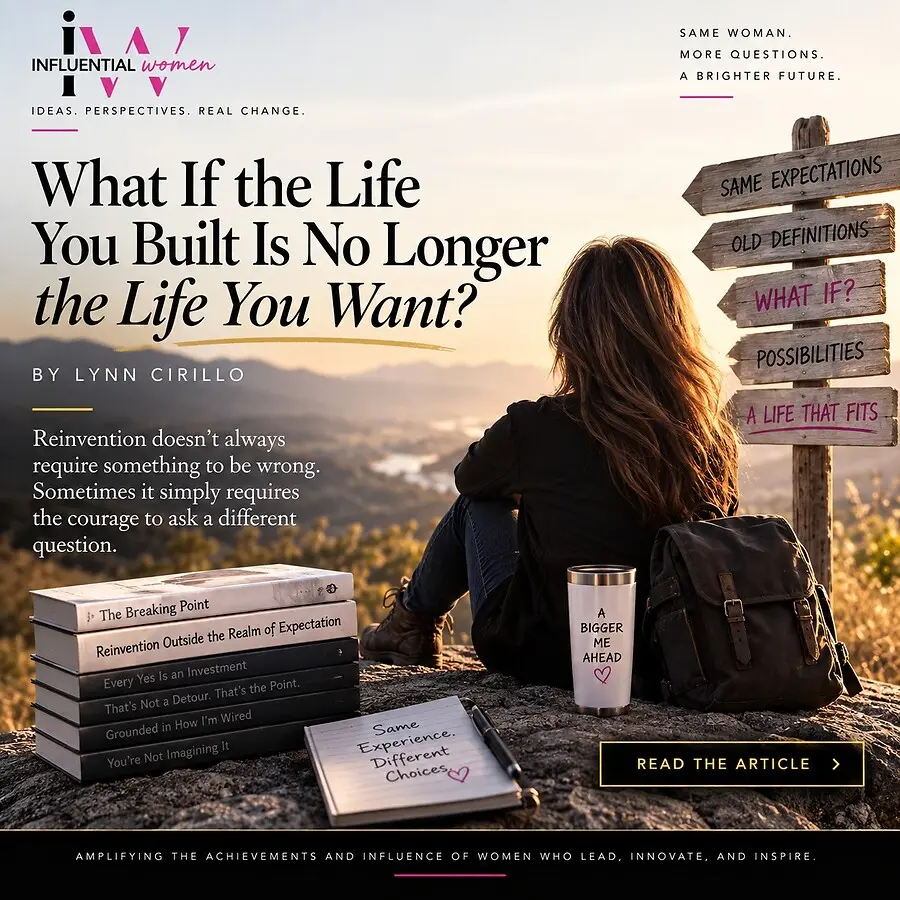
What If the Life You Built Is No Longer the Life You Want?
By Lynn Cirillo
We have made reinvention unnecessarily dramatic.
We talk about it as though something has to go terribly wrong first.
- The career implodes.
- The relationship ends.
- The company restructures.
- Burnout finally wins.
- Life delivers some unmistakable event that gives us permission to change direction.
But what if nothing is terribly wrong?
What if the life you built simply isn't the life you want anymore?
That may be one of the harder questions to answer.
Dissatisfaction is easy to justify when something is obviously broken.
Outgrowing something good is much more complicated.
You can be grateful for the career that built you and still not want to spend the next decade doing it.
You can appreciate the opportunities you were given and still question the definition of success you were taught to pursue.
You can be exceptionally good at something and no longer want your life organized around being good at it.
You can even love parts of the life you built while recognizing that other parts no longer fit.
None of those things require regret.
They require honesty.
We Confuse Capability With Calling
One of the easiest traps to fall into is continuing to do something simply because we are good at it.
Competence has gravity.
The better you become at something, the more people rely on you to keep doing it.
Eventually, other people's dependence on your capability can begin making decisions for you.
- You become the fixer.
- The dependable one.
- The leader.
- The person who can handle it.
- The person everyone calls when something goes sideways.
And there is satisfaction in being capable.
There is identity in it, too.
But capability answers a very different question from desire.
Can I keep doing this?
is not the same question as
Do I still want to?
Many people never give themselves permission to separate the two.
Some of Our Definitions of Success Were Inherited
Most of us began building our lives before we fully understood ourselves.
We absorbed ideas about what adulthood was supposed to look like:
- Build the career.
- Earn the title.
- Buy the house.
- Become financially secure.
- Be responsible.
- Keep advancing.
- Don't waste what you've worked for.
There is nothing inherently wrong with any of those things.
The problem comes when we stop examining whether they still belong to us.
A definition of success that made perfect sense at 25 may feel completely different at 45, 55, or 65.
Yet people often continue pursuing an old definition because changing it feels suspiciously like failure.
So they keep climbing.
Even after realizing they are no longer particularly interested in where the ladder leads.
Reinvention Doesn't Require Rejecting Your Past
This may be one of the biggest misconceptions about reinvention.
Changing direction does not require declaring the previous direction a mistake.
I spent more than three decades in the corporate world, much of it in leadership.
That experience shaped me.
It taught me how organizations operate, how people behave under pressure, how culture is created, how leadership affects people, and how much responsibility capable people can quietly accumulate.
I don't need to reject that chapter of my life to recognize that I don't want to recreate it.
That is not a contradiction.
That is evolution.
The person making the next decision has information the person making the previous decision did not have.
Experience is supposed to change us.
Why would we expect our ambitions to remain untouched by it?
The Hardest Part May Be Identity
Changing jobs can be relatively simple.
Changing the story you tell yourself about who you are is harder.
For years, people may know you through a title, profession, business, role, or reputation.
Eventually, you may begin knowing yourself that way, too.
- When someone asks what you do, you have an answer.
- When someone needs something, you know your role.
- When you achieve something, you know how to measure it.
Then reinvention introduces a deeply uncomfortable question:
Who am I if I stop being the person I have spent years becoming?
That question keeps many people inside lives they have already outgrown.
Not because they cannot leave.
Because they cannot yet imagine themselves on the other side.
Reinvention Can Be Additive
We often picture reinvention as demolition.
- Quit everything.
- Move somewhere new.
- Burn the old plan.
- Become an entirely different person.
Sometimes reinvention is dramatic.
Often, it isn't.
- Sometimes it is subtraction.
- Sometimes it is expansion.
- Sometimes it is finally creating room for parts of yourself that had been crowded out by responsibility.
- Sometimes it is deciding that achievement will remain part of your life without being the organizing principle of your life.
- Sometimes it is simply asking a question you haven't allowed yourself to ask before:
What else might fit me now?
That question is far less dramatic than blowing up your life.
It may also be far more useful.
You Don't Need Permission to Outgrow Something
There is an odd guilt that accompanies outgrowing a life that once worked.
We think gratitude requires permanence.
It doesn't.
You can be grateful and move forward.
You can honor what something gave you and release your obligation to remain there forever.
You can acknowledge that a version of your life was exactly right for the person you were when you chose it.
And you can acknowledge that you are no longer that person.
Perhaps reinvention isn't really about becoming someone new.
Perhaps it is about becoming curious enough to discover who you are when expectation, obligation, habit, and old definitions of success stop answering the question for you.
The life you built got you here.
You don't have to resent it.
You don't have to erase it.
And you don't have to keep living it simply because you were successful at building it.
Sometimes the most important question isn't whether you can keep going.
It is whether you would still choose the same destination if you were choosing today.
About the Author
Lynn Cirillo is an author, leadership strategist, and former Executive Vice President of Corporate Operations with more than three decades of experience in the corporate world. Her work explores leadership, organizational culture, identity, reinvention, and what becomes possible when we begin questioning the definitions of success we have spent years building our lives around. She is the author of the six-book Musings of a Recovering Executive series. Books 1 and 2, The Breaking Point and Reinvention Outside the Realm of Expectation, are available on Amazon. Learn more at MusingsOfaRecoveringExecutive.com.