What Many Businesses Discover Too Late About Operational Visibility
Why operational visibility and governance matter more than technology adoption in building resilient organizations.

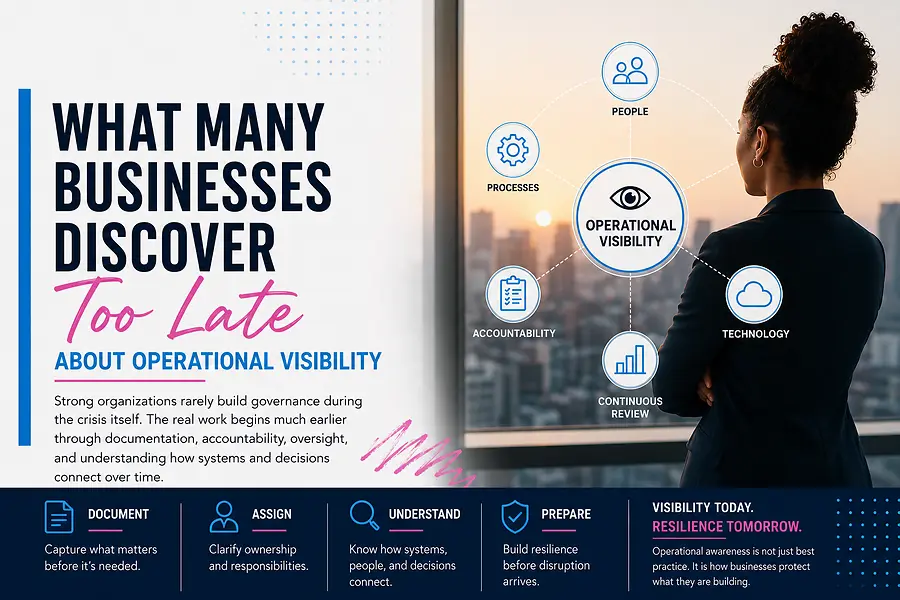
Many businesses do not realize how much of their organization is operating on memory instead of visibility.
Someone remembers the password. Someone knows which vendor manages a system. Someone understands how customer information flows through the website. Someone knows why a workflow was built a certain way three years ago. The problem is that eventually the business reaches a moment where “someone” is unavailable, overwhelmed, gone, or trying to solve a crisis while critical knowledge was never formally documented.
That is often where operational weaknesses begin to surface.
Many people still associate governance with large corporations, legal departments, or heavily regulated industries. In reality, governance begins much earlier than most organizations realize. Every decision involving technology adoption, customer communication, AI tools, vendor relationships, approvals, operational workflows, and employee access contributes to the overall maturity of a business, whether leaders formally recognize it as governance or not.
The difference is that some organizations build visibility around those decisions, while others rely almost entirely on assumptions, memory, or disconnected conversations spread across emails, meetings, and multiple platforms.
One of the biggest operational risks facing modern businesses is not always a lack of technology. In many cases, organizations are implementing systems faster than they are building oversight around those systems. Cloud platforms, AI tools, automation software, plugins, customer portals, integrations, and third-party services are being added into business environments every day, while documentation, accountability, and review processes quietly fall behind.
Everything can appear manageable until something changes.
A staffing transition happens unexpectedly. A vendor relationship shifts. An automation tool produces inaccurate information. A plugin update affects business operations. A suspicious message bypasses filtering. A workflow breaks during a busy period. Suddenly, organizations are trying to understand systems they never fully documented in the first place.
I recently explored this issue further in my article:
One of the most important things businesses can do before a crisis occurs is improve operational visibility. Organizations should understand what systems are connected, who owns responsibilities, where customer information flows, how approvals are handled, what risks have already been identified, and whether review processes exist to evaluate operational changes over time.
This conversation becomes even more important as AI adoption accelerates across industries.
Many organizations are moving quickly toward automation and efficiency without fully addressing governance expectations around human oversight, accountability, documentation, escalation procedures, review processes, or operational risk management. AI can absolutely improve productivity, but automation without visibility can also increase confusion at scale.
Businesses do not become resilient simply because they adopt more technology. They become stronger when they understand how their systems, responsibilities, vendors, people, and operational decisions connect over time.
That level of awareness rarely begins during a crisis itself.
It usually begins much earlier through documentation, visibility, accountability, review processes, and leaders willing to slow down long enough to understand what the organization is actually building before complexity outpaces oversight.
Governance is not just about compliance. It is about operational awareness.
It is understanding how the business functions beneath the surface before disruption forces those gaps into public view. Increasingly, the organizations that navigate disruption most effectively are often the ones that invested in visibility long before the headlines ever arrive.


