What Modern Digital Systems Still Misunderstand About Older Adults
Why operational design, not digital literacy, is the real barrier to technology access for older adults.

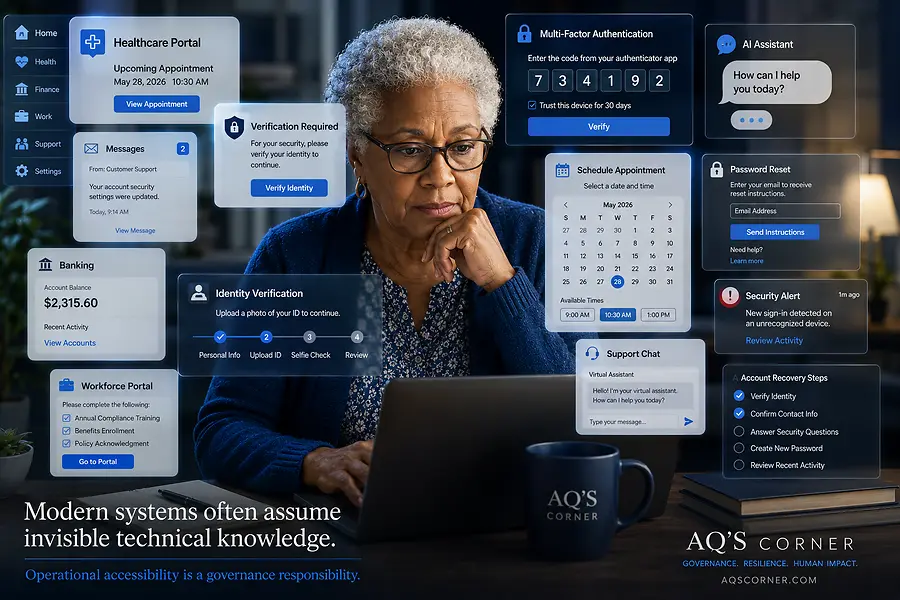
One of the most important things I have realized while teaching and working with older adults is that many digital systems quietly assume users already understand how modern operational environments function.
A login process may require multi-factor authentication, password recovery steps, app verification, QR code scanning, browser permissions, and cloud synchronization before someone can even access a service. These processes are often treated as basic operational expectations, despite significant differences in user familiarity, onboarding support, and long-term digital exposure.
That realization ultimately led me to publish a white paper titled Aging, Access, and Operational Design in Modern Digital Environments, focused on operational accessibility, governance maturity, AI trust, digital participation, and the growing complexity surrounding modern digital systems.
The deeper I researched the topic, the more I realized how often discussions surrounding older adults and technology become oversimplified. Many conversations still frame aging populations primarily through “technology resistance” or basic digital literacy assumptions. But in many cases, the challenge is not willingness to participate; the challenge is navigating increasingly interconnected systems designed around invisible technical expectations.
Older adults are actively participating in digital environments every day. Many manage finances online, use smartphones, communicate through apps, stream media, access healthcare portals, apply for jobs online, and interact with increasingly automated systems. Technology adoption, however, does not automatically eliminate operational complexity.
One of the strongest themes explored throughout my white paper work is that modern digital systems often assume continuous exposure to rapidly evolving technology conventions. Password managers, online verification systems, AI-assisted customer support, digital onboarding processes, and account recovery environments are frequently introduced incrementally over time without centralized support or long-term usability consistency.
This becomes even more significant as artificial intelligence becomes increasingly integrated into environments frequently used by older adults. AI systems now influence customer service interactions, search visibility, automated communication, financial platforms, healthcare systems, and workplace technologies. Trust, accessibility, and human oversight are becoming increasingly important governance discussions inside these environments.
One of the most important ideas explored throughout this white paper is that operational accessibility should increasingly be viewed as a governance issue rather than a separate accessibility conversation. Organizations make operational decisions every day involving onboarding, usability, authentication requirements, support pathways, interface design, recovery procedures, and automation systems. Those decisions directly shape who can safely and effectively participate in modern digital environments.
The issue is not whether older adults can adapt to technology.
The issue is whether modern systems are being designed with realistic assumptions about human onboarding, operational support, accessibility, and long-term usability.
Throughout my experience teaching older adults, I have repeatedly seen strong interest in learning, adapting, and participating digitally. What many people interpret as “technology difficulty” is often operational friction created by systems that assume continuous digital familiarity without recognizing how rapidly digital environments have evolved over time.
The more I research operational design, governance, accessibility, and digital participation, the more I believe one of the most important questions organizations should ask is not simply:
“Can users access the system?”
The question is:
“Was the system designed in a way people can realistically navigate, understand, trust, and sustain over time?”
And increasingly, I believe that question matters more than many organizations realize.
Featured White Paper
Aging, Access, and Operational Design in Modern Digital Environments
A Governance and Operational Analysis
Read the Full White Paper
AQ’S Corner White Papers & Research Library
Explore All White Papers & Research


