When Language Becomes Identity
Words Quietly Shape Who We Believe We Are

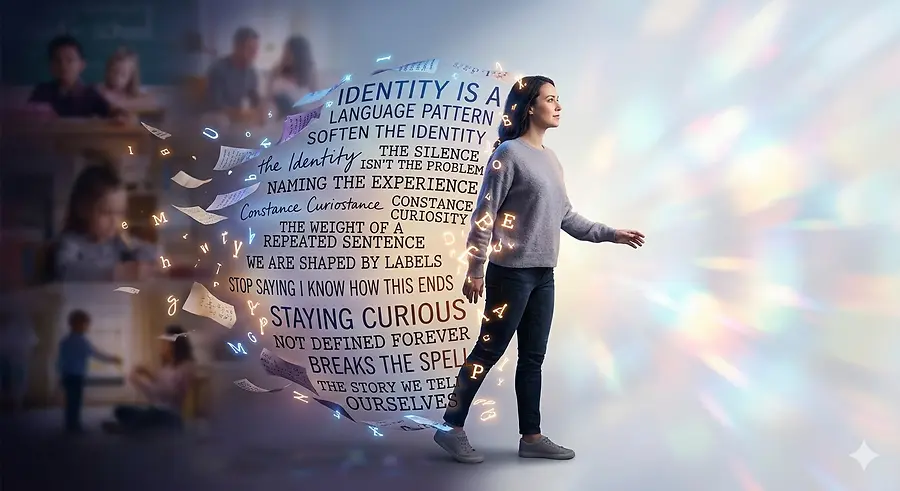
Many of the things we believe about ourselves are not objective truths. Instead, they are repeated language patterns that, over time, slowly solidify into an identity.
In my previous article, I spoke about the double meaning of a “spell”—how to spell a word is to give it form, while in mythology, it is an act of enchantment. Our self-image often begins with these childhood enchantments. Think about two siblings growing up in the same house: one is constantly told they are “resilient and bright,” while the other is labeled with harsh names or called “difficult.”
Even though they share the same roof, they grow up with different versions of their parents and, therefore, different versions of themselves. One is cast under a spell of confidence, while the other falls under a spell of limitation. This is how labels shape our early perception and interpretation of reality.
However, being shaped by these labels does not mean we are destined to stay within them. We see this all the time. I think of a college classmate who was told growing up that she wouldn’t be able to finish a degree. She shared this story with us while holding her official professional degree. Her mother refused to accept the teacher’s label, choosing instead to find ways to empower her daughter.
Another example is how two people can respond differently to the same roadblock. One person sees it and says, “This is as far as I can go,” because that is what their internal spell dictates. The other sees the same obstacle and asks, “How can I get over it?” The difference isn’t the struggle; it’s the internal label. One sees a world of barriers, while the other sees a world of opportunities. We are shaped by the stories told to us, but we are not defined by them forever—we can write our own.
How do we change our perspective?
A good starting point is differentiating between an experience and our definition or expectation of it. When we have a negative experience, we often use it as a crystal ball to predict the future. We think, “This happened before, so it will happen again.” We allow a past outcome to become a permanent definition of our capability.
But the truth is that every new circumstance brings a fresh set of variables: the people are different, the timing is different, and even you are different.
Instead of predicting outcomes based on old “spells,” I recommend shifting into a state of constant curiosity. When we are curious, we stop saying, “I know how this ends,” and start asking, “I wonder what will happen this time?” Curiosity breaks the spell of the past and allows us to notice new factors at play—the mood of the person across from us, the growth we’ve achieved, and possibilities we haven’t yet imagined.
Common phrases like “I am not enough,” “I am too much,” or “I always do it the wrong way” resonate with many of us. These aren’t just thoughts—they become what we might call “filter lenses.” The danger is that the more we repeat them, the more we believe them. Once we begin wearing these lenses, our brain acts like a high-powered magnet, focusing only on evidence that proves them right.
If I believe I am “bad at this,” my mind will magnify every mistake and ignore every win. This shifts our focus entirely toward how things might go wrong, creating a self-fulfilling prophecy instead of allowing us to see all possible outcomes.
Softening the Identity
The good news is that identity is not set in stone; it is a narrative that can be softened and rewritten with awareness. The key isn’t necessarily to jump from a negative thought to a “toxic” positive one. If you feel like a failure, telling yourself, “I am a total success,” can feel inauthentic—and your brain will likely reject it.
So how do we soften these lenses in the real world? Let’s look at a scenario many of us have experienced.
Consider a common workplace situation: you’ve sent an important message to your manager, and they haven’t responded. You follow up, and still… silence.
If your internal spell is “I am not enough” or “My work isn’t valued,” you may immediately start constructing a story. You might assume they are unhappy with your performance and begin spiraling into worst-case scenarios. Your stress increases, and you may even start acting defensively or withdrawing.
But when we shift into a state of curiosity—when we stop trying to “fix” the thought and instead begin questioning it—we create space to consider other possibilities. If the old lens says, “They haven’t replied because my work is bad,” curiosity asks: What else could be true?
The silence isn’t the problem. The story we tell ourselves about the silence is.
Once you recognize these patterns, you realize you have the power to interpret life differently. You aren’t changing the facts—the message is still unanswered—but you are changing your internal representation of those facts.
By staying curious, you leave room for reality to be something other than your worst fear. You are no longer just the subject of the story—you are the one holding the pen. You stop living under someone else’s enchantment and begin naming your own world.


