When the storm hits, face it and keep going.
Surviving a Caribbean hurricane at sea and discovering resilience in the heart of chaos.

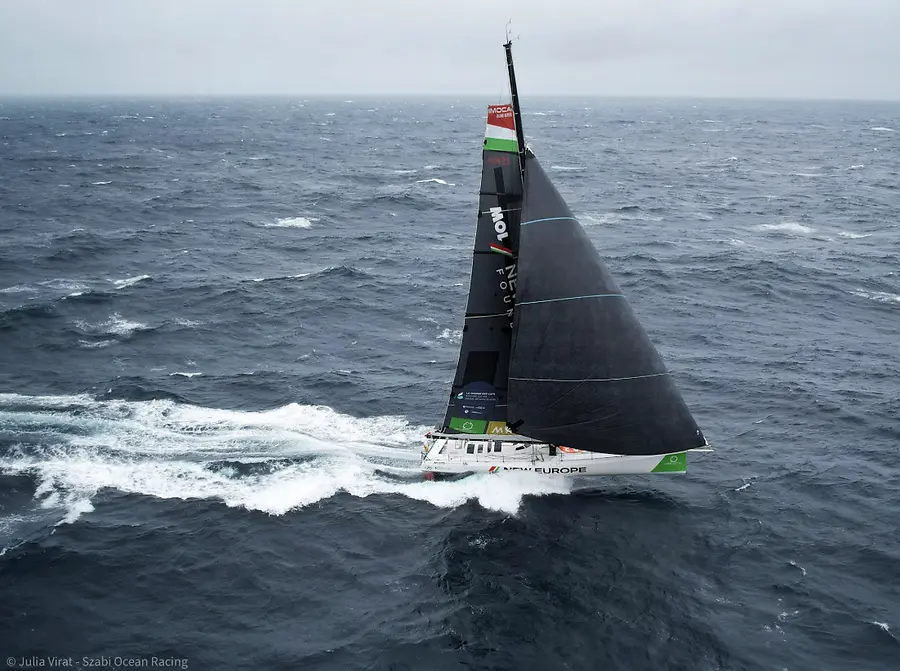
A Lifetime in 20 Days: When the Storm Hits, Face It and Keep Going
Double-handed, Szabolcs and I set off to take on one of the world's biggest offshore sailing races: crossing the Atlantic from France to Martinique aboard our 60-foot boat, New Europe.
On day three, we were hit by the remnants of a Caribbean hurricane. It was relentless, dark, and long. For nearly two days, we battled huge seas, exhaustion, fear, and uncertainty. There were moments when I questioned whether I could keep going. But wave after wave, hour after hour, we pushed on.
Eventually, the storm passed. The sun came back out. The sea calmed down. And with it came a renewed sense of gratitude and confidence. I was stronger. I felt alive. I had learned, and I was ready for the next challenge.
Life will throw storms at you, but as long as you hold tight and refuse to give up, you will always get through them.
Chapter 1: Delirium
Thursday, October 30
We knew it was coming.
This big front, with its beautiful colors on the weather forecasts, was about to hit us, but we were ready. We stacked all our sails and bags to one side of the boat and prepared the storm jib, ready to deploy it. We already had one reef in, and all the lines were set to put in the second.
It rarely happens, but we were ready a bit too soon.
The wind shifted south, but it took some time to pick up. At first, we had only 8 knots, then 10, then 15, slowly ramping up to 18. But it stayed there for several hours.
Finally, it came: 20, 22, 25 knots.
Okay, it was time to furl the J2, unfurl the storm jib, tack to cross the front perpendicularly, and get over it as quickly as possible.
There we were, heading due west into the black band coming toward us.
Very rapidly, the wind went from 25 knots to 27, then 30. We were definitely in it now. The sea state built, the rain started coming, and the clouds darkened.
Unfortunately, our autopilot wasn't helming as well as we could, so we took turns: 40 minutes each, alternating between the helm and lying down inside the boat.
We did that for about seven hours.
We were exhausted.
Conditions at the helm were delirious: horizontal rain hitting you in the face intermittently, waves crashing over the boat, salt in your eyes making you cry. You watched the boat climb those 5-meter monsters, and what came next was a huge slam back down.
The noise was terrifying.
Everything vibrated through your bones, and you did it over and over again in the rain beneath a dark sky.
A perfect Hollywood movie set.
Then came what we believed was the final front.
The wind picked up to 45 knots for about five minutes.
It was completely horrendous.
And right afterward, everything calmed down.
Szabi and I looked at each other with big smiles on our faces.
We had passed the front.
It was over.
But no.
It was only a brief reprieve in what would become a 48-hour battle within that front.
And as I'm writing this, we're still in it.
Chapter 2: Despair
After helming all day in the storm, rain, and monstrous seas with very little sleep, we were completely cooked.
My pants were no longer waterproof. I was literally swimming in my five-day-old dirty clothes, wet and stinking like a pig.
I was cold.
I was tired.
I was hungry.
At nightfall, in the pitch-black darkness, the sea state was no better.
I had a really rough time.
I got seasick and couldn't keep any food down.
The ride was so violent that even going to the bathroom became a mission.
Should I stay inside?
Should I go outside?
Which bucket?
Which side of the boat?
How do I hold on?
How do I avoid getting soaked?
I had to think through every move before making it, both to minimize the risk of injury and to manage the seasickness as best I could.
You crawled around the boat on all fours like a wild boar.
You got airborne with every wave and landed again thinking the boat was about to explode.
And you just hoped it would all be over soon.
When I finally managed to lie down after changing into a dry pair of pants, I wasn't sure how I would survive another ten days at sea.
But, as it always does, le sommeil porte conseil.
Chapter 3: The Wait
By some miracle, Szabi was feeling just fine, so he kept watch while I rested a little.
In the middle of this madness, I somehow managed to get a few hours of sleep.
Today, the strategy is different.
Let's not kill ourselves anymore.
We've done enough.
Let's slow down, let the autopilot do its job, and allow the humans on board to recover.
Let's simply watch and supervise this 60-foot carbon machine as it sails itself out of the storm down the Portuguese coast.
It's a funny feeling to go from actor to spectator.
As we observed New Europe's bravery, Szabi and I found ourselves chatting about life and composites. It was our first real moment of overlap since the start of the race.
I managed to keep down some potato purée, stay hydrated, and keep an eye on the crazy numbers still showing 30 to 40 knots of breeze.
We could hear the rain slamming into the cockpit, but we stayed warm and cozy inside.
While Szabi grabbed a nap, I had time to reflect and give you this genuine account of the past 48 hours.
Right now, we should be three to four hours away from the end of the storm.
The human body has an extraordinary ability to forget the worst and preserve only the best in memory.
Looking ahead, we should encounter lighter winds as we reach the Alizés—the Trade Winds.
They should finally allow us to enjoy the glamorous, downwind, champagne sailing to the Caribbean.
The sunshine is coming out now.
Over and out.
Chapter 4: Rebirth
I was dreaming about doing an open-ocean swim during a storm.
It was hard to breathe with every wave, but somehow manageable.
Then, at one point, a big wave rolled me over and...
Boom.
I woke up.
It took me a second to realize that I was, in fact, aboard New Europe, and that Szabi had just completed a solo tack, leaving me squeezed onto the leeward hull.
I had been deeply asleep when it happened, so it took me a few seconds to get out of the bunk and jump onto the pedestals.
From bed to workout in an instant:
Trim the jib.
Raise the board.
Trim the traveler and the mainsail so we could get moving again.
Only after the action subsided did I realize it was there—the thing I had been waiting for over the previous 48 hours.
The sunshine was back.
The sea was much calmer.
No more short, pounding, wind-driven waves, but rather the remnants of a long, smooth ocean swell accompanying us along the coast of Morocco.
With a huge smile on my face, I shouted to Szabi:
"Let's get the last reef out!"
That was it.
It was all over.
Full sails were out again on New Europe.
The only thing reminding us of the bad dream was the little storm jib still sitting on the foredeck.
I couldn't believe that only 15 hours earlier we had still been slamming and flying through that nasty storm in 35 knots of breeze.
Nature is incredible.
Birds now glided alongside us on the swell.
It felt as though we had just awakened from a nightmare and sailing had become this wonderful thing again.
We opened the front hatch and instantly welcomed fresh air to replace the rotten smell inside the cabin from all the wet gear and clothes.
I was so hungry.
I ate two meals, drank some grenadine syrup, and shared more stories with Szabi.
We also wanted to give New Europe her own rebirth.
So, bucket after bucket, we washed her deck clean of all the unpleasant remnants the storm had left behind: soggy chips on the floor, smashed avocado, human hair, wet paper towels, dried jellyfish, and even bunker fuel stains—heavy fuel oil likely delivered by a wave from a nearby cargo ship.
Life is good on board.
The horizon looks bright.
We're ready to take on this next chapter.
Thankful.
Hopeful.
Excited.
Thank you, life.
Bring it on.


