Who Gets to Shape the Future? Women, Law, and the Governance of Artificial Intelligence
Why women lawyers must lead the conversation on AI governance, accountability, and the future of technology.

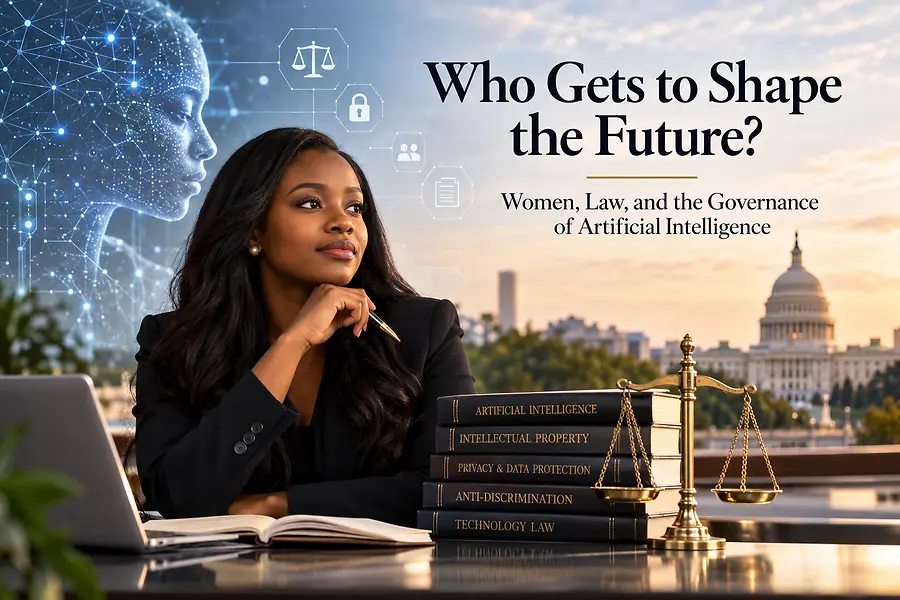
Who Gets to Shape the Future? Women, Law, and the Governance of Artificial Intelligence
Artificial intelligence is changing more than how we work. It is changing how institutions create, communicate, evaluate information, and make decisions. For lawyers, that transformation presents a fundamental question: How should existing rights, responsibilities, and legal principles apply when human decisions and creative processes are increasingly mediated by AI?
As a lawyer studying intellectual property and technology law in Washington, D.C., I am particularly interested in the space between technological possibility and legal accountability. AI can assist with recruitment, generate text and images, analyze enormous quantities of information, identify patterns, support professional decision-making, and automate tasks that once required significant human involvement. These capabilities can create extraordinary opportunities for efficiency and innovation.
But technological capability does not eliminate legal responsibility. In many circumstances, it makes responsibility more difficult to identify. Who is accountable when an automated system contributes to a discriminatory employment decision? What information was used to develop or operate that system? What happens when confidential information is entered into a generative AI tool? Who may claim copyright protection over material produced through a combination of human creativity and AI assistance? What responsibility remains with a professional who relies on an inaccurate AI-generated output?
And perhaps most importantly: Who gets to participate in writing the rules that answer these questions?
These are not merely questions for engineers. They are questions about law, governance, rights, institutional responsibility, and power. Women should be among those answering them.
AI Does Not Operate Outside the Law
Discussions about emerging technology sometimes create the impression that AI exists in a legal vacuum while governments race to create entirely new rules. The reality is more complicated. A law does not necessarily need the words "artificial intelligence" in its title to have consequences for the use of AI.
Depending on the technology, the context in which it is deployed, and the applicable jurisdiction, existing rules concerning employment discrimination, privacy, intellectual property, consumer protection, contracts, confidentiality, cybersecurity, professional responsibility, and regulated industries may already matter. Consider employment. If an employer introduces an algorithmic tool into recruitment or another employment process, the involvement of software does not automatically remove the underlying activity from existing employment law. A decision does not necessarily become legally neutral simply because technology participated in producing it.
This distinction is important because organizations can sometimes frame AI governance primarily as a technology question: Does the system work? Lawyers must ask additional questions. What decision is the system influencing? What law governs that decision? Could its operation affect protected rights? Who reviews its recommendations? What happens if the system is wrong? Who remains accountable?
The relevant question is therefore not simply whether AI can perform a particular function. It is whether that function can be performed lawfully, responsibly, and with appropriate oversight. That is one of the places where lawyers become essential to technological innovation rather than obstacles to it.
The Data Question Comes Before the AI Answer
Before an AI system generates an answer, recommendation, prediction, or document, another legal issue may already exist: data.
Organizations using AI should understand several basic aspects of the information entering their systems:
- What information is being collected or submitted?
- Where did that information come from?
- What is the organization permitted to do with it?
- Who can access it?
- How long will it be retained?
- Can the provider use it for another purpose?
- Does it contain confidential, proprietary, personal, or otherwise protected information?
These questions become particularly important with generative AI because using a system can involve transmitting information to an external technology provider.
For lawyers, this has an immediate professional dimension. Legal practice routinely involves information that clients expect to remain confidential. The convenience of an AI tool, therefore, cannot replace the lawyer's obligation to think carefully about how client information is handled, what a technology provider may do with submitted information, and whether use of a particular system is appropriate in the circumstances.
The same principle extends beyond law firms. Organizations implementing AI need governance structures addressing data access, vendor relationships, security, retention, permitted uses, internal responsibility, and human oversight.
In the United States, relevant obligations may arise from different sources depending on the context, including federal sector-specific requirements, state privacy laws, contractual commitments, professional obligations, and other applicable legal rules. Organizations operating internationally face an additional layer of complexity because privacy and data-protection requirements differ across jurisdictions.
That fragmentation is precisely why responsible AI governance requires more than adopting an internal statement declaring that an organization uses AI ethically. Governance requires operationalizing responsibility.
Intellectual Property Makes the AI Conversation Even More Complicated
My interest in intellectual property law makes one aspect of generative AI particularly compelling: the relationship between technology and human creativity.
AI systems can now produce sophisticated text, images, music, software code, and other material within seconds. But technological ability and legal protection are different questions.
In the United States, copyright protection has traditionally depended on human authorship. As generative AI becomes incorporated into creative processes, one important question is therefore not simply whether AI was used, but what creative contribution came from the human being using it.
This distinction matters. A person might use AI as one tool within a much larger creative process involving selection, arrangement, revision, modification, and independent expression. Another person might provide a short instruction and accept an automatically generated result with little additional creative contribution. Those situations can raise different questions concerning the extent of protectable human authorship.
There is also a separate legal debate surrounding the material used to develop generative AI systems. Questions concerning copyrighted works, licensing, training practices, infringement, and defenses under copyright law continue to be examined through litigation, policymaking, scholarship, and industry practice.
The law in this area continues to develop, and that uncertainty itself is important. Responsible legal analysis should resist attractive but inaccurate absolutes such as "AI owns the copyright," "anything generated by AI is copyright-free," or "using copyrighted material in connection with AI is automatically infringement."
Legal analysis depends on the jurisdiction, the facts, the applicable rights, and the particular conduct at issue. That complexity demonstrates why the future of AI cannot be shaped by technologists alone. Creators, lawyers, businesses, policymakers, researchers, and the public all have legitimate interests in the rules governing creative technologies.
AI Is Also Becoming a Professional-Responsibility Question
For lawyers, AI governance is not only something we advise clients about. It increasingly affects how legal services themselves are delivered.
Generative AI can assist lawyers with tasks such as organizing information, developing research strategies, summarizing documents, and producing preliminary drafts. But efficiency does not transfer professional responsibility from the lawyer to the machine.
AI-assisted legal work can create several practical risks:
- An AI-generated legal proposition may be incorrect.
- A citation may be inaccurate or nonexistent.
- A generated document may omit legally significant facts or distinctions.
- Confidential information may be mishandled if a tool is used without understanding its terms, settings, or safeguards.
- An apparently persuasive output may still require independent legal research and professional judgment.
A lawyer, therefore, cannot treat an AI-generated output as authoritative merely because it is presented confidently. Human judgment, verification, confidentiality, competence, and professional responsibility remain essential.
This illustrates a broader principle that should inform AI governance across professions: automation of a task does not necessarily automate accountability for that task.
Technology may assist professional judgment. It should not become an excuse to abandon it.
Regulation Is Developing, but Governance Cannot Wait
Governments around the world are considering how existing law should interact with AI and where new rules may be necessary. Their approaches are not identical.
In the United States, AI governance is developing through a combination of existing federal law, state legislation and regulation, agency activity, litigation, contractual practices, professional standards, and organizational governance. Other jurisdictions have taken different approaches. The European Union, for example, has established a dedicated AI regulatory framework structured around categories of risk.
These differences matter, particularly for organizations operating across borders. Technology may cross jurisdictions almost instantly; legal obligations do not become uniform simply because the technology does.
An organization operating internationally may therefore need to consider privacy requirements in one jurisdiction, employment obligations in another, intellectual-property rules, contractual commitments, sector-specific requirements, and AI-specific regulation simultaneously.
This is why lawyers should resist treating "AI law" as though it were one isolated body of rules. AI governance increasingly sits at the intersection of multiple legal disciplines.
Organizations also should not assume that responsible governance must wait until every legal question surrounding AI has been conclusively resolved. Governance can begin with questions lawyers and institutions already know how to ask: Who is responsible? What is the intended use? What information is involved? What risks are foreseeable? What safeguards exist? When is human review necessary? How will decisions be documented? What happens when something goes wrong?
Where Do Women Enter This Conversation?
For me, this is where AI governance becomes more than a technical or doctrinal discussion. It becomes a question of participation.
Technology governance involves choices about which risks receive attention, what safeguards are considered necessary, how competing interests are balanced, and whose experiences inform institutional decisions. Representation in those conversations should therefore be substantive, not symbolic.
My own legal journey began in Kenya and later brought me to Washington, D.C., where I have continued studying intellectual property and technology law. Moving between these environments has reinforced something important for me: technology may operate globally, but its consequences are experienced locally.
A system developed in one country may eventually influence employment, financial services, education, creativity, government services, or access to information somewhere entirely different. The people affected may live under different legal systems, have different economic circumstances and technological infrastructure, and possess very different mechanisms for challenging decisions.
This is why conversations about global AI governance need perspectives beyond the jurisdictions and institutions that dominate technological development. African lawyers, policymakers, researchers, technologists, entrepreneurs, civil-society organizations, and communities should participate in conversations about technologies that will affect African societies.
Women should likewise not enter these conversations only as consumers of technologies designed by others. Women should participate throughout the ecosystem as lawyers drafting governance frameworks, policymakers evaluating regulation, technologists building systems, researchers interrogating assumptions, entrepreneurs developing solutions, judges interpreting emerging disputes, creators protecting human creativity, and institutional leaders deciding whether and how AI should be deployed.
Good AI Governance Begins With Better Questions
Lawyers do not need to become software engineers to contribute meaningfully to AI governance. But we do need sufficient technological literacy to identify the right legal questions.
Before an organization deploys an AI system, lawyers and decision-makers should consider:
- Purpose: What exactly is the system being asked to do?
- Data: What information does it receive, where does that information come from, and where does it go?
- Rights: Could its use affect legally protected interests or materially influence decisions concerning individuals?
- Accuracy: How will outputs be tested, reviewed, and verified?
- Human oversight: Which decisions require meaningful human review?
- Transparency: What should affected individuals know about the system's use?
- Vendors: What contractual protections, representations, and responsibilities govern third-party providers?
- Confidentiality: Could protected, proprietary, privileged, or sensitive information be exposed?
- Jurisdiction: Which laws apply to the organization, system, data, and affected individuals?
- Accountability: If the system causes harm or produces an incorrect result, who is responsible for identifying, escalating, and addressing the problem?
These questions turn abstract principles into governance.
A company saying that it uses AI "responsibly" is not, by itself, a governance framework. Responsibility must be reflected in processes: risk assessment, procurement, contractual controls, access management, documentation, human oversight, training, monitoring, escalation procedures, and accountability.
Leadership in the AI Era
On International Women's Day this year, my team at Crown Women Rising received recognition for sisterhood during a period in which we had been refocusing and restructuring our work. The timing made the recognition especially meaningful.
It reminded me that leadership is rarely an entirely individual exercise. Behind many achievements are people who challenge us, encourage us, create opportunities for us, correct us, and sometimes simply remind us why we started.
I believe technological governance requires the same humility. No lawyer, engineer, regulator, company, university, government, or country has every answer to the questions artificial intelligence is creating. That should not discourage participation. It should broaden it.
Women entering law, technology, policy, business, academia, and public service should see themselves not simply as people preparing to survive technological change, but as people capable of shaping its direction.
That means learning how these systems work, understanding the law, asking difficult questions, entering policy conversations, building institutions, challenging assumptions, protecting human creativity, and advocating for communities that may otherwise be overlooked. And when we gain access to the rooms where technological decisions are being made, we should create pathways for other women to enter them too.
Who Gets to Shape the Future?
The future of artificial intelligence will not be determined by technology alone. It will be shaped by legislation and regulation, but also by contracts, court decisions, professional standards, procurement decisions, corporate policies, technical design choices, institutional practices, and the judgments of people deciding how these systems should be used.
That means the future is not something simply happening to us. We are participating in its construction.
For lawyers, our responsibility is not to stop innovation simply because it creates unfamiliar questions. Nor should we assume that innovation is inherently beneficial simply because it is technologically impressive. Our contribution is to help create the conditions under which innovation and accountability can coexist.
For women, there is an additional opportunity. We can refuse to stand at the edge of one of the most consequential technological transformations of our time. We can understand it, question it, regulate it, build with it, and help determine whom it serves.
The legal architecture surrounding artificial intelligence is still developing.
Women should be among those helping to build it.