Why Governance, Risk, and Control Can No Longer Be Treated as “Enterprise-Only” Conversations
Understanding why governance, risk, and control frameworks are essential for all businesses in today's complex digital landscape.

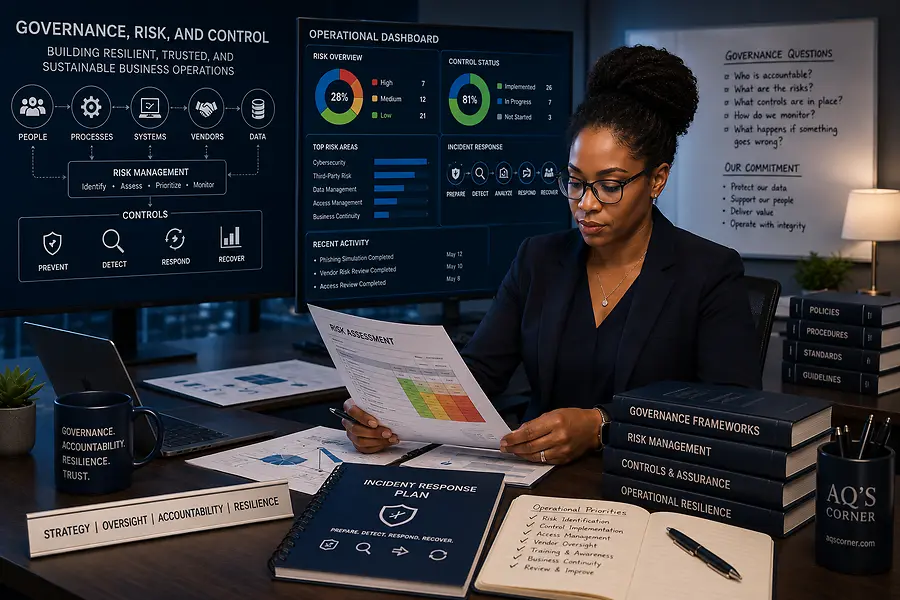
One of the things I have realized throughout my professional experience is that governance is often misunderstood as something reserved for large corporations, compliance departments, or heavily regulated industries.
In reality, governance already exists inside nearly every business operation, whether organizations formally recognize it or not. Every decision involving customer information, employee access, vendors, cloud platforms, AI tools, websites, communication systems, or operational workflows introduces responsibility, accountability, and risk.
That realization ultimately led me to publish a white paper titled Governance, Risk, and Control in Small Business Operations, focused on governance maturity, operational resilience, accountability, risk awareness, and the growing complexity surrounding modern digital environments.
The deeper I researched the topic, the more I realized how often small businesses adopt technology faster than they develop governance structures around it. Organizations now routinely rely on cloud platforms, AI-assisted tools, payment processors, remote collaboration systems, shared storage environments, digital communication platforms, and interconnected workflows that continue expanding operational complexity over time.
Modern businesses no longer need to be large to face operational risk.
Throughout my career, I worked in environments where governance, risk awareness, incident readiness, accountability, and controls mattered. That included reviewing incident response plans, participating in tabletop exercises, supporting governance-related operational activities, and working alongside environments where documentation, oversight, escalation procedures, and review processes were essential parts of resilience and continuity planning.
Those experiences shaped how I began thinking about Governance, Risk, and Control beyond compliance language alone.
One of the strongest themes explored throughout my white paper work is that organizations often do not recognize operational fragility until disruption exposes it. A phishing incident reveals weak awareness practices. A staffing transition uncovers undocumented dependencies. A compromised account exposes weak access management. A vendor issue reveals gaps in oversight or visibility that existed long before the incident itself.
What appears manageable on the surface is not always well governed underneath it.
One of the most important ideas explored throughout this white paper is that controls are not only technical safeguards. Controls also exist through operational behaviors, accountability structures, review processes, training, documentation, escalation procedures, and organizational consistency.
A weekly phishing review is a control.
A documented incident response procedure is a control.
A process for removing former employee access is a control.
The more I researched Governance, Risk, and Control in modern business environments, the more I realized many organizations are already performing governance activities informally without fully recognizing them as governance functions. Vendor approvals, AI usage decisions, access permissions, onboarding practices, operational reviews, and technology oversight all influence organizational resilience whether or not they are formally labeled as governance activities.
This becomes even more important as businesses continue integrating AI-assisted systems into daily operations. Many organizations are implementing AI-enabled workflows while conversations surrounding oversight, accountability, review expectations, and governance maturity remain underdeveloped.
One of the biggest misconceptions surrounding GRC is that it only exists to satisfy audits or regulatory requirements.
In reality, governance maturity increasingly affects:
- operational continuity
- workforce resilience
- customer trust
- incident readiness
- vendor oversight
- long-term organizational stability
The more I research modern digital environments, the more I believe one of the most important questions organizations should ask is not simply:
“What technology are we using?”
The question is:
“Do we fully understand the risks, responsibilities, and dependencies connected to the systems we rely on every day?”
And increasingly, I believe that question matters more than many organizations realize.
Featured White Paper
Governance, Risk, and Control in Small Business Operations
Read the Full White Paper
AQ’S Corner White Papers & Research Library
Explore All White Papers & Research


