Why Human-Centered AI Governance and Catastrophic AI Risk Are Not Separate Conversations
Why Governance Maturity Matters More Than We Realize in AI Development

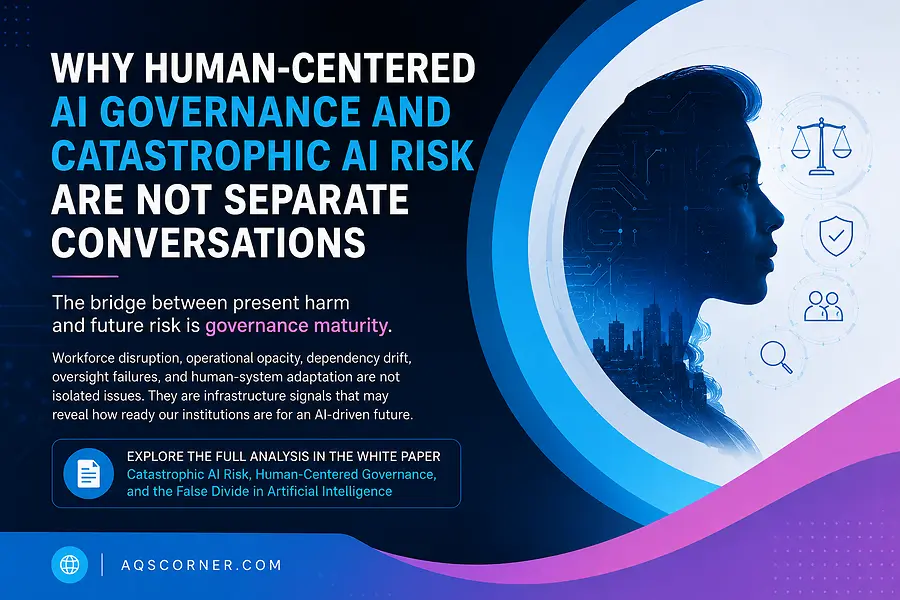
One of the biggest mistakes happening in artificial intelligence discussions right now is the assumption that catastrophic AI risk and human-centered governance concerns are separate conversations.
In many environments, AI discussions increasingly appear divided into categories. One side focuses on AGI alignment, autonomous systems, existential-risk discussions, and long-term civilization-scale concerns. Another focuses on workforce disruption, operational visibility, automation without oversight, emotional manipulation, dependency drift, and the practical governance concerns already affecting organizations and communities today.
The problem is that operational systems rarely fail in isolated categories.
Many governance failures begin quietly through smaller operational weaknesses before broader instability becomes visible. Accountability gaps, fragmented oversight, operational opacity, weak escalation pathways, and dependency-driven workflows may initially appear disconnected from larger AI-risk discussions. In reality, they often reveal how institutions behave under technological pressure.
That is why human-centered governance concerns should not automatically be minimized as “smaller” issues.
Bias, automation without meaningful oversight, workforce disruption, misinformation ecosystems, emotional dependency, and fragmented accountability structures are not simply implementation problems. Increasingly, they may function as infrastructure signals that reveal broader governance maturity challenges within modern AI ecosystems.
One of the most important questions organizations may need to ask moving forward is not simply how advanced artificial intelligence systems become, but whether institutions are developing the operational maturity required to govern increasingly complex digital environments responsibly.
As artificial intelligence becomes increasingly embedded in:
- business operations
- educational systems
- communication platforms
- productivity ecosystems
- operational infrastructure
organizations are becoming more dependent on systems they may not fully understand operationally. Convenience often accelerates faster than governance literacy. Over time, this creates environments where operational visibility weakens while dependency deepens.
Another issue emerging within modern AI environments involves what I often describe as dependency drift.
Dependency drift occurs when individuals or organizations gradually reorganize operational behavior around automated systems without fully recognizing the long-term implications of that adaptation. This may include overreliance on AI-generated outputs, reduced verification behavior, passive trust in automation, declining operational understanding, or the normalization of convenience-oriented workflows that slowly reshape human decision-making patterns over time.
The danger is not always immediate collapse.
The danger is normalization.
Human behavior increasingly adapts around system behavior. Many of these changes occur gradually enough that organizations may not recognize the operational transformation happening in real time. That is part of what makes governance maturity increasingly important within evolving AI ecosystems.
Unfortunately, many AI conversations are becoming polarized in ways that weaken broader governance discussions.
Some communities minimize practical governance concerns because they are not considered “big enough” compared to catastrophic-risk discussions. Others dismiss long-term AI-risk concerns entirely because present-day operational issues feel more immediate. Both approaches create fragmented governance thinking within interconnected technological environments.
Healthy governance discussions should be capable of holding both realities at the same time.
Organizations should be able to discuss:
- catastrophic AI risk
- alignment concerns
- long-term systemic implications
while simultaneously addressing:
- workforce disruption
- operational visibility
- digital literacy
- dependency management
- emotional manipulation
- human-centered oversight
These are not competing conversations.
They are layered governance responsibilities.
This thinking ultimately led me to publish the governance and operational visibility white paper, Catastrophic AI Risk, Human-Centered Governance, and the False Divide in Artificial Intelligence, which explores how present-day governance failures may reveal broader institutional readiness challenges as artificial intelligence ecosystems continue evolving.
Download White Paper (PDF)
Catastrophic AI Risk, Human-Centered Governance, and the False Divide in Artificial Intelligence
The future of artificial intelligence governance may depend not only on technological advancement, but also on whether organizations, institutions, and communities develop the operational maturity required to maintain visibility, accountability, resilience, and meaningful human oversight as systems become increasingly complex.
Because the bridge between present harm and future risk may ultimately be governance maturity itself.
You can explore additional governance and operational visibility resources at:
AQ’S Corner


