You're Not Falling Apart. But You're Not Okay Either. Here's Why.
Understanding Nervous System Burnout and How to Reclaim Your Body's Ability to Rest

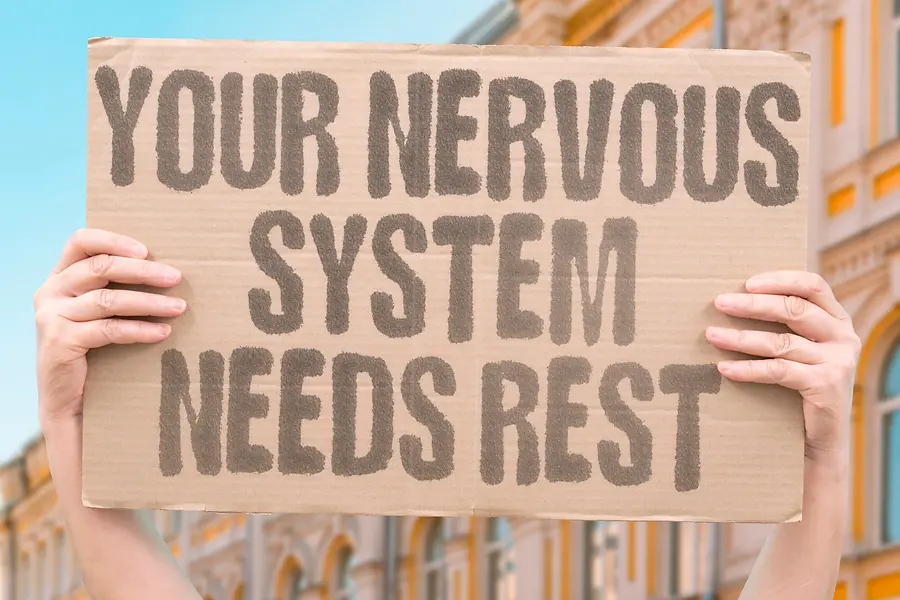
You're Not Falling Apart. But You're Not Okay Either.
Here's Why.
By Tanvi Patil | Founder of HealingRhythmRx
Board-Certified Pharmacotherapy Specialist | Breathwork & Sound Healing Practitioner
Let me tell you about the kind of tiredness that sleep does not fix.
You are not sick. You are not falling apart. You are not even dropping any of the balls you are juggling.
By every external measure, you are doing well.
But something feels off.
Your mind does not fully slow down at night. Your body does not fully relax on the weekend. Even when things are calm, there is still a low hum of pressure underneath everything, like a laptop with too many tabs open. Technically running, but slower than it should be.
I know this feeling. I lived in it for years.
And for a long time, I called it the wrong thing. I called it responsibility. I called it drive. I called it “what it takes to succeed.”
The Burnout Nobody Names
Here is what I have learned from working with high-functioning women, and from navigating this myself as a clinical pharmacist and healthcare leader:
The most common form of burnout in high-achieving women does not look like collapse.
It looks like this:
You are still showing up. Still delivering. Still taking care of everyone and everything.
Your clarity is not what it used to be.
Rest does not feel restorative anymore.
You feel like you are constantly running, but you are not sure what you are running toward.
And the most confusing part? You are doing everything right. So why do you feel this way?
This Is Not a Mindset Problem. It Is a Body Problem.
I spent over a decade as a clinical pharmacist. I was trained in cardiology, pharmacogenomics, disease mechanisms, and patient outcomes. I understood how the body responds to stress at a cellular level.
But here is what most of us, even those with medical training, are rarely taught:
Chronic stress does not just live in your mind. It lives in your body.
When you are under prolonged pressure, which is often the reality for high-functioning women, your body activates the HPA axis, your central stress-response system. Your adrenal glands release cortisol, your primary stress hormone. In short bursts, cortisol is helpful. It sharpens focus and helps you get through demanding situations.
But when cortisol stays elevated day after day, the research tells a different story.
Chronic elevated cortisol can:
Interfere with sleep quality
Reduce prefrontal cortex activity, the part of the brain responsible for decision-making and clarity
Disrupt hormonal balance
Impair memory and focus
Accelerate cellular aging at the level of telomeres
A landmark study published in the Proceedings of the National Academy of Sciences found that chronic stress is directly linked to shorter telomere length, meaning cells may age faster than they should.
This is not about being stressed sometimes. It is about living in a body that has been running an alarm system continuously for years. And that comes with a biological cost.
The Moment I Started Listening Differently
My shift did not come from a better strategy or a more organized calendar.
It came from learning to listen to the signals my body had been sending for years—the signals I had become very good at ignoring.
That is what led me to breathwork, sound healing, and somatic practices. At first, I came to them personally, as someone who needed them.
But what I discovered, and what research continues to support, is that these tools work at the same physiological level where stress is stored.
What the Research Actually Says About Breathwork
Your breath is one of the few things you can control that directly changes your body’s stress chemistry.
When you slow your breathing down, your heart rate variability increases. That is your nervous system shifting from alarm into recovery. A review of more than 200 studies confirmed this happens both during and after slow-breathing practices.
When breathing slows to roughly four breaths per minute over an eight-week period, cortisol levels measurably decrease. The same research also showed improvements in focus and mood.
Slower breathing also quiets the brain. Studies measuring brainwave activity found that breathing fewer than ten breaths per minute consistently increased alpha waves, the brain state associated with calm and present awareness, while reducing anxiety and tension.
Across 58 clinical trials, relaxation and breathwork-based practices produced measurable reductions in cortisol levels. These results were not anecdotal—they were replicated repeatedly.
Consistent breathwork operates at the same physiological level where stress is stored. That is what makes it different from many other approaches people try when they are running on empty.
What Nervous System Burnout Actually Feels Like
Most women I speak with have never heard it described this way. And the moment they do, something shifts.
Nervous system burnout is not dramatic collapse. It is quieter, and far more common.
In your body:
Tight jaw
Shallow breathing
Disrupted sleep despite exhaustion
Evening restlessness
Slow recovery from stress
In your mind:
Decision fatigue
Mental fog
Reduced tolerance for noise, demands, and uncertainty
In your energy:
Not a crash, but a steady, quiet depletion that never fully restores.
In your sense of self:
Managing life rather than living it. Performing rather than being present.
If you are nodding as you read this, your nervous system is not broken. It has adapted. It learned that “on” is the safest setting.
And it can learn something different.
The Four-Phase Framework I Use With Clients
Through my clinical background and somatic training, I developed a four-phase approach called HealingRhythmRx.
Phase 1: Regulate
Before anything else, your body needs to feel safe—not conceptually, but physiologically.
We use breathwork, sound healing, and nervous-system tools to shift the baseline and send one clear signal: the threat has passed.
Without this, everything else is built on tension.
Phase 2: Release
Stress does not disappear simply because circumstances change.
Somatic research suggests the body can store unresolved stress as physical tension patterns. This phase allows for gentle release without overwhelming the nervous system.
Often, this is where people experience a true exhale for the first time in years.
Phase 3: Restore
As the nervous system settles, something changes.
Sleep deepens. Energy stabilizes. Mental clarity returns—not because of increased effort, but because resistance has been removed.
The body already knows how to repair itself. It simply needs the conditions to do so.
Phase 4: Reconnect
This is where healing becomes sustainable.
You reconnect with your voice, your intuition, your body, and your ability to lead from grounded energy instead of survival mode.
You begin operating from fullness rather than depletion.
Why This Is Different From What You Have Already Tried
You may have tried therapy, yoga, meditation, supplements, time off, or stronger boundaries. And some of those tools may have helped. They are valuable.
But if you returned from vacation still exhausted, if meditation apps sit unused because you are too depleted, or if boundaries collapse under pressure, there is a reason:
Surface-level interventions cannot fully resolve a nervous system adapted to chronic stress.
You can reorganize your life and still carry the same internal state into every environment you enter.
The nervous system stores patterns physiologically. To shift those patterns, you need tools that work at the same physiological level.
This is where breathwork, sound healing, and somatic work can help—not as trends, but as evidence-informed interventions.
What Becomes Possible on the Other Side
This is not about becoming someone new.
You do not lose your ambition.
You do not lose your drive.
You do not lose your commitment.
What you lose is the cost:
The constant tension
The hidden depletion
The feeling of running on borrowed energy
What becomes possible is leading from clarity instead of pressure. Performing from fullness instead of exhaustion. Resting—truly resting—without guilt.
Being present in the life you have built.
A Different Definition of Success
For many high-achieving women, success has meant holding everything together. Delivering. Pushing through.
And there is real strength in that.
But eventually, the body asks for something different. Not less ambition, but a different way of carrying it—one that is sustainable, grounded, and human.
That is the work.
And it begins with one honest question:
What would it feel like if your body finally felt safe enough to rest?
Tanvi Patil is a board-certified pharmacotherapy specialist and founder of HealingRhythmRx. She integrates more than a decade of clinical pharmacy leadership with breathwork, sound healing, and somatic practices to help high-functioning women move from chronic stress to regulated performance. Based in Roanoke, she is available for keynote speaking, corporate wellness programs, and one-on-one work.
HealingRhythmRx
LinkedIn Profile