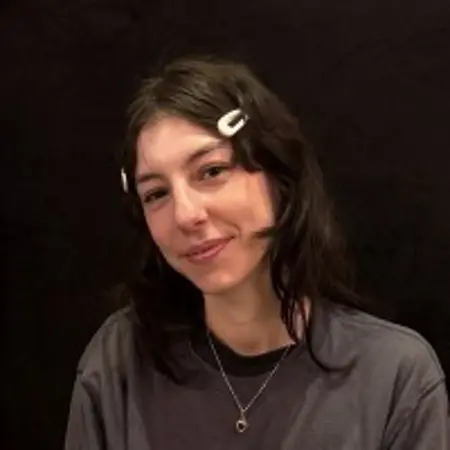
Her Story
About Dalila
I started my career by going to art school at the Cooper Union for the advancement of science and art in New York City, where I focused on graphic design and sculpture. I spent most of my time there working on how to bridge the gap between scientists or engineers and artists, developing communication between disparate academic backgrounds. After that, I took some time off and worked in the arts world as an artist assistant and in a ceramic studio for a long time. I was making no money and was depressed about that, even though I felt like it was a valuable aspect of society. It wasn't well remunerated, and I had to find a way to transform that into something that could potentially be made into a more sustainable career. I had family, mentors, and professors, mostly women, who allowed me to bounce ideas off of them, which has been a crucial part of making it this far. Now I'm working in the government relations sector through urban planning, where I do a lot of equity and data-driven work. I'm working on map making to facilitate the public's use of government data, spending a lot of my time on data analysis and data visualization. I'm also completing my master's in urban planning at SUNY Albany with a concentration in environmental planning, which I've been doing while working for two and a half years. I'll be completing my master's in May and finishing my thesis on agricultural land protection.
Her Interview
Ten minutes with Dalila
01What do you attribute your success to?
I think there have been a decent amount of people that have supported me, my family definitely. I went to art school and was making no money, I was depressed about that, even though I felt like it was a valuable aspect of society. It wasn't well remunerated, and I had to find a way to transform that into something that could potentially be made into a more sustainable career. Having other people come to you and bounce ideas off of you, your family, mentors, professors, mostly women I should say, has definitely been a crucial part of making it this far, although I hope to make it further, who knows?
02What’s the best career advice you’ve ever received?
I think I've spent a lot of time thinking about our why. This is particularly pertinent to people working in public service and in government, but if you can remember why you're doing what you're doing, it makes it a lot easier to make your decisions in terms of guiding yourself forward in your career. So having a strong guiding mission has been really helpful for me.
03What advice would you give to young women entering your industry?
I think a lot of women have been socialized to not see themselves in the highest possible position. I don't really think it's necessarily everyone's goal or desire to be the CEO or be the owner of a company or whatever we view as the highest position, but I think we end up cutting ourselves off at a point that feels comfortable, that feels like it's somewhere we've seen ourselves. My advice is to try to look beyond the place that you've seen yourself, and even if you look and you see and you think that's not actually where I want to be for one reason or another, just being able to imagine yourself as far as you can has the potential of opening up new possibilities.
04What are the biggest challenges or opportunities in your field right now?
Planning is a pretty small sector. A challenge is that it is not necessarily a licensed profession like engineering or architecture, and so your skills are often labeled more under the managerial or soft skill realm. I do do a lot of mapping, which I try to make up for feeling inadequate sometimes in that way, but in reality I think the distinction between hard and soft skills is not very helpful for the world. When you're in a sector that isn't licensed, it can be much more difficult to ascertain what level someone is working at, and it's more about the connections you make and how good you are at interacting with the public, with the community, and it's much harder to quantify that. So sometimes that can be very difficult in both the hiring sense and in trying to present yourself in the field. In terms of opportunities, the urban landscape is constantly changing, and we have things like climate change to deal with and we have housing crises. There's no shortage of issues that are touched on by the urban planning field, and so there really isn't a shortage of challenges but opportunities just as much in terms of what sorts of innovation can come and how to improve people's relationship to urban space.
05What values are most important to you in your work and personal life?
In my work, we do a lot of equity and data-driven work, making sure that decisions are being made off of really salient and well thought out and well collected data. Making sure that that data is accessible to the public so that everyone has access to the same information and no one is being left out. I hope that's also pertinent in my personal life, but I think these days finding time to really spend time with people and having a balance between work and your private life is a really important value.
Join Influential Women and start making an impact. Register now.