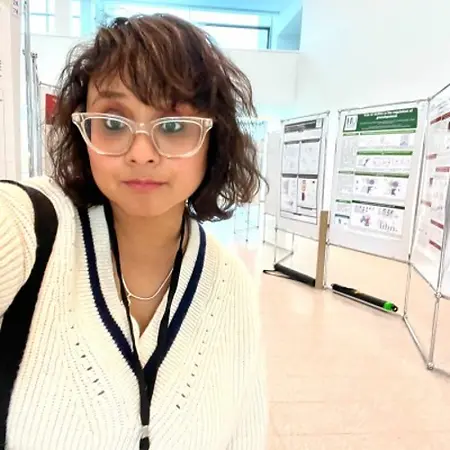
Her Story
About Deepti
I have been in academic research for over 10 years, starting from my post-masters work in India and completing my PhD in Sydney in 2019. After my PhD, I did my first postdoc in the Netherlands at the University of Groningen, and since January 2023, I've been working as a postdoc researcher and visiting fellow/scientist at NCATS (National Center for Advancing Translational Sciences), an NIH Institute. At NCATS, I develop assays for high throughput screening, which is unique because we work with 1536 well plates - something unusual in academic settings where most people stick to 96 well plates at max. I also generate cells from iPSC-derived macrophages, while most people stick to immortalized cell lines. NCATS has a collection of all approved drugs from the European Union, Japan, Australia, and the FDA banked in our facility, and we miniaturize our assays to do high-throughput screening in very tiny wells. This expertise is what pharmaceutical companies do, so working at NCATS means you're good to work at a pharma company. I see NCATS as having the best of both worlds - it doesn't work purely as an academic university lab, but it doesn't work as a biotech pharma company either. It's sort of a mix of academic research and biotech research, positioned right in between.
Her Interview
Ten minutes with Deepti
01What do you attribute your success to?
I think I'm very high on emotional intelligence, and I'm very resilient. Even if things are not working out, I don't give up. In science, experiments often don't work - they say 90% of the time experiments don't work, and just 10% of the time they work. So if somebody is not resilient and at it all the time, then chances are for being not motivated. My resilience and refusal to give up, even when things aren't working, are the reasons I've been able to reach this far. Though I have to admit, these are also the reasons for being burned out, because you don't give up.
02What’s the best career advice you’ve ever received?
The best advice I received was from my PhD advisor. He told me that sometimes as a researcher, you end up finding something which is going against the norm, and then you become hesitant about what you have found or what the results are indicating. His advice was to be truthful to myself and stick to what I'm seeing. He said don't be hesitant about it - if that is the truth, do your best to your ability, and then stick to it. Don't be jittery about it. This advice has really shaped how I approach my research work.
03What advice would you give to young women entering your industry?
I would say just follow your heart and be passionate. The field that I'm working in, science, requires a lot of rigorous work. You need to be really, really passionate about it because there are times when things don't work - most of the time they don't work. We go to a lab and do experiments, and experiments often don't work. They say that 90% of the time experiments don't work, and just 10% of the time they work. So if somebody is not resilient and at it all the time, then chances are for being not motivated. So be very passionate about it, true to your character, and resilient. I would really like to see more women in my field because even now, even with so many people talking about it and so many support for women by society and otherwise, gender equality is not there in my field, in science. You look at Nobel Laureates - there's hardly women scientists who have been getting recognition. There are less women at the leadership positions, and this is the case in America. Think about other countries where women don't have rights and privileges - it's even less.
04What are the biggest challenges or opportunities in your field right now?
I think the biggest challenge is that there are different models of doing research. One is academic research, which universities do, and there is translational research, which biotech pharma companies do. The academic research labs do good research, but often it leads to dead ends - whatever they're looking at never goes to clinical trial stage. There should be more cross-disciplinary work or team collaboration between biotech and academic researchers, which doesn't happen for many reasons. Maybe they don't know how to do it, there's no mechanism, I don't know. I'm saying this because all my education and training has been in university settings, and now I'm part of NCATS, which is sort of a mix of academic research and biotech research, right in between. So I can see the difference. NCATS doesn't work as purely as academic university labs, but it doesn't work as biotech pharma companies either - they say it has the best of both worlds. People should collaborate, they should talk and have more multiple projects where they're talking to each other. If somebody's working at academic labs, they should reach out to companies and see whether they can take over, because pharma companies have a lot of money. They can do research on a larger scale - maybe recruit 200, 500, or 1,000 patients from hospitals because they have money. Academic settings don't have that, but they have dedicated workers, which are often PhD students or postdoc researchers. The world would be a better place if they came together, because then the solution to a problem would be reached faster if they worked together.
05What values are most important to you in your work and personal life?
Integrity, honesty, and being truthful are the most important values to me in both my work and personal life.
Join Influential Women and start making an impact. Register now.