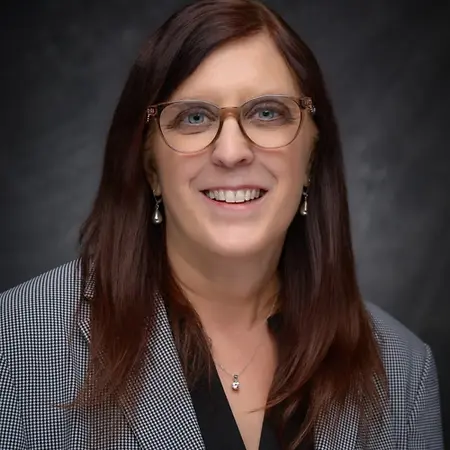
Her Story
About Donna
I have dedicated over 26 years to higher education leadership, serving as Provost and Senior Vice President for Academic Affairs where I oversee the entire academic enterprise including all academic programming, faculty support, student success, and enrollment management. My most notable achievement has been turning around a university that was on the brink of closing with a $22 million operational budget deficit. I was instrumental in mitigating that deficit and was responsible for the first enrollment growth in over a decade. I led the university in developing its first academic master plan and strategic enrollment plan, and positioned the institution so that two large universities competed to merge with it. My career path has taken me from classroom teacher to school administrator in public schools, then to professor in educational leadership and curriculum, department chair within a college of education, College of Education Dean, and now to my current role. I am excited to be moving to Hudson Valley Community College where I will serve in the same leadership role and also oversee workforce development, connecting academic programming directly to workforce needs. Throughout my career, I have been driven by my why statement: I create conditions so that those whom I serve can thrive. I am passionate about the transformative power of education, particularly for first-generation students and those from underserved communities, and I believe that schools are the fulcrum of how society grows and improves.
Her Interview
Ten minutes with Donna
01What do you attribute your success to?
I go back to my dad. My dad hung the moon. He was a nuclear physicist, and I grew up in a home with a father who set such an amazing, powerful example. I grew up always wanting to be smart, like my dad. He was the first person who believed in me. When I was very young, he was working on a master's in industrial management and had to take one of those leadership assessments as part of it. I was probably only 10 or 11 at the time, and he handed it to me and asked me to take it. After I took it, he laughed and said, yeah, you need to go into management. At the time I was so quiet and shy, I would have never seen that in myself. But there was something he saw in me that somehow kind of set me on a track that made the difference. He was the first cheerleader, the first person that very quietly believed in me. My admiration and adoration of him, and his constant faith in me throughout my life, was what made the difference all along and kind of led me down the path of every goal I set.
02What’s the best career advice you’ve ever received?
The best career advice I've ever received wasn't anything directly stated, but rather learned by example. My very first administrative position was with this incredible woman, Vicki Denmark, and the way she led with integrity taught me everything. I've somehow managed to always walk into organizations experiencing crisis - my first position as an assistant principal was one of crisis, my first position as a dean we experienced crisis, and certainly here at NJCU we've experienced crisis. Because of my first position as an assistant principal and watching how she conducted herself as a female leader in a very male-dominated situation in rural Georgia, no less, a very fundamentalist community, and led with such grace and integrity and strength, I learned so much from her example on what it means to be a female leader, leading with strength and integrity through crisis. I've taken that with me in every situation I've been in, and to me, that was the best advice - through her example.
03What advice would you give to young women entering your industry?
I would say it's so very important to really build a strong sense of self and to build a strong network of people they can trust. By that, it can be that one trustworthy soul. I call them bold truth-tellers. When I went on my interviews, people often talk about going on listening tours, and I say, no, I don't do listening tours. I gather data from people in safe spaces, and then I find a few bold truth-tellers who are willing to talk to me, even though I know they don't trust me, but they're willing to tell it like it is. You've got to find people who are willing to tell you things you don't want to hear, and you've got to build a thick enough skin and a strong enough sense of self that you can hear things from people that you may not want to hear. That's a hard thing to do. You need to get to an emotionally healthy state where you are willing to be mutually vulnerable with someone. Whatever it's gonna take, be it therapy or whatever exercises emotionally you need to do to get to a point where you can be mutually vulnerable with others, you gotta get to that state in order to have the potential to grow into a leadership position. Until you get to that, you're not really going to be able to make the kind of changes within an organization that it's going to need, especially the way things are changing today.
04What are the biggest challenges or opportunities in your field right now?
Higher education is changing at such a pace. Only 22% of Americans have any faith in higher ed right now. Universities are closing right and left. My university, most of the people I love are losing their jobs as we speak, and it's absolutely gutting me. It is a very difficult time right now. I have, for the past 10 years, been kind of sounding the call about how we need to change. We're drowning in our own varnish. We have to always be prepared for change. You have to be at a place where you are always in a position of mutual vulnerability, willing to learn from one another, willing to learn from industry, eager to partner. One of the things I'm most excited about is that the president of Hudson Valley Community College, when he hired me, actually changed the structure of his college so that I'm also going to oversee workforce development. Academic programming has to be connected to workforce development because this is how higher ed is changing. Not everyone is seeking a degree anymore. We have to be ready for the changes, and we can never rest on our laurels, because as soon as we make those changes, we have to be ready for the next iteration of changes. We can't see any change as an enemy. A lot of university professors look at AI as an enemy, and I'm like, absolutely not. It's a part of reality, so how do we use it? How do we see it as a part of who we are and what we do and make it part of our classroom? That is gonna make or break folks in higher ed. Either you wake up terrified of the changes, or you wake up every morning saying, bring it on, what's next? I'm of the position of the latter.
05What values are most important to you in your work and personal life?
I think the most important values to me are self-reflection. Making sure that I stop and reflect, and that I don't internalize what's happening. I think particularly as a female in a leadership position, I've seen so many women struggle because they internalize what's happening in their particular context. Women that I've mentored in leadership programs, I have to always say to them, this isn't about you. You've got to step out of it, and you've got to look at it. To me, that's so important - to stop, reflect, look at the situation. Having been an assistant principal, having been yelled at, cursed at, called names, it teaches you to say, this isn't about me. That's one of those most important skills as a leader, is to be able to self-reflect, look at a situation, and analyze it, and understand this isn't about me. Let me look at the situation and figure out how we need to solve it. When I know it's not about me, I can be more empathetic and say, what's going on in that person's life? What's going on in their situation that I need to solve? What are the conditions here that I need to improve to help others? To me, that's been the most important thing.
Join Influential Women and start making an impact. Register now.