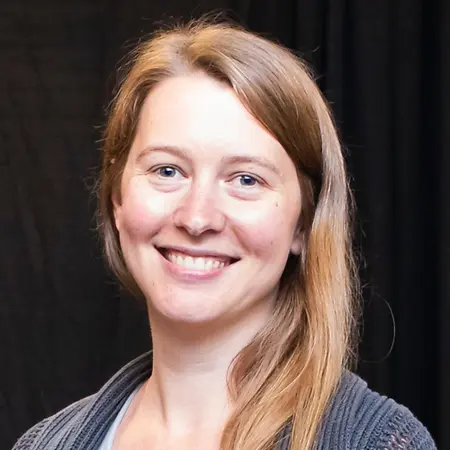
Her Story
About Faith
I'm a non-traditional student who started at community college off and on for about five years while supporting myself after high school. I transferred to Smith College for my junior and senior years, where I lived off campus and worked to support myself, graduating in 2010 with a bachelor's degree in Spanish and Latin American History. For about ten years after that, I worked in a wide range of direct care, social work, and public health positions as a bilingual English-Spanish speaker, including working with teen parents, helping individuals experiencing homelessness obtain medical care, and providing patient navigation for individuals living with HIV and co-occurring substance use and mental illness. These positions were really high stress, high burnout, and low pay, and I realized they weren't sustainable for me long-term. I wanted to have a bigger impact, so I enrolled at the University of Massachusetts Amherst in the School of Public Health and Health Sciences, Health Promotion and Policy Department in 2017, where I gained mixed methods research experience conducting both quantitative and qualitative research methods. I graduated with my MPH in 2019 and went straight through into the PhD program. During my master's program, I really loved being a student and doing research, and I found that I was good at it, so I decided to continue on. I never intended to fall into cannabis policy, but was offered an internship with the Cannabis Control Commission in Massachusetts, and that is what led me to conduct that kind of research. I obtained my doctoral degree in February 2025 after giving birth to my daughter during my first semester of my doctoral program and COVID hitting six weeks later, graduating on time with my cohort in spite of that. I immediately started my current role as a Postdoctoral Research Fellow at Johns Hopkins University Bloomberg School of Public Health in the Drug Dependence Epidemiology Training Program.
Her Interview
Ten minutes with Faith
01What do you attribute your success to?
I think my success ties back to curiosity and a desire to learn about as many different things as I can, and being open-minded to different ways of thinking and being. I also have tremendous support and encouragement from my husband, who has been my number one cheerleader, as well as my family overall, who have been incredibly supportive. Having someone who believes in you really does help. Everyone has good days and bad days, and it's nice to know on the bad days someone says you can still do it.
02What’s the best career advice you’ve ever received?
I can't remember someone ever explicitly saying something that changed my path, but if I could reflect on my academic journey, it would be to follow your curiosity and be open-minded to your curiosity. For example, I never intended to fall into cannabis policy, but was offered an internship with the Cannabis Control Commission in Massachusetts, and that is what led me to conduct that kind of research. Being open to where your curiosity takes you can lead to unexpected and meaningful career paths.
03What advice would you give to young women entering your industry?
I'm a number one supporter of higher education, and so I would encourage everyone to go to college and really lean into the voice in the back of your head telling you what is most interesting to you. I would also recommend aligning yourself with people who lift you up and who lead with kindness, rather than aligning yourself with perhaps the most world-renowned researcher, or someone who on paper might look really impressive. I think it's more important to establish respectful and kind relationships that are really defined by mutual respect and kindness, because you can't do this type of work alone. Having people who are mentors who are available to support you, rather than make you second guess why you're pursuing what you're doing, is really crucial.
04What are the biggest challenges or opportunities in your field right now?
Public health as we know it in the United States has been pretty systematically dismantled under the Trump administration, and that has had really significant impacts on the field, as far as our ability to obtain funding to conduct the research that we do, as well as academia kind of as we know it being really threatened by the Trump administration. There has been a significant loss in funding and resources to academic institutions that focus particularly on public health research that centers health equity, that centers structural racism. For those of us who are committed to pursuing those lines of inquiry, it's very challenging to find the funding to do our work, to find positions to pay us livable wages, and that's incredibly challenging right now.
05What values are most important to you in your work and personal life?
When it comes to research, I think the most important thing for me is to involve the individuals who I'm researching, to really center the voices of the people who I'm trying to help, rather than make assumptions about what help I think they need. It's really important to engage the communities that you're working with and make sure that you're asking the right research questions based on what they identify research needs to be. I also think it's crucial to center health equity and the role that structural racism has played in shaping pretty much all of the systems in which we live.
Join Influential Women and start making an impact. Register now.