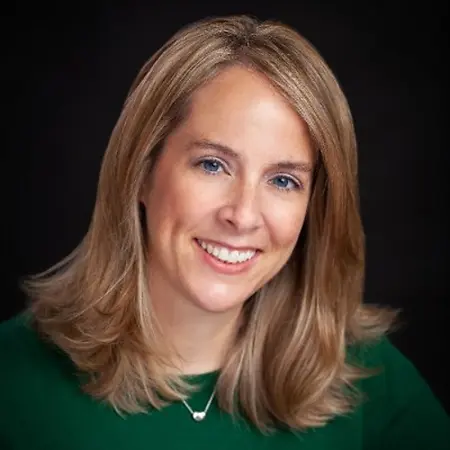
Her Story
About Karen
I've been in my field for over 20 years, starting when I finished my education and took a position at Kessler Foundation as a postdoc in 2005. I did a 2-year postdoctoral fellowship at Kessler Foundation, which included a great deal of training in rehabilitation research, grant writing, and clinical experience. Because Kessler Foundation is located inside a rehabilitation hospital, it gave me direct access to patients and experience working with them. After those 2 years, I was hired as a research scientist and I've been there ever since. My background is in biomechanics, and what biomechanics is, is the physics of human motion, studying bones and muscles and how they coordinate within the human body to create motion. My original passion in life, and still is, is sports. I love all things sports, watching sports, playing sports, and really, sports is biomechanics in action to conduct an athletic event. What I do in my job is I use biomechanics to help restore function after a neurological injury or neurological deficit. After a stroke or a brain injury, which is really the population that I deal with, there's usually motor challenges, and so what we try to do is novel strategies or interventions that could be technology, motors, robots, or a novel clinical approach to help restore motor function. That could be movement, coordination, balance, or the combination of all of that to restore walking function. I work at a really amazing place. Kessler Foundation is very passionate about really improving the lives of individuals with disabilities. We have a tremendous infrastructure to do really comprehensive clinical trials research, looking at mechanistic changes in neurophysiology as well as functional changes, which really impacts the participant or patient's quality of life immediately.
Her Interview
Ten minutes with Karen
01What do you attribute your success to?
I work at a really amazing place. Kessler Foundation is very passionate about really improving the lives of individuals with disabilities, and I've worked there for the majority of my career. We have a tremendous infrastructure in order to do really comprehensive clinical trials research, looking at mechanistic changes in neurophysiology as well as functional changes, which really impacts the participant or patient's quality of life immediately. The population that we deal with is amazing, and they just want to get better, but they also want to make the experience for the next person that has a stroke or a brain injury better. It's an amazing group of people to work with who really want to help the next person who unfortunately has to go through this injury or incident. I was also really lucky that I got great training in grant writing, so I've been lucky enough to have a great team around me, which includes engineers, physical therapists, and research assistants. They've been with me for a long time. My team has been together a really long time, and so we're able to implement the grants that we get in concert. We work together with multidisciplinary fields to really make it all work, and I've been very fortunate to get grant funding. My applications have been funded by the Department of Defense, National Institutes of Health, and NIDILRR. I think I've gotten over $25 million over the last 20 years, which is pretty amazing. I've been really fortunate to work with amazing company industry partners who are startups and established institutions who come up with really interesting and novel devices, that they're willing to take feedback on how to improve the devices after the research, and we are also very fortunate to be able to connect with them and collaborate with them to really be able to investigate the state of the art to make a huge impact on patient care and patient recovery.
02What’s the best career advice you’ve ever received?
That's very easy. That's from my mom. She said something you love to do, and get someone to pay you for it.
03What advice would you give to young women entering your industry?
I would say make sure, make sure whatever you do for your employment, you love it. I think having more women in STEM fields is amazing, and I think we should push for that moving forward. Really, having a good foundation in math and science in your education is important, and really applying what you learn in school makes it really fun to do your job. It's one thing to, especially in research, research can sound really boring, but the truth is, it's very exciting, and it's very innovative, and it changes every day. I get the opportunity to ask really interesting questions, and then I just get to find the answers through research. And so, if you are interested in a research career, just stay curious, and keep asking questions, and that's gonna drive the clinical innovation, and then you know, grants will get funded, because it's a very interesting and innovative field and question, and people will want to know the answer with you, so your grants will get funded.
04What are the biggest challenges or opportunities in your field right now?
I think the most exciting thing is the ability to do research on really novel devices that are coming out, and really novel robotics from industry. The challenge is that we really need to get efficient and enough efficacy data. We usually are able to get safety and feasibility data for FDA clearance. But the challenge is getting enough efficacy data, meaning the data that shows the device will work in a large population to really make a big impact and is superior or equivalent to what we're doing now. And so efficacy data takes a longer amount of time, and usually requires a longer amount of research. And so while we often get FDA clearance for a lot of these devices, in order to implement them into clinical practice, it requires a greater amount of research data, or clinical trial data, before it can actually become standard of care.
05What values are most important to you in your work and personal life?
I think teamwork and integrity. In order to do what we do, it takes a really solid team, and it also takes trust. We have protocols that we have to fulfill, and protocols that we have to follow. And also, the participants and patients that we interact with trust us to keep them healthy and keep them safe and, you know, make the right choices. And also the data that we have and we publish, we want the public to trust what we're publishing. So, I think teamwork and working together, and all working toward continuous, the trust in order to have, you know, high integrity and publish really quality research.
Join Influential Women and start making an impact. Register now.