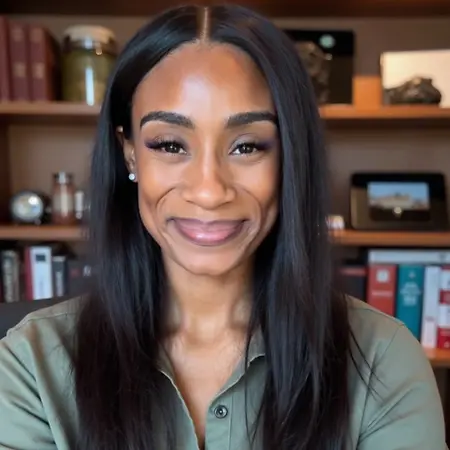
Her Story
About LaShata
My professional life is a blend of executive leadership, organizational strategy, and curriculum design. I've been in education for 10 years and transitioned to nonprofit work 3 years ago, though I still work closely with higher education institutions, universities, and the college market, specifically pre-law and law students. My days are systems-oriented - I'm building systems, working on training programs, and being intentional with recruitment strategies. In the mornings, I check organizational priorities, respond to leadership communication, review deadlines and contracts, and problem-solve. I'm often reviewing presentations and working on convention education and learning management systems. In the evenings, I do advocacy work through my nonprofit, Black Girls Who Live, and my education wellness agency, Carrying the Weight, focusing on wellness and mental health. I'm naturally emotionally intelligent, drawn to deep conversations and intentionality, and I'm passionate about neurodivergent learners and creating inclusive spaces for people with different lived experiences.
Her Interview
Ten minutes with LaShata
01What do you attribute your success to?
I attribute my success to my faith in God, for sure. I am a believer. My mother, who had me at a young age, and my grandma - my mother was on her own since she was young. I have a strong family of women who have not allowed me to give up on myself. That's a testament to who I am today. My faith in God and my strong family of women are the foundation of everything I've accomplished.
02What’s the best career advice you’ve ever received?
The best career advice I've ever received is to not be afraid to try something new. You can change your mind in careers. My career has been a testament of trying something new every time. I went from being a special education teacher to working with college students, and now I'm working in a nonprofit doing training and development for pre-law and law students. It's a testament of not being afraid to try something new.
03What advice would you give to young women entering your industry?
My advice to women entering my industry is to be intentional, be strategic, and be creative. Realize that your capacity matters. Understand where your energy goes, who has access to you, what systems support you, and what version of success is actually sustainable. When you're coming into nonprofit or people-helping industries like mine, try to figure out where your energy goes and what fills your cup the most. Who has access to you, whether that's in work or outside of work? What systems best support you - whether that's AI, the community you build outside, or professional associations you're a part of? And what version of success is actually sustainable? Even within this industry of training and development, we keep building and building, but is it sustainable for you? Have the answers to those questions as you're entering into this field.
04What are the biggest challenges or opportunities in your field right now?
The opportunities in my field include the ability to transform, to be creative, to reassess what learning and training looks like, and to really have the art and the science to things when it comes to training. I'm able to build connections, develop workshops, do wellness work, infuse my values into different places, and build scalable systems. I'm able to become more process-minded because I'm doing a lot of different things. The challenges are that it's carrying too much mentally - my brain holds ideas, responsibilities, leadership, and creativity all at once, and that's a lot to be carrying. I also have difficulty separating my identity from my responsibility and my work. A lot of high-achieving women have that issue as well, where I have my work professionally, but I also have my mission in life, which can overlap with some of the work that I do. So it can make it hard to rest, disconnect, or delegate because you don't want to disappoint people and you're very passionate about what you do. Another challenge for me is wanting spaces that stay surface level - I'm naturally an emotionally intelligent, deep conversation, intentionality type of person, and sometimes when you don't have environments or relationships or spaces that support that, it can be frustrating or disappointing.
05What values are most important to you in your work and personal life?
The values most important to me are integrity, respect, wellness, and humility. I really live by integrity and doing what you say you're going to do. Respect is another big one for me - do what you say you're going to do and live by those things. Wellness is crucial - the well-being of myself and the well-being of others is through and through. I care deeply about neurodivergent learners, being one myself, and I also care about spaces as it relates to different people and different lived experiences. That's where a lot of my advocacy work comes from. And humility - I'm very humble for all the things that I've received as a first-generation college student, and I'm grateful to even be in this life that I get to live now.
Join Influential Women and start making an impact. Register now.