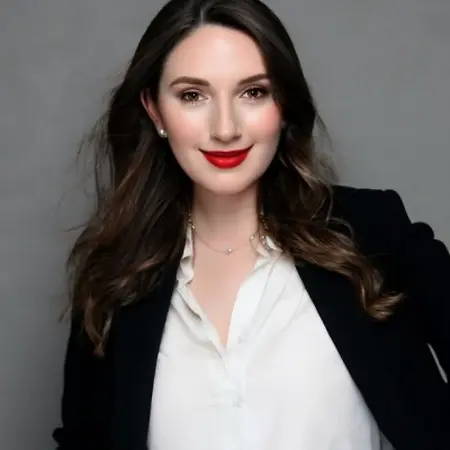
Her Story
About Lauren
I began my career as a teacher in New York City, teaching 9th and 12th grade in the South Bronx and middle school in Harlem. After seeing how our schools were failing black and brown kids, I realized I could make a larger impact in the nonprofit sector, outside the bureaucracy of the school system. I quickly learned that while I knew how to work with kids, I didn't know how to run a business. I saw a huge gap in the nonprofit sector - even though we're non-for-profit, you still have to make a profit to keep the lights on. This insight launched my 15-year journey in the nonprofit sector, focused on teaching nonprofit leaders to be strong business owners so they can make a larger impact. I grew two nonprofits from the ground up: Practice Makes Perfect and Suit Up, which taught career readiness to students from underserved communities - not just what you wear, but the hard and soft skills needed to be successful outside the classroom. Now, as Executive Director of Gratitude Network, I oversee our fellowship program working with 30 leaders every year from 30 different countries, and I work with our alumni network of over 400 nonprofit leaders. A lot of my day-to-day involves being the spokesperson for Gratitude Network and advocating for why leadership development is important in the nonprofit sector. Through our work, these 400 leaders are serving over 200 million children across the globe, which is one of my favorite stats - even though I'm not working directly with 200 million children, the leaders I'm coaching are, so if we make sure those nonprofits are doing well, the world's in a really good place.
Her Interview
Ten minutes with Lauren
01What do you attribute your success to?
I would say having my mom as an incredibly strong leader has been foundational - she's the dean of a business school out in LA, at LMU. Having an incredibly strong female leader as a mother showed me that I could do anything, and that running a company is the norm, not something that's for other people. Getting to see a very strong female professional grow up and sit at the dinner table with me definitely shaped who I am. The only other thing I would say is being an athlete. So much of what we learn as athletes is our grit and perseverance and getting back up when you fall down. Especially in running startup nonprofits, there's a lot of falling down and failing fast. I feel like a lot of the reasons I've been successful is because I know that with grit and perseverance, you get back up and you try something new, and it works the next time.
02What’s the best career advice you’ve ever received?
Surround yourself with people smarter than yourself. I have 5 mentors that I go to that I always say, when I grow up, one day I want to be you. I've really built those mentor-mentee relationships so that I don't feel like I'm on an island. Even as I build my board and my staff, I make sure that they are complementing my skill sets, so that we really can build a strong organization that lasts the test of time. A lot of times I joke and say, yeah, I hired you because you're smarter than me. You don't want to be the least informed, but you want to have people that are going to challenge you as well.
03What advice would you give to young women entering your industry?
First and foremost, find mentors. It's not just finding a mentor, but letting them know, hey, I would like to set up quarterly calls, so it's not the expectation that the mentor reaches out to you - that is a relationship that you own. Find incredibly strong role models that you can reach out to just to check in. But then also, take initiative and not be afraid. You're gonna learn a lot, but really make sure you take initiative, make yourself useful, and just try to learn as much as possible. Be a sponge.
04What are the biggest challenges or opportunities in your field right now?
I think there's a huge opportunity to just teach the world more about nonprofits and their acceleration and how we need to support nonprofit leadership. There's a lot of talk about supporting programs, but how do you make sure you support the leader so that they can ultimately do more work? So I think that's a huge opportunity to educate the public. Some of the challenges we face are that we're purposely global because we believe in building a global society, but there's a lot of pushback around that - people asking, should we just be focused on the U.S. and be a little bit more granular? That has been a challenge, but we believe we have a lot to learn from other countries, and creating those relationships is ultimately going to make a better world. So navigating that tension with supporters and donors who are geographically constrained is something we deal with a lot.
05What values are most important to you in your work and personal life?
At Gratitude, we talk about four core values. First is trust - building and maintaining relationships that are founded on that. Second is excellence - setting the bar incredibly high and making sure that you and the team around you is meeting it. Third is passion - loving the work you do, because it helps you get up every day. The last one, and especially as a female leader, is courage - making sure that you are brave enough to take bold actions and really challenge the status quo. There's a lot of white men in the world. It's time for women to take over, and that takes a lot of courage. In my personal life, in the Reilly family with my 3 kids and one more on the way, we have two rules that are values: you always tell the truth, no matter what, and you be a good human. Every single thing else will filter in through that. If you are a good human and you always tell the truth, that's going to lead you on a path of success. We talk about what the behaviors of a good human are, modeling that in the house, and catching people being a good human - like going out of your way to pick up garbage or stepping in when you see your sister being bullied.
Join Influential Women and start making an impact. Register now.