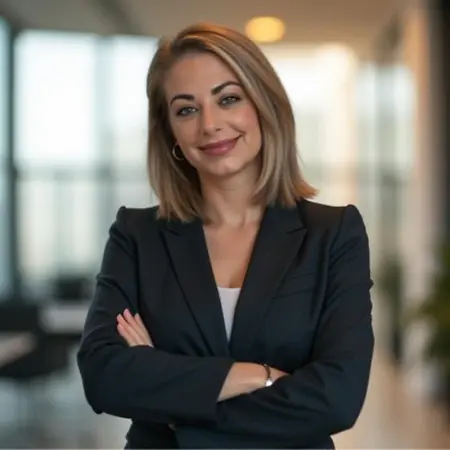
Her Story
About Lia
I started my career on the clinical side after attending Drexel University's nursing program, which I chose because they had a co-op option and I'm a hands-on learner. I worked in the hospital as a medical assistant and did hands-on internships, then continued working across high-acuity units including emergency department, NICU, labor and delivery, and neurosurgery. I quickly realized I was really interested in the business behind the hospital and recognized a lot of gaps in care related to operational efficiencies within the healthcare system. I got my degree in health administration and moved into industry because I had a special interest in med tech related to women and children, which I later learned is the most underserved area in terms of funding for innovation. I started working for Astarti Medical, developing personalized feeding software for neonates, which was the first of its kind. I was also an investor in that company. After about 3 years, I opened my own consulting business, Carrington Consulting, because I was approached by international companies looking to bring their technologies to the United States. I helped them build sales and marketing infrastructure, develop commercial plans, and build teams around digital and predictive solutions. Then I had a personal experience that changed everything. While having my second child, I had a missed diagnosis of preeclampsia, and because of that, my daughter and myself almost died. She spent time in the NICU, and I have long-term health effects from that experience. This very clearly pointed out the gap in care and why we have a really high maternal mortality rate in the United States. When Neopredix asked me to help them commercialize their preeclampsia prediction tool and assist with product development for the U.S. and European markets, I very happily accepted. I'm proud to share that we recently got CE certification in Europe and launched our preeclampsia prediction tool called PreFree, and we're actively working on FDA approval now. I've progressed through several director roles at Neopredix over three and a half years, and was recently promoted to Chief Operating Officer. I continue to build my consulting company alongside my work at Neopredix, and I just incorporated a new joint consulting venture with a partner based in Europe to provide cross-Atlantic expertise.
Her Interview
Ten minutes with Lia
01What do you attribute your success to?
I have always been a very curious person. I never was really satisfied with the status quo, and I've always had this need to sort of see through the matrix. When you're really closely involved with something or passionate about something, it's easy to get wrapped up in the little details, and those little details often slow you down and cloud the big picture of what you're trying to achieve. Sometimes innovation is just not pretty, so you need curiosity, you need to be ingenuous and able to adapt and move quickly. I've always had this ability to do both things, kind of see through the matrix and understand big picture what needs to be done, but then at the same time just always digging for the right solution, because where there's a will, there's a way. This is where we're moving to, this is what is happening. There is going to be a tremendous amount of AI in healthcare, and the world is shifting tremendously in that way. We're in a technology boom in so many ways. I've just been always very adaptable, curious, and direct in my opinion about how and why things should move in a certain direction. And also ensuring that you're surrounded by a really good team of hardworking individuals that are working towards a common goal.
02What’s the best career advice you’ve ever received?
There are two things that really stick with me. Pretty early in my career, I was talking with a very successful sales leader in the industry, and we were trying to figure out how to price a solution. She looked at me and said, if you just do the right thing, the money will come. She told me that as long as you stay honest in this business, as long as you are really honest about what you know and what you don't know, and that whatever solution you're trying to bring to market is something that you truly believe will make a difference in people's lives, if you always work with that in mind and never bring greed or ego into the mix, you will succeed. The money, the funding, the accolades, everything that comes with it will come naturally. But if you don't do all of that with authenticity, then it'll all fall apart. I always have used that as a way to check myself to ensure that any company I work with, I truly believe in, and any decision I make is based solely on what's best for the company and the recipients of whatever technology we're selling them. Honesty and authenticity is really key. The other piece is about ego. It could be really easy when you're leading a team to pick a direction and run in that direction and forget that there is a team of people around you with really important opinions. Having the ability to put your ego aside and what you think is best and foster a team that can have ideas, iterate openly, and feel comfortable to share their opinions is incredibly important in an innovative environment, because we're all doing this for the first time and nobody really knows what they're doing. We're all just trying to figure it out, and you're only as good as the people and the resources around you.
03What advice would you give to young women entering your industry?
Do not be afraid. I had a lot of fear early on that my opinion didn't matter, that what I had to say wasn't as important as maybe some other people in the room who might have had a bit more experience. So do not be afraid. Trust your instincts. At the end of the day, even the people who are the most successful, at one point they had no idea what they were doing, and they had to trust in their brain, in their abilities, and in their instincts. Have the confidence to know that is the rightful place to step into the next level. Never be afraid to believe in yourself and reach for the stars, because I think a lot of times insecurities really limits our capabilities. I would also repeat my two very important lessons and learnings from those that I look up to, which was the piece about being authentic and doing the right thing, and the money will come. Those are all very important to me, so I think I would share all of that.
04What are the biggest challenges or opportunities in your field right now?
The biggest thing is that not only am I working to bring innovation to the bedside in a market that is very much against us, but I'm doing it within a niche that is the most difficult within the difficult. Our healthcare system is not set up to accept new technology for various reasons. One is the regulatory hurdles, the FDA, and then you have your reimbursement from payers, insurance companies. Up until recently, and actually it still doesn't quite exist, we're very close, but there's no way for predictive tools within medicine to get true reimbursement from insurance companies. So the incentives are difficult for hospitals to adopt innovation, same thing for physicians. Also, AI is a scary word a lot of the time for doctors and hospitals because it comes with risk. There's fear of replacement of jobs. So on top of having to innovate and maintain a company's strengths and fortitude through this very difficult market, you're also having to educate the market and really introduce them to a whole new concept for the first time. But the tone is definitely shifting there, and it's more widely accepted culturally within medicine. On the regulatory and payer side, we're still navigating those challenges, but we're getting there. There's a handful of companies in the space that are all the first to do this, so it's just taking us a bit longer, but we expected that. And then ensuring that you're running your company lean enough so that you maximize the utility of the capital that you have and can use that to really overcome the unforeseen hurdles that you face, because if you don't prepare for that, you will quickly fail in this market. A lot of it has to do with money, funding, and permission.
05What values are most important to you in your work and personal life?
Definitely authenticity. That's a common theme for me because people can pick up on that right away. Studies show you can show many different features of your personality or give many people many different feelings, but if you show them true authenticity, your chances of not just being liked, but accepted and trusted and believed in are really off the charts. But the second you start lying to people or you're not speaking in truth or you're trying to sell something that's not real, you're not gonna get very far. So authenticity, I tell that to my kids, I tell that to myself. It's true in personal and in business. The other thing is a need for confidence. You have to be confident and really believe in what you're doing. There's real value in ensuring that you are a strong foundation for all the people around you to learn from. Making sure that you're believing in what you're doing, that you have the strength within you to make your voice heard, to stand up for the people who are receiving injustice around you, really just being a good person, I think it goes a long way in business and in your personal life. For me, a huge thing that's important is serving the underserved. It's really easy just to take your wins and forget everything that's behind you, but for me, I really like working in med tech but serving a population that is suffering because of the lack of attention. Why women are dying left and right, and children are dying left and right, to me there's no better place to focus my attention in career. I also want to add that positivity and happiness is a personal responsibility and a choice. You can't depend on other people to make you happy or make you think in a positive way, and you also can't blame other people for making you feel bad or think negatively. In life, you have a choice to either be happy and be positive, or be sad and negative. Always surround yourself with people and things that guides you in the right direction, because you're only hurting yourself otherwise. This really helps develop self-respect, and carrying that into business has been really helpful to me, because at the end of the day, people would rather be around positive people than negative people.
Join Influential Women and start making an impact. Register now.