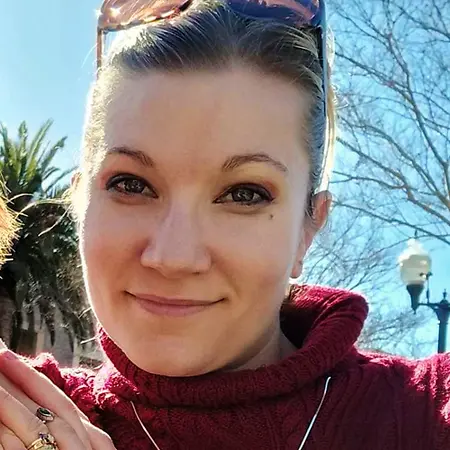
Her Story
About Machelle
My journey into education began during my undergraduate years when I discovered my love for helping fellow students understand difficult concepts. There's something magical about seeing the light bulb turn on, watching that moment when it finally clicks - that's what got me thinking that education would be a good career path for me. I earned two bachelor's degrees from Franciscan University of Steubenville in 2012, one in chemistry and one in biology, originally planning to become a forensic chemist. I wanted a complete background of the sciences in case something non-human came up, so I needed the zoology and botany background. I then pursued five years of graduate work at CSU Sacramento to get a more holistic understanding of my field, because I really enjoyed the chemistry portion of it. For over a decade, I've been dedicated to education, and my typical day used to look very different until a year ago when I got laid off from my long-time teaching job due to budget cuts at the school. Now my current typical day is much more chaotic - I'm an adjunct faculty at Jessup University in Rocklin where I teach math and chemistry courses during fall and spring semesters, and I'm also a substitute teacher for K-12 schools within about a 35-mile radius of where I live. While the substitute position is completely on-call with no stability, it gives me the freedom to encounter multiple teaching styles, multiple school styles, multiple grade levels, and be able to step in and help out whenever a particular school needs me. Last summer, after getting laid off, I remembered I had a passion for phlebotomy, so I went back to school to become a certified and licensed phlebotomy technician. I got my license in January after completing the 40-hour didactic classroom training, a 40-hour externship, passing the National Healthcareer Association nationwide board exam, and meeting California's rigorous state licensing requirements through the California Department of Public Health. I am now actively seeking a hospital job because so many of them are in desperate need of more healthcare workers.
In my free time, I like to read, spend time in nature, and go bowling. I'm an avid bookworm that usually devours full fiction novels in just a few days and I have a few hundred books in my personal library. Being in nature is such a relaxing pass time for me and I enjoy going on walks and hikes along many of the trails near my house. When I'm not curled up with a book or hiking amongst the trees and rivers, you can find me competing in leagues at the local bowling alley, having fun with friends and family.
Her Interview
Ten minutes with Machelle
01What do you attribute your success to?
I attribute my success to my parents, who always encouraged me to pursue my passions and to go for whatever education really inspired my curiosity. My parents met at Cal Poly University in San Luis Obispo, where my mom was finishing her Masters in Math to be an educator and my dad was finishing his Bachelor's in mechanized agriculture. They have always had a passion for learning, discovering, and sharing, which they passed on to me and my two younger sisters.
02What’s the best career advice you’ve ever received?
The biggest piece of advice I've been given is to go for what you put your mind to. If you put your mind to it, you will achieve it. You might not achieve it in the way that you thought you would at the beginning, but at least you can say you did achieve it. This advice has really resonated with me throughout my career, especially as I've navigated unexpected changes like being laid off and transitioning into new fields like phlebotomy.
03What advice would you give to young women entering your industry?
I would want other women to know themselves - why are they wanting to be educators? What drives them? What drives you to teach? Why do you have this passion? Is it just because it's a career, or is it because you love the process of seeing that aha moment the same as what I saw, and what I love? So my advice would be to really know yourself. Why are you doing this? Understanding your true motivation and passion for teaching is essential before entering the field of education. Students only learn when their teachers make the material interesting, and teachers only do that when they are interested in the material and the teaching process.
04What are the biggest challenges or opportunities in your field right now?
As an adjunct faculty member, the biggest challenges I've noticed over the years at multiple different schools would be stepping into a class with no history of how the class has been set up or how the school works. It's almost like substitute teaching, where the school needs someone just for this one class and you say you'll do it, but you have no idea where anything is on the campus as it's brand new. You also don't know how much freedom you might get - some schools are super rigorous about what you can and can't teach, even at the higher education level, and other schools are extremely teacher-oriented where they have full academic freedom to teach each class how they see fit. In K-12 substitute teaching, the biggest challenges would be going to a new school where the children need the adult stability of having that same teacher every single day, so when they get a substitute, it really throws everything into chaos. The schedules are completely different, and because there are so many more behavioral developmental challenges dealing with young children, substitutes have a slightly harder time to transition. But once you get to know a few of the students because the school calls you back multiple times, it gets a lot easier - they remember you, they know you, you know them, and it starts to build that relationship between student and teacher.
05What values are most important to you in your work and personal life?
I would say devotion to the subject matter that you are teaching would be a big one. Dedication to kindness and compassion are also extremely important to me and having a lot of patience would definitely be a third core value. These values guide me both professionally in my teaching and personally in how I approach life and interact with others. The world needs kindness more than it needs division. I try to share love and kindness each day.
Join Influential Women and start making an impact. Register now.