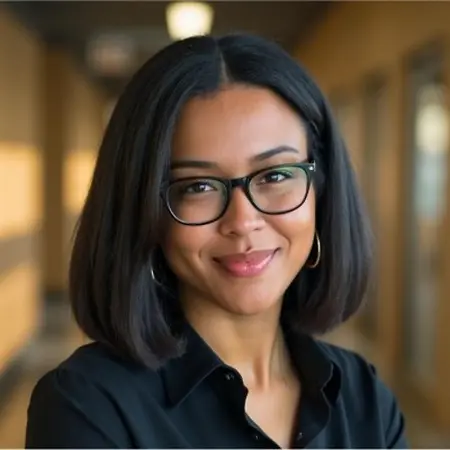
Her Story
About Marisa
My journey in learning and development has been shaped as much by my personal experiences as by my education. I'm from Florida originally, but I moved to Indiana when I was younger after my parents got divorced. Having to navigate a different place with a lot of crime, losing friends and family at young ages, attending funerals every single year - all of that shaped my perspective that life is short. I learned not to take things too seriously or too personally. Moving about 5 times up north, having to meet new friends each time, taught me to be resilient and adapt to pretty much anything. Dealing with grief brought me to a place where I just keep pushing, especially given that I'm in a career my family has not been able to achieve, making more money than they were able to make. Now at ChenMed, where I've been for 4 years, I've progressed from Instructional Designer to Senior Learning Experience Designer to Senior Manager and now Associate Director, Learning Business Partner. I lead a team of 3 designers, and we handle all the performance development, performance management, and training requests for the entire company. My typical day involves partnering with leadership to filter through the needs of the business and consulting with clients on the best approaches to handle performance problems, whether that's training, change management strategies, or other solutions. What I'm most proud of is being the first in my family to go to college and being in a leadership role where I get to impact organizational change.
Her Interview
Ten minutes with Marisa
01What do you attribute your success to?
I attribute my success to transparency, over-communicating, and really just caring about my team on both a personal level and a career level. I try to be very vulnerable up front with my team to make them feel like they can be vulnerable as well, and we can just talk through things honestly and transparently with each other. Defining and sustaining the culture of my team is something I'm very intentional about, because it could make or break everything - the work that's being done, the team dynamic, all of it. Culture means a lot to me. I would describe my leadership style as servant leadership, where my credibility to lead is in direct correlation with my ability to serve.
02What’s the best career advice you’ve ever received?
Your credibility to lead is in direct correlation with your ability to serve. This quote really resonates with me and captures how I think about leadership. It reminds me that being a leader isn't about being in the spotlight or having authority - it's about how well you can serve the people you're leading. I also live by the perspective that we're all on a floating rock, so what are you worried about anyways? Life is short, and that helps me not take things too seriously or too personally.
03What advice would you give to young women entering your industry?
I would say a couple different things. First, find your voice and use it. Don't be afraid to speak up and contribute your perspective. Second, give yourself grace on the failures, the mishaps, and the journey that you're on of learning. This field requires continuous growth and adaptation, and you're going to make mistakes along the way. Be kind to yourself through that process and remember that the learning journey is part of what makes you better at what you do.
04What are the biggest challenges or opportunities in your field right now?
I see two major challenges right now. First is accountability on leaders and their teams. We're doing a lot of development with our leaders, but I still don't think they quite understand how big of a role they have on pretty much everything - any systems we implement, any change that comes along. Leaders really make it or break it. The second challenge, especially with so much AI and technology, is that I don't want us to lose our human element and what makes us human. We need to remember what drives humans, what motivates us, what makes us feel connected, what makes us want to continue working where we're at. There are so many dynamics to us as humans, and I don't want that to be lost. We need to maintain human identity and meaning under technological pressures. The biggest opportunity is teaching people how to stay themselves in an AI workplace. When AI is going to take care of the cognition, we don't want people to lose that competence and those neuropathways that are developed from being able to start from ground zero. We need to keep people from becoming dependent or hollow, unable to critically think. Developing that critical thinking in people is the opportunity.
Join Influential Women and start making an impact. Register now.