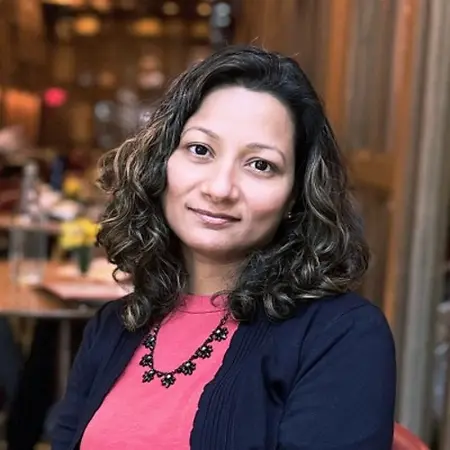
Her Story
About Sabah
I've always been in the tech field throughout my career, though I've made a significant shift from being purely technical to becoming a people manager. I started my career in India, where I completed my master's in IT and began working through an internship at a small organization. When my husband got a position in the United States, I moved here and continued in the tech field. My journey has been unique because I've essentially started my career twice - I took two-year breaks after each of my two children were born, and each time I returned to the workforce, I had to start from zero and climb back up. Before joining Verisk, I worked in Chicago in a similar tech field as a people manager. At Verisk, I've been a director for the last two and a half years, but I was a manager before that. As Director of Web Development, I'm responsible for the face of our company - the verisk.com public website - handling everything end-to-end including development, deployment, updates, and outages. We work in disciplined three-week sprints, and I help business units with cookie compliance as well. Even though I'm in a leadership role now, I deliberately stay active in hands-on development work because I'm not ready to give up that part of me as a developer. My typical day involves juggling management responsibilities like emails, guidance, recruiting, interviewing candidates, and filtering profiles, while also picking up development tasks for feature updates and informing stakeholders. While I know I would have been in a better place career-wise if I hadn't taken those breaks, I have no complaints - I feel I'm in a pretty good place after starting fresh twice in my life.
Her Interview
Ten minutes with Sabah
01What do you attribute your success to?
I wouldn't say I'm completely successful yet - I could have been better, and I'm not in a place where I can settle and say I'm done. There are so many different definitions of success, and I feel that definition changes with time. My definition of success now could be different from what it will be five years down the line. Success could mean position, power, money for some people, or being a decision maker who impacts a lot of people - these are all valid definitions. But if I had to point to the biggest factor that contributes to where I am right now, I would say it's the people around you and the kind of team you build. Family support matters tremendously, and having people around you who support you makes all the difference. Sometimes when you're struggling and say 'hey, I couldn't get it done,' your team is out there saying 'yeah, don't worry about it, we're gonna take care of that.' I feel like the people around you and what kind of team you build - that would be the biggest thing that would make you successful.
02What’s the best career advice you’ve ever received?
I've had some great mentors in my life who have taught me a lot in terms of skills and career advice. I remember an old mentor of mine who always advised me to do my best - this is your job, try your best and be your best. Obviously, this is a measurement of your success and how you're going to see yourself. But he told me to never forget to always create a fine line between your personal and professional life. He taught me that sometimes when you have a lot of things going on and you're thinking 'oh, I have to leave early, I have this going on,' you need to always think about what you're going to get back and what you won't get back, and make a decision based on that. Yes, there's a meeting or something going on, and you will get to it tomorrow - you can sit late and do that work. But at that moment, if you have to go and attend something or be with your kid because they are down, you just have to make the decision about what's going to last for long. That advice helps me stay grounded. Sometimes when I have to make a decision and I have something else going on, I ask myself: is it that important? Can I drop it? Can I postpone it? Can someone else do it? And let me just focus on something that's more important. I think that was good advice that kind of sticks with me so far.
03What advice would you give to young women entering your industry?
When I started in the tech world many years ago, there were not very many women - I remember at some point I worked in an office where I was the only woman. But that's not the case anymore. Women are everywhere in the tech field now, which is really great. I definitely believe there's nothing in that world that women can't do. For whatever reason, they weren't there before, but now that's changed. My advice is that women should keep themselves up-to-date and plan on doing that continuously. I know women enter the tech world and they're doing great with all these great college degrees, which is wonderful, but I would say they also have to plan their path in the sense of 'hey, this is what I know right now, what can I learn more in three years down the line, five years down the line?' That's where they can stay ahead of the curve. It's not just for women, it's for men as well, but I would say it will be very helpful for women to do that more so they can stay ahead of the curve and be at higher positions in the tech world if that's what they look for and want. And that's not impossible. They have to figure out if this is what they want to do, but if they want to, they just have to plan ahead - what should I be doing right now that's going to help me five years down the line, in terms of learning as well as soft skills. You have to think about what you need to do right now. For example, with AI right now, anyone will say AI. But I would say not just AI - think about it, read articles, understand what they're thinking of doing with AI in five years down the line and start learning about it and understanding it. You can't learn everything because it's not out there yet, but at least have that thought process so that five years down the line when that thing actually comes, you will have a thought process for that well ahead in advance.
04What are the biggest challenges or opportunities in your field right now?
AI is a big thing, we all know. It's kind of a big opportunity in terms of how much you can ride on that wave. Since I've been in the tech field for so many years, I think we are at a place where we have to reinvent ourselves in terms of AI because you cannot ignore it - it's out there. I think the biggest challenge right now that I'm facing, and I feel like everyone is facing, is that we are so used to all this work. I know what I'm doing, I know everything about it, but you still have to not do it the conventional way - you have to do it using AI. Initially, we were like 'hey, why should I do that? I know what I'm doing.' But you still have to accept that. It's more like this huge wave where you accept it and see how you can use it, and then see if it's actually helping you. Long story short, you know your work and you've been doing it for many years - I'm sure that's the case with people in other fields as well - but now you really have to do it in a different way using AI. I think it's the biggest challenge and opportunity of these times. We as humans initially were rejecting it, saying 'I'm not gonna accept it, I think I know what I'm doing.' And then slowly you were like 'okay, you know, you have to try it, you have to use it, and then you have to learn it, you have to master it.' So it's really kind of challenging yourself, and you have to go through all those stages. If at first you're unable to figure out how to make your life better with it, you have to try again.
05What values are most important to you in your work and personal life?
I've thought about this a lot. I think there are a lot of values that are important for me, and sometimes they are hard to hold on to, but I feel like transparency and empathy are two important values that really mean a lot to me. Yes, sometimes people do wrong stuff or they miss things - I do the same thing - but you just have to have a little empathy to understand that maybe they're having a bad day or something going on. It shouldn't be a pattern, but if it's just a moment, I think we all have to be a little empathetic with people around us. I know there are targets and things, but I feel like that goes a long way in building your team because you want those people to trust you. They need to see you as a leader who understands that part. And transparency - sometimes you know of things, and I feel like if you can, you should tell them in a way that makes sense, because that goes a long way. If you're being transparent and they see that, that also relates to trust. They know that person is going to look out for us. From a team-building perspective, I feel like those two values go a long way.
Join Influential Women and start making an impact. Register now.