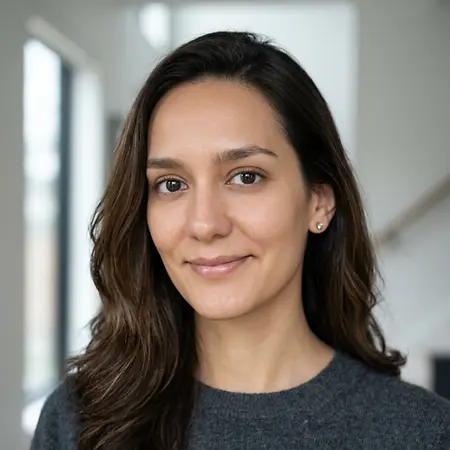
Her Story
About Sarah
Sarah Flatland has built a meaningful and inspiring career in Applied Behavior Analysis through her passion for helping children and families thrive. Currently serving as ABA Program Director at Hearts and Hands Therapy Services, Sarah oversees clinic services across multiple states while leading clinical growth, mentoring Board Certified Behavior Analysts (BCBAs), and developing training programs focused on ethical, person-centered care. With nine years of experience in the field and six years as a BCBA, she has dedicated her career to helping children with autism, cerebral palsy, Down syndrome, and other developmental needs build communication, independence, and life skills that improve their quality of life. Sarah’s journey into ABA began unexpectedly after earning her bachelor’s degree in American Sign Language from St. Catherine University. Originally planning to become a special education teacher, she discovered ABA while working as a registered behavior technician during graduate school and quickly realized she had found her calling. Inspired by seeing children make meaningful breakthroughs in communication and behavior, she shifted her graduate studies toward Applied Behavior Analysis and later earned her Master of Education degree from University of Cincinnati. Throughout her career, Sarah has worked across Wisconsin, Minnesota, Georgia, and now supports programs expanding into Massachusetts. She has also mentored and supervised numerous clinicians pursuing board certification, helping prepare the next generation of behavior analysts to provide compassionate and inclusive care. In addition to her clinical leadership, Sarah is deeply passionate about mentorship, diversity, and empowering others both professionally and personally. She believes strong leadership comes from collaboration, integrity, and creating opportunities for others to succeed. Her dedication to advocacy and resilience extends beyond her professional work, as reflected in her memoir, From Survival to Empowerment, which chronicles her journey overcoming personal adversity and rebuilding her life and career. Recognized in Who’s Who Among American Business Leaders (2025–2026), Sarah continues to focus on expanding access to high-quality ABA services while helping children and families feel seen, supported, and empowered.
Her Interview
Ten minutes with Sarah
01What do you attribute your success to?
I attribute my success a lot to my military upbringing. My dad was active duty when I was born, and that upbringing taught me resiliency, taught me the ability to adapt quickly to change, and it also taught me how to step out of my comfort zone and do things that were hard. A lot of us are so fear-bound. We don't want to step out of our bubble. We don't want to do things that are too difficult and challenging, and change can be very scary, but sometimes with change comes very rewarding, fulfilling things. I also learned so much about myself through overcoming adversity. When I was in college, I ended up in an abusive marriage that I didn't think I would get out of, but I did escape the abuse before it escalated too far. I became a single mother in college, trying to figure it out with a young child. I had to work full-time to support my child, go to school full-time because I was bound and determined to not have student loans with nothing to show for it, and I was commuting on average 5 hours a day for school from Western Wisconsin to St. Paul. During blizzards, that commute was about 10 hours a day. I was diagnosed with PTSD, so I was working through all of that. I would take my daughter to school with me and pay a classmate to watch her while I was in class. Those years taught me my strengths, my weaknesses, how to grow a backbone, and to never give up.
02What’s the best career advice you’ve ever received?
One book I read that really helped me in my undergraduate degree was The 7 Habits of Highly Effective People by Stephen Covey. One of the habits makes you think about what people will say about you when your time is here, when you're no longer on this earth. Do you want to leave a positive impact, where people are going to remember what you did for them, how you helped them? Or do you want to leave an impact where people are thinking, oh, I'm glad she's gone? I want to leave a positive impact. I want to bring a little bit of light into this world, because it can get so dark sometimes. That philosophy of living intentionally and thinking about the legacy you want to leave has been incredibly influential in shaping my career and how I approach my work.
03What advice would you give to young women entering your industry?
I would say do it for the right reasons. If this isn't your passion, don't pursue this industry. Look for something that you love, something you're going to be happy doing, because when you love what you do, you never work a day in your life. But if it is something you want to do, go for it. Take the bull by the horns, and don't look back, because it is extremely rewarding, and you will find yourself doing things you never thought you were capable of. Be okay with feeling challenged. Be okay with getting outside of your comfort zone. If you need to cry, cry. We all do during grad school. But don't let it stop you. Don't let failure stop you, either. When you fail, get back up, take accountability, move forward. One big thing I tell a lot of my BCBA candidates is if an issue arises, sometimes it can feel debilitating in that moment, but just think about a year from today. If a year from today, it is something that's not even on your radar, don't let it ruin your entire day.
04What are the biggest challenges or opportunities in your field right now?
Some of the biggest challenges in ABA and behavioral health include insurance fraud going on in the industry. There are organizations out there that just see dollar signs when they see therapy. They want to make as much money as they can off of the therapy side of things and neglect the human side. They overwork their teams and overbill. Unfortunately, because of that insurance fraud, we're seeing a lot of pushback from insurance companies, and we're also seeing a very small percentage of our population getting overworked to the point of burnout, and that's causing people to leave the field and causing loss of access for the kids that need the supports. On the opportunity side, we're a very small percentage of the population - we only make up .0009% of the population. There's not a lot of board-certified behavior analysts in the world. The U.S. has the largest percentage, and we still can't meet the need. Rates of autism diagnoses continue to climb, and a clinician can only support a certain number of kids. Because of this shortage, there is a huge demand within the field. My field does pay well, which is a perk of the job. There's also job security - I'm getting headhunters reaching out to me on LinkedIn on a daily basis. Because of the demand, if a clinic you worked at happened to close for whatever reason, you can pick up another job the very next day, no problem. Organizations will move people across the country.
05What values are most important to you in your work and personal life?
When it comes to both my work and personal life, I'd say one of my biggest values is just valuing everyone. It doesn't matter if people look, sound, or act different than you, and it doesn't matter if they have different religious beliefs than you. We can learn from those who are nothing like us, and valuing the input of everyone around you can help you grow. I may be the ABA program director for my organization, leading teams of people, but I never look at people in a role below mine as beneath me. I never look at them as they are less than me just because they don't have the credentials or education I have. I know I can learn from them just as much as they can learn from me, so I value the input of every person I come in contact with in both my personal and professional life. I also value helping people and leaving a positive impact on society. I want to help build independence. I love seeing the kids I work with go from being considered untreatable in some cases to communicating and being able to go through life and get all their needs and wants met while also being able to cope through difficult situations. I want to help prepare kids and families so parents don't have to worry about what will happen to their child when they pass on.
Join Influential Women and start making an impact. Register now.