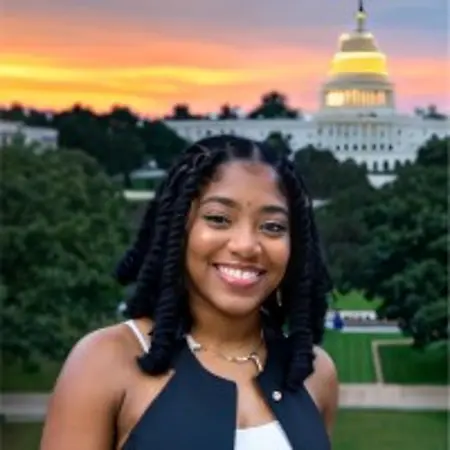
Her Story
About Shayla
My dedication to public service and equity, especially in education policy, was crystallized when I worked for Senator Van Hollen, but the foundation for that work was built years earlier through a series of experiences that grounded me in justice. Before serving in Senator Van Hollen's office, I had interned at the Maryland State's Attorney's Criminal Justice Department as a research aide, reviewing body-worn camera footage. That experience gave me early exposure to accountability, data analysis, and how policy decisions play out in real life. As someone who went to high school in Baltimore City, I had the experience of taking to the streets as a high school student, advocating after the killing of Freddie Gray, who was murdered in my city when I was in high school. It was an eye-opening experience to realize that these policy issues impact us directly, especially for people that look like me, and then being able to go directly into the body-worn camera unit from Maryland State's Attorney's Office to review that footage, but also with the lens of we have the power to change these systems. We can get involved at a very early age and make the changes that need to be done. Those are the experiences that pushed me to get into justice-related work, regardless if that's health or education or social security policy, whatever it is, just the lens of equity and justice stems from that early experience of taking to the streets as a high school student.
Her Interview
Ten minutes with Shayla
01What do you attribute your success to?
I attribute my success to my mom. I was a first-generation college student, and my mom put me through college. I think that I'm her wildest dreams personified. My late grandmother said before she passed that I was so smart that it made her scared of what my future would look like in a good way. Those are the folks that crowned me, and I attribute my success to them. They spoke this into existence for me, and I'm just living up to the charge.
02What’s the best career advice you’ve ever received?
The best career advice I've received is to send every email like your boss is CC'd on it. In terms of how you do your work, do your best, but also always be mindful that anything that you send is a representation of you. And so you just always have to have an eye to that. Another piece of advice was don't let perfect be the enemy of the good. Yes, I'm a perfectionist, but that takes a lot of time. Your good is good enough when we can work together and collaborate on making it perfect. It doesn't have to be perfect by yourself.
03What advice would you give to young women entering your industry?
Jump into this field if you are passionate about this work. You will find your footing on what part of that work you want to do. I've bounced around with advocacy, legislation, communication, digital advocacy. If you let the fact that you are passionate about this work lead you, you'll find your fit in all the avenues that you could do this work in. But make sure that it's something that you love, because it's hard, it's emotionally taxing, it's academically challenging, but it's worth it.
04What are the biggest challenges or opportunities in your field right now?
The biggest challenge is diversity in the field itself. I have experience from working on Capitol Hill specifically. There are not a ton of people of color in general, let alone people of color who are of a queer community or who are women. Both are identities that I identify with. And so, after you kind of distill that a lot of people don't look like you and don't occupy the same identities as you, it becomes a difficulty navigating that. So I encourage women of color to get into the field as often as possible. The greatest opportunity is probably the network of people that you will find once you get into the field and you start asking questions. You'll learn that the people on the Hill, or the people who are hill adjacent, or have formerly worked on the hill, they want to see people succeed. They're happy to have chats about how to navigate the space. But the other challenge is also that being on the Hill to work in federal policy, having come from the Hill is like being in a clique, or being in a secret group where you're in or you're not in. And so you have to figure out, if you're not in that field, how to get in it, how to navigate and penetrate that bubble of the people who are in the know, and then how to maintain those relationships after you're no longer in that bubble.
05What values are most important to you in your work and personal life?
The values most important to me are kindness, equity, perspective, truth, and accountability. Kindness should be the first one. Kindness takes folks a lot farther than they would think, and it's just an important way to ground yourself before having conversations with anybody, or keeping relationships up, is to come as your best self and be kind, because everybody deserves kindness. We're whole people outside of the work that we do, so we need to respect that. I hold true to equity, perspective, truth, and accountability in talking to folks about holding their members of Congress accountable, but also in having a working relationship with people.
Join Influential Women and start making an impact. Register now.