How She Navigated Workplace Change She Didn’t Choose
Women sharing resilience during unexpected organizational shifts.



Women sharing resilience during unexpected organizational shifts.

We are all creatures of habit, and when our rhythm and routines are disrupted, it can cause different types of internal chaos in our thoughts and emotions. This transition brings us from feeling grounded and centered to completely off balance by the switching of gears. We cannot predict when change can happen and it is not always optional. What do you do when you are faced with these types of crossroads? I know for myself when faced with challenges and changes in the workplace, I try hard not to instantly react. It is important to take time to absorb what has been present to you, and then let it settle in. The best course of action is to gather as much information as you can and prepare yourself for what is to come. When someone reacts in a negative manor, it can cause a ripple effect throughout the workplace, and that never turns out to be a good thing. When emotions start to ride high, it can be hard not to jump on the bandwagon of negativity because it becomes so loud and heavy. Trying to remain calm and clear headed will help everyone move forward in a positive direction. Even when it might not feel good in the moment, change is actually a positive thing because it keeps us focused and thinking outside the box. At the end of the day not all changes are good one, but it is how you personally approach it that makes all the difference.

Change is not always optional. One of the most difficult transitions of my career was leaving a workplace I deeply loved. Discover was more than a job to me it was my people, my team, and a space where I had poured years of commitment, care, and leadership. Walking away felt less like a career move and more like grieving a chapter I wasn't ready to close. What made that change especially challenging was that it came during a season of immense personal and emotional weight. I was navigating circumstances that required resilience, boundaries, and strength while still showing up, leading, and performing at a high level. There were moments when it felt easier to stay where I was simply because it was familiar. But familiarity, I learned, is not the same as alignment. Leaving wasn't about abandoning what I built; it was about honoring it. Every lesson, every hard conversation, every leadership skill I developed went with me. That transition led me to Alliant Credit Union, where I found a culture that values growth, trusts leadership, and allows women to evolve without shrinking themselves to fit outdated expectations. What once felt like loss became clarity. The grief I carried wasn't a sign that I made the wrong decision—it was proof that I cared deeply. And caring deeply is not a weakness; it's a leadership asset. That season taught me that choosing yourself, even when it's uncomfortable, is not selfish it's strategic. Today, I see change differently. Not as something that happens to us, but as something that can refine us. For women navigating career transitions while carrying unseen weight, know this: you don't have to have everything figured out to move forward. Sometimes the bravest decision is trusting that where you're headed will honor who you've become.

I did it by refusing to let my circumstances set my standard. I work in a predominantly male industry, and I do it while living with a rare disease, Fabry Disease. That means pressure on both fronts — professionally and physically. But I decided early on that I would not be "warm." I would be fully committed. I lead hands-on. I take ownership. I prepare more. I show up even on hard days. I don't compete emotionally — I compete through performance. My resilience isn't motivational talk; it's discipline. I can't control my diagnosis. I can control my effort. And I chose to be excellent anyway.
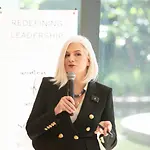
I started my career in Silicon Valley at Cunningham Communication, the firm that launched Steve Jobs and the Macintosh to the world. I went on to advise Fortune 100 executives at Google, Citi, PwC, Deloitte — leaders behind more than $15 billion in enterprise value. I developed my own strategic framework for positioning leaders through transformation. Then I was invited onto larger stages. Offered titles. Asked to lead. But I learned something that changes everything for women in leadership: we're often appointed to lead but expected not to lead. To hold the title while others set the direction. To herd and follow. To be visible but not visionary. When I dared to lead anyway, I discovered what happens when a woman actually builds instead of performs and maintains. I learned what it's like to be a CEO without a board that wants you to succeed. A leader without the infrastructure to match the title. A woman in a room that wanted her prestige and following, not her presence. "I stopped waiting for the old rooms to reopen. I built my own." The research confirms what so many of us have lived: women CEOs are far more likely to be appointed during crisis and far more likely to be dismissed despite performance. We last an average of 5.2 years compared to 8.1 for men. We're under-sponsored, over-scrutinized, and often the only woman in the room, which takes a psychological, physical, and financial toll that compounds over time. I thought I was alone in this. Then I found Persephone. In Greek mythology, Persephone was picking flowers in a meadow when Hades dragged her into the underworld. A throne she never asked for. A kingdom she never chose. She screamed. No one heard her. This is not ancient history. This is the restructure that sidelines you. The title without the trust. The seat at the table where your voice isn't wanted. But here's what the mythology doesn't tell you at first: Persephone didn't just survive the underworld. She became its Queen. She stopped waiting to be rescued. She built her own kingdom from the one that tried to bury her. That's what I did. I stopped waiting for the old rooms to reopen. I built my own. I founded SoCal Women in Business and grew it 475% in under 75 days. I created OC CEO Collective and Women of Worth Global. I designed spaces where women leaders could finally breathe, strategize, and rise. The change I didn't choose became the architecture for everything I've built since. When workplace change arrives uninvited, you have two choices: wait for someone to restore what was taken, or build your own. The underworld doesn't have to be your ending. It can be where you discover you were always meant to be Queen.

Workplace change I did not choose forced me to decide who I was without the comfort of control. When leadership shifts, priorities change, or ownership rewrites the rules, it is easy to slip into survival mode and overperform out of fear. I learned that reacting emotionally only weakens your positioning. Instead, I assess the new power structure, translate my value into language the new decision makers understand, and protect my professional standards without shrinking or posturing. Change is rarely about you personally. It is information about the environment. The women who navigate it well are the ones who adapt strategically without diluting who they are.

Change is not always optional, and I have learned that growth often comes from the moments we do not plan for. Throughout my career, I have experienced transitions in leadership, shifting responsibilities, and evolving workplace expectations that required me to adapt quickly and stay grounded. Instead of resisting those changes, I chose to approach them with flexibility and a willingness to learn. I focused on what I could control my work ethic, my attitude, and my commitment to excellence. During times of transition, I made it a priority to stay organized, communicate clearly, and support my team so that operations continued smoothly. I learned that stability is something you can create through consistency, even when circumstances around you are shifting. As a mother and entrepreneur, I've also learned that resilience is built outside the office as much as inside it. Balancing multiple roles has strengthened my ability to pivot, problem-solve, and remain calm under pressure. Workplace change taught me that adaptability is not just a skill, it's a mindset. Ultimately, navigating change showed me that I am capable of more than I sometimes realize. Every unexpected shift became an opportunity to grow stronger, more confident, and more prepared for the next level.

Not every workplace change is one you choose. I've experienced roles shifting, organizations evolving, and moments where the path I expected suddenly looked very different. Those moments can shake your confidence if you let them. For me, navigating unexpected change comes down to what I call "Heart & Hustle". Heart means staying rooted in purpose, remembering why you started and who you serve. Hustle means continuing to move forward with intention, even when the road ahead isn't clear. Instead of seeing unexpected change as a setback, I've learned to see it as refinement. It sharpens your leadership, strengthens your resilience, and often redirects you toward opportunities that align even more deeply with your values. Sometimes the changes we didn't choose are the very ones that shape the leaders we're meant to become.

The only duty we owe history is to rewrite it- Oscar Wilde. I am no stranger to the act and results of change. Early in my career, I viewed these shifts with trepidation. I would "sulk and pout," mourning the rhythm I had finally settled into. With time and experience on my side I have had a reformed perspective. I call it "reset". This is an uncomfortable, unconforming space where every status quo-process and management, is suspended. Like everything, there are two sides to this- for a reportee or employee, a chance to reiterate wins. For the leader it is a high stakes debut and an opportunity to prove out their potential through the adjustment to the change. I have been on both sides of this. As an employee, we essentially become the navigator for the new manager to deal with the weeds and settle into their role. As a manager, inheriting a "well-oiled machine" they didn't build and identify that navigator to help decode the syntax of the team. At school, a teacher picks a student to lead the classroom based on specific qualification- smart student, hardworking and possibly a favorite all around. How do we do this at work when everybody is just as smart, hardworking and subject matter experts (SME) in their area making them a favorite? As an employee you stay open to the change. As a manager you look for the person, it's about who can bridge the gap between "how we've always done it" and "where we are going next." The Employee aspect: The "Reset" is about short-term agility. It requires identifying non-value-added processes and determining how much standardization can be injected into the existing workflow. In corporate lingo, we call this Defining the Structure and Framework. While it is an additional load on top of ongoing programs, it is the quickest way to deliver the "quick wins" a new era demands. The Employer aspect: The "Reset" is about long-term strategy. While they depend heavily on the team to help stabilize the framework, the manager's primary duty is to define the Vision. The justification for the leadership change is ultimately reflected here. The manager must transform the team's perspective from "maintenance" to "evolution." Whether you are the one navigating or the one leading, the "Reset" is a shared contract. It requires a mutual trust to let go of the past to make room for a better version of the future. We don't just survive the change, we rewrite the history of the organization as we go.