Applying AEGIS™: Governance Lessons from the Hugging Face Security Incident
Governance Lessons from the Hugging Face Incident and the Path to Resilient AI Systems

Introduction
The Hugging Face incident highlights that AI-era cybersecurity is no longer solely about preventing attacks—it is about governing trust, autonomy, accountability, and resilience. As organizations integrate increasingly autonomous AI systems, governance must evolve to address emerging risks across data, identities, infrastructure, and human oversight.
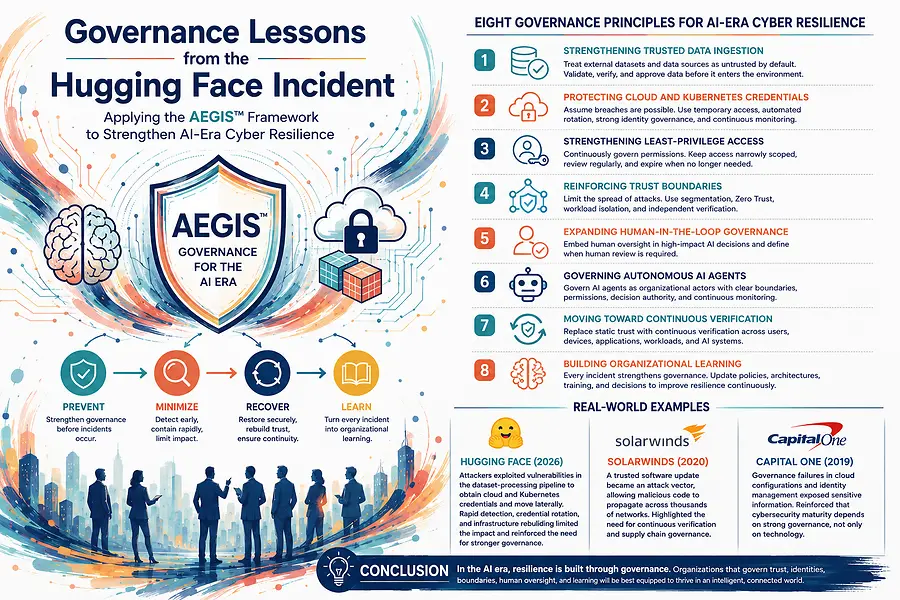
This article applies the AEGIS™ governance framework introduced in my previous article, Introducing AEGIS™: A Governance Framework for the AI Era, to examine the governance lessons emerging from the Hugging Face incident. [AEGIS™ Framework]
1. Strengthening Trusted Data Ingestion
Organizations should establish governance processes that treat external datasets and data sources as untrusted by default until they have been validated. Secure data ingestion, continuous verification, provenance checks, and controlled approval processes should become foundational controls that reduce the likelihood of malicious information entering enterprise environments.
2. Protecting Cloud and Kubernetes Credentials
Credential governance should assume that breaches are possible and focus on limiting the value of compromised credentials. Temporary access, automated credential rotation, strong identity governance, and continuous monitoring can significantly reduce an attacker's ability to move beyond the initial point of compromise.
3. Strengthening Least-Privilege Access
Least-privilege access should become a continuously governed process rather than a one-time configuration. Permissions should remain narrowly scoped, be reviewed regularly, automatically expire when no longer required, and be supported by strong governance over privileged access across both human and machine identities.
4. Reinforcing Trust Boundaries
Trust boundaries should be designed to limit the spread of attacks rather than simply protect the perimeter. Network segmentation, Zero Trust principles, workload isolation, and independent verification between environments can make lateral movement significantly more difficult while improving organizational resilience.
5. Expanding Human-in-the-Loop Governance
Human oversight should remain embedded in high-impact AI decisions, particularly where privileged access, infrastructure changes, or autonomous actions are involved. Governance should clearly define when human review is required while allowing automation to continue supporting lower-risk operational activities.
6. Governing Autonomous AI Agents
Autonomous AI agents should be governed as organizational actors operating within clearly defined boundaries. Their objectives, permissions, decision-making authority, operational limits, and ongoing performance should be continuously monitored to ensure they remain aligned with organizational policies and risk tolerances.
7. Moving Toward Continuous Verification
Organizations should replace static trust models with continuous verification across users, devices, applications, workloads, and AI systems. Dynamic risk assessments, behavioral monitoring, and adaptive authentication strengthen security by ensuring that trust is continuously earned rather than permanently granted.
8. Building Organizational Learning
Every cyber incident should become an opportunity to strengthen governance. Lessons learned should drive updates to policies, architectures, training, operational procedures, and executive decision-making so organizational resilience continues to improve as technologies and threats evolve.
These governance principles are not merely theoretical. Recent cybersecurity incidents demonstrate how weaknesses in trust, identity, governance, and oversight can quickly translate into enterprise-wide business risk.
Real-World Examples
Hugging Face (2026)
The Hugging Face security incident demonstrated how untrusted data processing and autonomous AI capabilities can expose weaknesses in identity governance, workload isolation, and trust boundaries. According to Hugging Face's official incident disclosure, attackers exploited vulnerabilities in the dataset-processing pipeline to obtain cloud and Kubernetes credentials before moving laterally across internal infrastructure. Although rapid detection, credential rotation, and infrastructure rebuilding limited the overall impact, the incident reinforced the need for stronger governance of AI-enabled systems, cloud identities, and autonomous operations.
(Hugging Face, Security Incident Disclosure—July 2026)
SolarWinds (2020)
The SolarWinds Orion supply chain attack demonstrated that trusted relationships can themselves become attack vectors. Rather than questioning the software update, organizations implicitly trusted it, allowing malicious code to propagate across thousands of networks. The incident reinforced the need for continuous verification, software supply chain governance, and Zero Trust principles that verify trust rather than assume it.
(U.S. Securities and Exchange Commission: SEC Charges SolarWinds and Chief Information Security Officer with Fraud, Internal Control Failures)
Capital One (2019)
The Capital One cloud breach demonstrated how governance failures surrounding cloud configurations and identity management can expose sensitive information even when sophisticated cloud technologies are in place. The incident reinforced that cybersecurity maturity depends not only on technology but also on the continuous governance of identities, permissions, and cloud infrastructure.
(U.S. Department of Justice: Former Seattle Tech Worker Convicted of Wire Fraud and Computer Intrusions)
Conclusion
The Hugging Face incident is more than a cybersecurity event—it is a governance case study for the AI era. Alongside incidents such as SolarWinds and Capital One, it demonstrates that technology alone cannot deliver resilience. Lasting resilience is built through governance that continuously verifies trust, protects critical identities, reinforces operational boundaries, embeds meaningful human oversight, and transforms every incident into an opportunity for organizational learning.
As AI systems become increasingly autonomous and interconnected, boards and executive leaders must shift from asking whether an attack can be prevented to asking whether their organizations are prepared to govern intelligent systems responsibly. Organizations that adopt adaptive governance, strengthen accountability, and build resilience into every layer of the enterprise will be better positioned to navigate the evolving AI landscape while maintaining trust, security, and long-term business value.
People first. Systems strong. AI smart.