Finally, an Overview of San Francisco International Airport (SFO)
It is about time we gave a deep-dive to SFO!

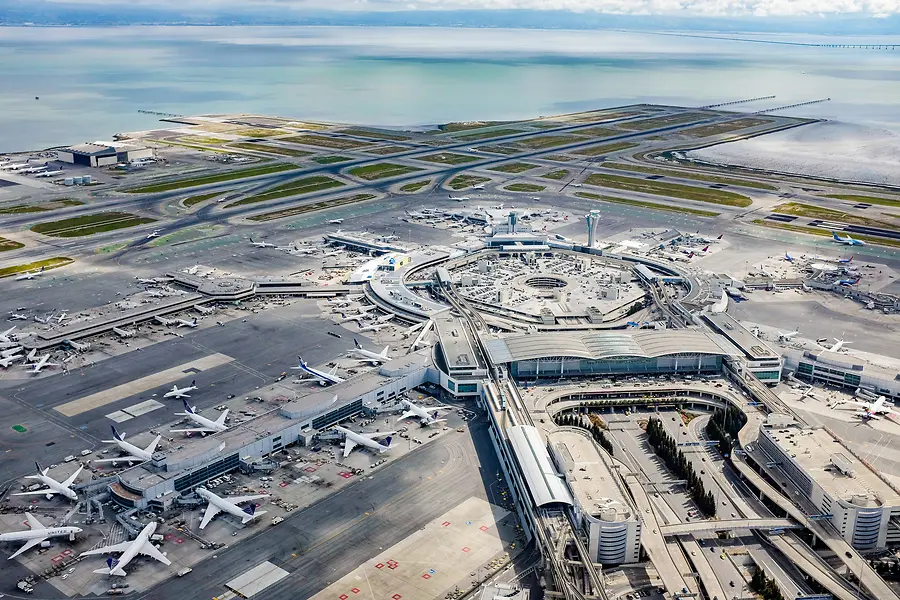
A review of my home airport before I move feels long overdue. It is finally time to write about San Francisco International Airport — better known as SFO. The gateway to the Pacific, SFO is arguably the most important airport in the western United States. Let’s explore this airport in detail with the official Brooke In The Air travel treatment.
Many people argue that Los Angeles International Airport (LAX) is the most important airport on the West Coast. However, LAX has fewer destinations and more rigid scheduling due to congestion, and it is not a dedicated hub for any single airline. Instead, it serves as a hub for multiple carriers, including American Airlines, United Airlines, Alaska Airlines, and Delta Air Lines, while also functioning as a major gateway for all three global alliances: Star Alliance, SkyTeam, and Oneworld.
As the aviation saying goes: if everyone has a city as a hub, then no one truly owns it as a hub.
San Francisco, by contrast, is a dedicated fortress hub for United Airlines. A fortress hub is generally defined as a hub where a single airline controls 68% or more of annual passenger revenue share. United has only one other fortress hub in its network of eight hubs: Newark Liberty International Airport. Although O'Hare International Airport is United’s central home base, the airline has not yet reached fortress-hub status there.
The Early Years of SFO
SFO’s origins began modestly. On March 15, 1927, the City and County of San Francisco leased 150 acres from the Darius Ogden Mills estate to create what was then called Mills Field. The airport officially opened on May 7, 1927, as Mills Field Municipal Airport of San Francisco.
The land originally consisted of cow pasture leased from the Mills family estate, overseen by Ogden L. Mills, grandson of banker Darius O. Mills. Beginning in 1930, San Francisco purchased and expanded the property to more than 1,100 acres. The airport was renamed San Francisco Airport in 1931, and the word “International” was added after World War II as overseas air service rapidly expanded.
United Airlines quickly became the dominant carrier at the airport after its formation in 1934, launching Douglas DC-3 service to Los Angeles and New York in 1937. A new passenger terminal funded through President Franklin D. Roosevelt’s Public Works Administration opened that same year.
The Jet Age Arrives
The jet age officially arrived at SFO in March 1959 when Trans World Airlines (TWA) introduced Boeing 707 service to New York’s Idlewild Airport, later renamed John F. Kennedy International Airport.
Soon afterward, United constructed a massive maintenance facility for its Douglas DC-8 fleet, and in July 1959, SFO installed one of the first jet bridges in the United States.
By the 1960s, SFO had become one of America’s premier international gateways. Airlines such as Lufthansa, Japan Airlines, Qantas, and Pan American World Airways expanded service across the Pacific and beyond.
SFO During the Modern Era
The 1990s dot-com boom transformed SFO into one of the busiest airports in the world. During that period, the airport ranked as the sixth-busiest airport globally, fueled largely by Silicon Valley’s explosive growth.
A massive $2.4 billion International Terminal opened in December 2000, replacing the previous international facilities and dramatically modernizing the airport.
Today, the International Terminal remains one of the most impressive airport terminals in North America.
The Runway Challenge
One of SFO’s greatest operational challenges has always been weather.
Because the airport’s parallel runways are only 750 feet apart, low-visibility conditions dramatically reduce arrival capacity. In overcast weather, only two runways can safely operate simultaneously.
This has led to decades of debate over proposed runway expansion projects involving San Francisco Bay fill, floating runways, and regional traffic redistribution to nearby airports such as:
- Oakland International Airport
- Norman Y. Mineta San Jose International Airport
Environmental concerns and political opposition ultimately prevented major runway expansion plans from moving forward.
Most recently, on March 31, 2026, the Federal Aviation Administration implemented a permanent ban on simultaneous side-by-side visual approaches to runways 28L and 28R. This reduced maximum arrival capacity by approximately 33%, significantly increasing delays during peak operations.
Terminal Layout and Passenger Experience
SFO currently consists of four terminals:
- Terminal 1 (Harvey Milk Terminal)
- Terminal 2
- Terminal 3
- International Terminal
Together, they contain 121 gates spread across seven concourses.
Harvey Milk Terminal 1 represents one of the airport’s most progressive developments. Named after Harvey Milk, it became the world’s first airport terminal named after an LGBTQ leader.
Terminal 3 serves primarily as the domestic hub for United Airlines and contains multiple United Club lounges as well as an American Express Centurion Lounge.
The International Terminal is arguably SFO’s crown jewel. Opened in 2000, it remains one of the largest international terminals in North America and was engineered using advanced seismic isolation systems to withstand earthquakes.
Transportation Connections
One of SFO’s greatest strengths is its connectivity.
In 2003, the Bay Area Rapid Transit extension to the airport opened, providing direct rail access to downtown San Francisco, Oakland, and the East Bay.
That same year, the AirTrain automated people mover system began operating between terminals, parking garages, rental car facilities, and the BART station.
Compared to many American airports, SFO remains remarkably easy to navigate.
Final Thoughts
San Francisco International Airport is more than just an airport. It is a cultural gateway, a technological symbol of the Bay Area, and one of the most historically significant aviation hubs in the United States.
Yes, it has weather delays. Yes, it has operational constraints. But few airports combine history, architecture, route diversity, public transportation access, international connectivity, and passenger experience as successfully as SFO.
For travelers heading to Asia, Oceania, or the Pacific Rim, SFO remains one of the premier gateways in North America.
This was a lengthy review, but I wanted to provide a full portrait of the primary aviation gateway of the American West Coast.
Thank you all for reading, and as always, I encourage you to plan your next adventure through Brooke In The Air.