The Cost of Being Called Resilient
When the ability to keep going hides the price of doing so

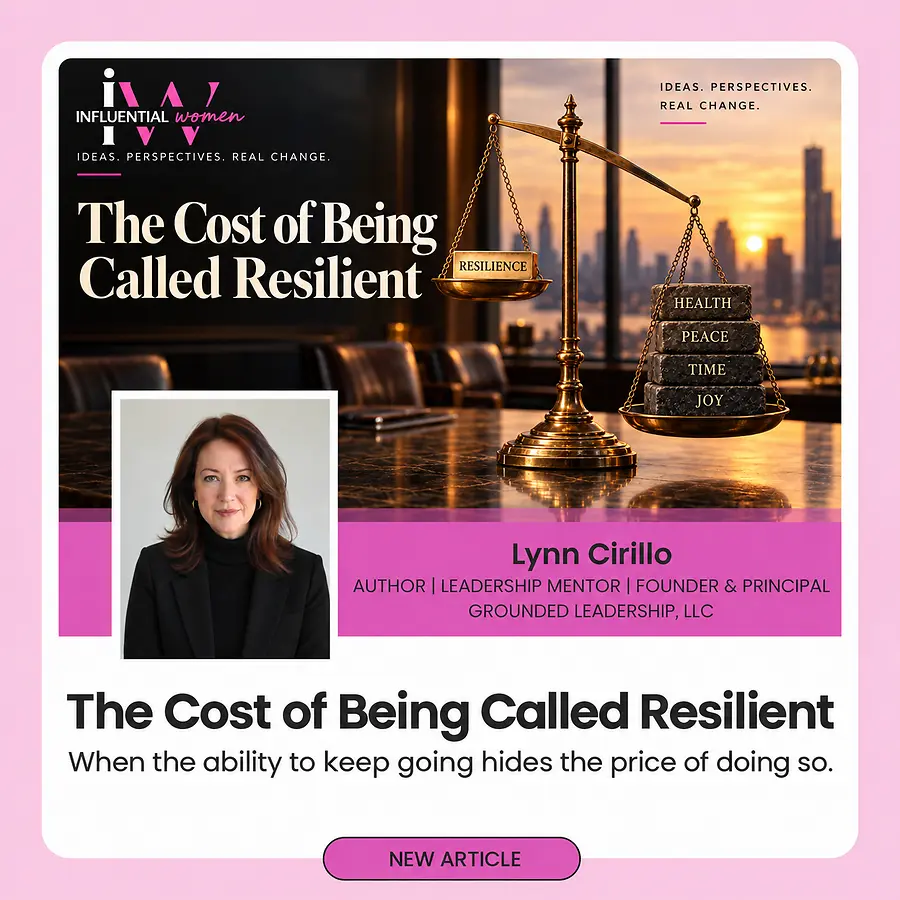
The Cost of Being Called Resilient
When the ability to keep going hides the price of doing so
Lynn Cirillo
I thought I was resilient. Turns out I was surviving.
And it was costing me.
For years, I measured my capacity by what I could handle. The complicated decisions. The competing priorities. The responsibility of being the person others relied on when something needed to get done.
I could lead the meeting, solve the problem, and support the team. From the outside, that looked like strength. From the inside, it often felt like doing whatever was necessary to make it through another day.
Because I could still deliver, I assumed the cost was manageable.
I had confused my ability to keep functioning with evidence that I was fine.
The Performance Can Outlast the Person's Well-Being
In leadership, we tend to notice the visible measures first. Did the deadline get met? Was the problem resolved? Did the team deliver?
Those measures matter. They also tell an incomplete story.
They do not tell us whether someone has enough energy left to participate in their own life. Whether an ordinary workday requires an entire evening of recovery. Whether the person who once contributed ideas freely has started conserving every word because speaking up has become another thing to survive.
A person can remain highly effective while the personal cost of that effectiveness keeps rising.
That was the part I struggled to recognize in myself. My competence remained available, so I continued drawing on it. I gave less attention to what was becoming unavailable elsewhere: patience, curiosity, peace, and the energy to enjoy the life I was working so hard to support.
The work was getting done.
The bill was arriving somewhere else.
Resilience Needs Room for Recovery
Resilience has value. We need the ability to adapt, respond to setbacks, and move through difficult seasons. Leadership includes pressure, and meaningful work will not always be comfortable.
But recovery has to belong in that conversation.
If the expectation is that people will absorb pressure indefinitely, we have left something essential out of our definition of resilience.
There is a difference between navigating a difficult season and organizing your entire life around enduring one.
Survival narrows the question to: How do I get through this?
With enough support and room to recover, other questions become possible: What needs to change? What choices do I have? Is this still sustainable?
Those questions are harder to ask when all your available energy is committed to making it through the day.
When Praise Becomes Permission to Ask for More
"You're so resilient."
Sometimes those words offer meaningful recognition. Sometimes they become the explanation for why the same person keeps receiving more responsibility.
They can handle it. They always figure it out. They never let us down.
Over time, an employee's reliability can become an assumption built into staffing decisions, workloads, and deadlines. Their willingness to step in becomes part of how the organization operates.
The exception becomes the expectation.
Leaders need to examine what happens after the compliment. Does recognition lead to support, resources, or a more manageable workload? Or does it lead to another assignment?
A useful question is: Whose ability to keep absorbing pressure is making our current approach appear sustainable?
The answer may reveal a problem that strong performance has allowed us to overlook.
Accountability Requires a Response
We cannot ask employees to be honest about capacity while consistently rewarding them for acting as though they have no limits.
If someone says the workload is unsustainable, the response matters more than the invitation to speak openly.
Something may need to move. A deadline. A priority. An assignment. An expectation.
Sometimes the most responsible leadership decision is to acknowledge that the available resources cannot support everything being requested.
That requires more than encouraging people to practice self-care. An evening routine cannot resolve a workload that repeatedly exceeds the time and resources available to complete it.
Before asking how we can help people become more resilient, we should examine which pressures we have the authority to reduce.
Count the Cost Before the Collapse
I respect the version of me who kept going. She carried real responsibilities and made decisions with the information and options she had.
I also wish she had asked a different question sooner.
Instead of only asking, "Can I handle this?" I wish she had asked, "What is handling this taking from me?"
That question belongs in our personal decisions and our leadership conversations.
Health, peace, time, and joy deserve a place in the calculation. They cannot remain invisible simply because they do not appear on a performance report.
Being able to carry the weight does not mean you can afford the cost.
And no one should have to reach a breaking point before that cost receives our attention.
About the Author
Lynn Cirillo is the founder of Grounded Leadership LLC and a former Executive Vice President of Corporate Operations. Drawing on more than three decades of corporate experience, she writes about leadership, identity, accountability, and the personal cost of professional expectations. She is the author of The Breaking Point and Reinvention Outside the Realm of Expectation, the first two books in the Musings of a Recovering Executive series, both available on Amazon. Learn more at MusingsOfaRecoveringExecutive.com.