Your Nonlinear Path is Not a Liability
How Your Scattered Career Path May Actually Be Your Greatest Asset

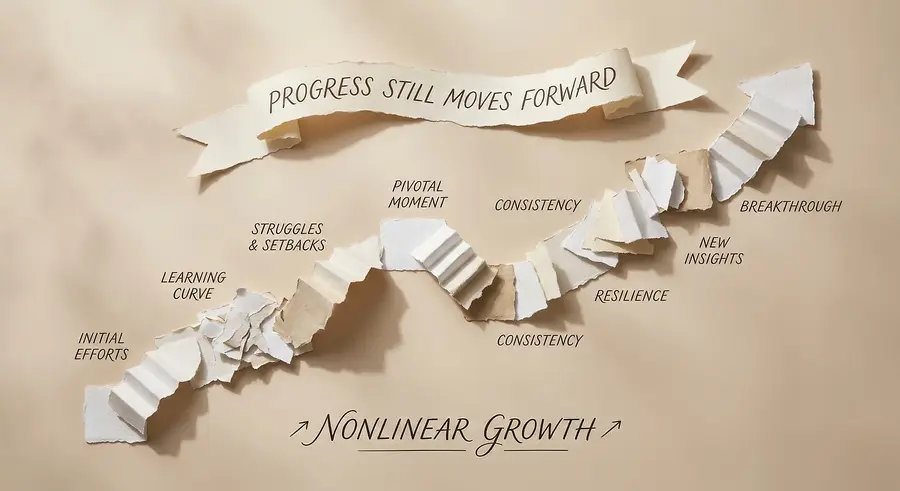
Why the experiences that don't seem to fit together may be exactly what makes you uniquely qualified.
For a long time, I thought a successful career was supposed to tell a clear story. One decision naturally led to the next. Education supported the career you chose, experience built on itself, and eventually you could look back and see a recognizable progression. The older I get, the more I realize how rarely real life works that way.
Careers change. Circumstances change. Priorities change. Sometimes we discover that the thing we thought we wanted no longer fits. Sometimes an opportunity introduces us to something we never knew we wanted. And sometimes a chapter ends because life, rather than careful planning, decides for us. When that happens, it can be difficult not to wonder whether we've somehow gotten off track.
There is a particular pressure to have a career that makes sense on paper. We are encouraged to specialize, establish a niche, build expertise, and create a résumé that tells one cohesive story. There is certainly value in knowing what you do and being able to communicate that clearly. But I have come to believe there is a significant difference between having a clear sense of what you offer and having a perfectly linear path that led you there.
My own career hasn't been linear. My education and professional experiences have taken me through different areas, and over time I've built a business that encompasses insurance, tax preparation, bookkeeping, education, consulting, and content creation. Those things weren't all part of one master plan from the beginning. There wasn't a moment when I sat down and mapped out exactly how each piece would eventually connect. For a while, I wondered whether that made my path look scattered. Now, I see it as one of the things that has made me adaptable.
The connection between those experiences isn't necessarily the industries themselves. It's the skills and perspective I've carried from one chapter into another. Research taught me to look beyond the obvious answer and ask better questions. Education taught me to remain curious. Working with clients taught me that knowledge isn't particularly useful if you can't communicate it in a way someone can understand. Entrepreneurship taught me that planning matters, but so does the ability to adapt when reality doesn't cooperate with the plan.
Those lessons didn't stay behind when I moved into something new. They came with me.
I think we sometimes underestimate the value of experiences because we judge them by whether they directly led to where we are now. We look at an old job, a degree, a career change, or even a period when we weren't working in our intended field and ask, "How does this fit?" If we can't immediately see the connection, we may assume the experience wasn't useful.
But careers aren't built only from job titles.
They're built from judgment, communication, relationships, problem-solving, curiosity, resilience, and the ability to understand people.
Some of the most important professional skills are difficult to put into a bullet point on a résumé. They develop quietly over time, often in circumstances that have very little to do with the position you eventually hold.
There is also a tendency to romanticize the nonlinear path after the fact. We like the story where every detour was secretly part of the plan, and every setback was preparing us for something better. Sometimes that's true. But sometimes a detour is simply a detour. Sometimes a career change comes with financial consequences. Sometimes starting over means giving up something you worked hard to build. Sometimes an opportunity doesn't work out, and sometimes we make decisions that, with the benefit of hindsight, we would make differently.
I don't think we need to turn every difficult experience into a beautiful lesson in order for it to have value.
Something can be disappointing and still teach us something. A mistake can be a mistake and still make us wiser. A difficult season can be difficult without needing to be reframed as something we were "meant" to experience. There is a certain freedom in being able to acknowledge that some parts of our journey were hard without forcing ourselves to find a perfect reason for them.
What matters is what we do with what we've learned.
Most of us make decisions with incomplete information. We choose a degree because we think we know what we want. We accept a job because it seems like the right opportunity. We start a business because we see a need. We change direction because something no longer feels right. Then, as we move forward, we learn more about ourselves and about the world around us. That new information sometimes changes the decision. Changing your mind when you know more than you did before isn't necessarily inconsistency.
Sometimes it is growth.
I've experienced that evolution in my own business. What started in one area has expanded as I've listened to what clients actually need and recognized where my skills could provide additional value. Insurance led to broader conversations about financial protection. Tax preparation opened the door to conversations about financial clarity and planning. Bookkeeping created another opportunity to help business owners understand the numbers behind their businesses. Education and digital resources became another way to make complicated subjects more accessible. My podcast has given me yet another platform to have conversations about people's experiences, challenges, perspectives, and the parts of their stories that aren't always visible on the surface.
Those things may look unrelated if you look at them individually. When I step back, I see a common thread: helping people make sense of things.
That has become increasingly important to me. Whether someone is trying to understand an insurance policy, navigate their taxes, make sense of their business finances, or simply have a conversation that challenges the way they see something, I am drawn to the same role—taking something complicated and helping bring clarity to it. I didn't necessarily know that was where all those experiences were leading me.
I had to live them first.
That is one of the uncomfortable truths about career development. We often want clarity before we make a decision. We want to know that the next step is the right one before we take it. We want reassurance that the time, money, education, or energy we're investing will eventually make sense.
We rarely get that kind of certainty.
Sometimes clarity comes after movement rather than before it.
You take the opportunity. You learn. You discover that you enjoy something you didn't expect to enjoy—or that you don't. You meet people who influence the way you think. You develop a skill that becomes useful years later. You realize that the thing you once thought was your destination was actually just another chapter.
That doesn't mean we should abandon intentionality. Quite the opposite. Being intentional means paying attention to what you're learning and being willing to adjust when your circumstances or priorities change. A career can have direction without having a straight line.
I also think this matters because women are often navigating far more than a professional trajectory. Career decisions can intersect with parenthood, caregiving, relationships, education, financial realities, personal growth, and seasons of life that aren't easily planned. Sometimes the most responsible decision professionally is not the one that looks the most impressive on paper.
There may be seasons when advancement takes priority. There may be seasons when flexibility matters more. There may be times when starting something new is the right choice, and other times when stability is what you need. Those decisions can change over time.
That isn't a lack of ambition.
It's recognizing that a career exists within a life, not the other way around.
If your path doesn't look the way you expected it to, I think it's worth resisting the urge to immediately label it as a problem. Look at the experiences you've accumulated rather than only the titles you've held. Consider what you know now that you didn't know five or ten years ago. Think about the people you've learned from, the challenges that changed how you approach problems, and the skills you developed in places you never expected to use them.
You may find that the story is more connected than you thought. Or you may find that it isn't—and that's okay too.
Not every chapter needs to connect perfectly. Not every decision needs to become part of a grand narrative. Sometimes we simply move forward with what we know, learn something new, and make the next decision from there. I have stopped expecting my career to look perfectly linear when viewed from the outside. I am more interested in whether the work I'm doing now reflects what I've learned, what I value, and how I want to contribute.
The different chapters of my career haven't made one another irrelevant. They've given me a wider perspective to bring into the work I do today.
And perhaps that's the part of a nonlinear path we don't talk about enough. A straight line may be easier to explain, but a varied path can give you range. It can teach you how to enter unfamiliar situations, how to ask questions, how to listen to people with different experiences, and how to recognize that there is rarely one solution that works for everyone. Those qualities don't always show up neatly on a résumé.
But they matter.
So if your career has taken a few unexpected turns, you don't necessarily need to defend them. You don't need to pretend every decision was strategic. You don't need to rewrite your history so it looks more intentional than it actually was. You can simply acknowledge that you've changed, you've learned, and you've continued moving forward.
Your path may not be linear. It may not even make complete sense yet. But that doesn't make it a liability.
Sometimes the experiences that don't seem to fit together are the very experiences that give you something valuable to offer.
And sometimes, you don't understand the shape of your path until you're far enough along to look back and see that you weren't lost.
You were becoming someone with a perspective you couldn't have gained any other way.