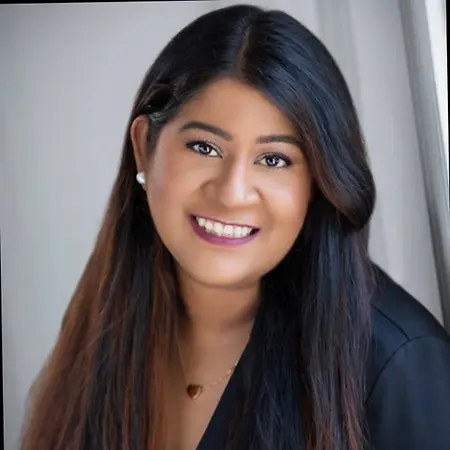
Her Story
About Aiswarya
I've been in supply chain for over 3 years, and what drew me to this field was its complexity and the way it touches everything. I originally started as a finance and international business major at the University of Illinois, but after doing internships abroad in finance and marketing, I realized I wanted more human interaction and complex problem solving. When I discovered supply chain through my seniors at Illinois, I learned it mixed everything - finance, marketing, accounting, sales, engineering, strategy, risk, and legal. I transferred to Wayne State University to continue my supply chain education, and that's where things really clicked for me. Supply chain is everything from beginning to end of a product or service lifecycle, and what I love most is the creativity and problem solving it involves. You need a deep analytical mind but also flexibility - if it's not A, it's B. If I can't get something from Mexico, can I get it from China? If my parts aren't ready, can I use old parts? It's about constantly keeping the movement going so there are no bottlenecks and keeping the flow uninterrupted. I was fortunate to complete a highly competitive two-year rotational program at Edwards Life Sciences, where they only take two people every year. I rotated through three different teams for 8 months each, gaining deep expertise in production planning, supply planning, and R&D sourcing. While procurement and sourcing is where I naturally have a lot of passion, I also really enjoy the planning and strategic side, along with negotiation. I've earned my Lean Six Sigma Green Belt and CPIM certifications in the last couple of years. What makes supply chain so interesting to me is that no two days are the same - one day your shipment could be stuck because of pirates near the African coast, another day all your boxes smell like garlic because they were shipped in a truck that used to transport garlic. My typical day involves assessing the situation each morning, checking for back orders and pressing issues, following up with suppliers and internal team members, and then going into execution mode if there are emergencies or fires. Communication and expectation setting between all the different teams is super important since supply chain is so interconnected. I meet with different stakeholders, talk to external vendors, sometimes walk over to the engineering desk to look at drawings and parts together. The continuous improvement principle is something I have in my life as well - constantly learning and getting better, even if it's just a little percentage every single time.
Her Interview
Ten minutes with Aiswarya
01What do you attribute your success to?
I attribute my success to the mentors and teachers who believed in me and pushed me forward, especially given my unique path. Having teachers and people, including pastors, who believed in me from a young age has been absolutely critical and paramount to everything I've done. I would be nowhere near where I am if I didn't have my professors and teachers supporting me. My journey has been quite unexpected - I'm a cancer survivor who had to start and stop my education multiple times due to surgeries and recovery. Transferring to Wayne State University was a turning point for me, and the professors there were amazing and understanding about my concerns. I still keep really good relationships with several of them. Education is something you never lose, and it was definitely a struggle to keep going back and forth and not lose faith in myself, but believing that I was meant for something kept me going. My family has also been incredibly encouraging - my mom is someone I really look up to, as she's constantly learning and evolving in her own career. The continuous improvement principle I learned in supply chain applies to my life as well - constantly learning and getting better, even if it's just a little percentage every single time. Sometimes the unexpected surprises are good, and my journey has made me more empathetic, stronger, more tenacious, and a well-rounded person.
02What are the biggest challenges or opportunities in your field right now?
One of the biggest challenges I see is the privatization of supply chain, where different firms are buying out suppliers or suppliers are merging into one. While I understand why that's happening, when these mergers occur, the engineering talent and processes tend to get lost. That level of expertise from people who've been working at a company for 20 or 30 years, and the quality of products they're working on - when they leave, how is the knowledge transfer being maintained? How is that integrity being maintained? As processes get more automated and machines get more automated, it's hard to maintain that same level of consistency and quality every time. There's also the heart and soul aspect - when a mom and pop shop that's been running a metals facility for 30 years sells to a much bigger company, it becomes a little bit more profit-driven, whereas before you could call up the business owners directly. Supply chain is very much a relationship-based industry, and maintaining those relationships and the quality and legacies of niche companies is really important. AI in supply chain is going to be really interesting. I've used it at my company a little bit, and it can definitely be great to automate things like taking meeting notes, emails, and schedules. I'm excited to see it progress in the Excel space more, though I don't think it's quite there yet. The challenge is that its suggestions aren't perfect, and we as supply chain professionals have to be able to discern when it makes sense to use it, whether we can trust the suggestions based on our experience, and whether we can trust the recommendations it's giving us. While there's a huge push to adopt AI, and where you can automate you should, I think there are some processes that should still have a human element and human oversight because accuracy is really important in supply chain. I don't think it should be a blind acceptance yet. Another ongoing challenge is the geopolitical risk of things - moving stuff around, localization, tariffs, and deciding where you want to build your supply chain network of facilities and warehouses. That's going to be really interesting as time goes on as well.
Join Influential Women and start making an impact. Register now.